More Difficult Problems (Leaving Cert Mathematics): Revision Notes
📚Revision Notes
More Difficult Problems
When dealing with area and volume calculations, some problems require you to think beyond basic formula applications. These more challenging problems often involve flow rates, ratio comparisons, and composite shapes. Understanding these concepts will help you tackle complex real-world applications with confidence.
Flow rate problems
Flow rate refers to the volume of liquid that passes through a pipe or channel per unit of time. This creates an important relationship between the speed of flow and the volume displaced.
Understanding the flow rate concept
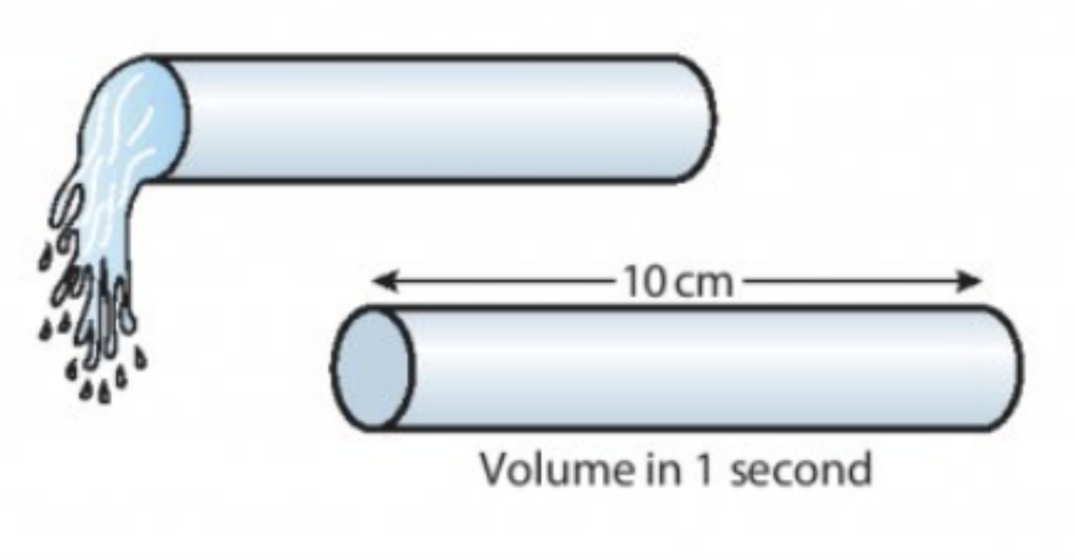
When water flows through a cylindrical pipe, the volume of water that passes through in one second equals the volume of a cylinder with the same radius as the pipe and a length equal to the distance the water travels in that time.
Note
For example, if water flows at 10 cm/sec through a pipe, then in one second, the volume of water equals the volume of a 10 cm length of that pipe. This visualisation helps you understand why we multiply the cross-sectional area by the flow speed.
Key formula for flow problems
The volume per second =
Where is the radius of the pipe's internal diameter.
Example
Worked Example: Filling a Cylinder
Problem: Water flows through a cylindrical pipe of internal diameter 3 cm at the rate of 14 cm/sec. How long will it take to fill a cylinder of base diameter 14 cm and height 45 cm?
Step 1: Calculate the volume of water flowing per second
- Radius of pipe = cm
- Volume per second =
- Volume per second = cm³
Step 2: Calculate the volume of the cylinder to be filled
- Radius of cylinder = cm
- Volume = cm³
Step 3: Calculate the time needed
- Time = Total volume ÷ Volume per second
- Time = seconds
Ratio problems when dimensions are not given
Sometimes you need to compare volumes without knowing the exact measurements. Instead, you're given ratios of corresponding lengths. This technique is particularly useful for comparing similar shapes.
The key principle
When linear dimensions are in a certain ratio, volumes are in the ratio of the cubes of those linear dimensions.
Important
Critical Rule: If two similar shapes have corresponding lengths in the ratio , then their volumes are in the ratio .
This is because volume involves three dimensions, so each dimension contributes to the scaling factor.
Example
Worked Example: Comparing Cylinder and Cone Volumes
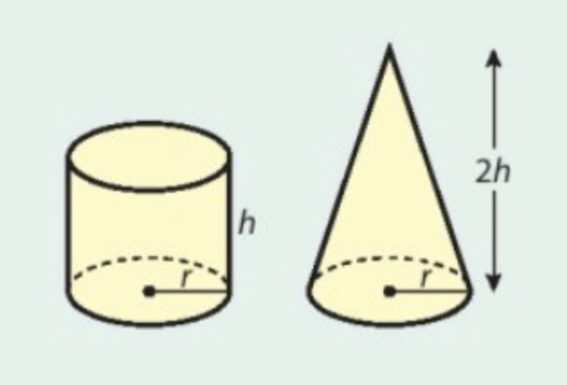
Problem: A cylinder and a cone have radii of equal lengths. If the height of the cone is twice the height of the cylinder, find the ratio Volume of cylinder : Volume of cone.
Step 1: Define the variables
- Let radius of each figure =
- Height of cylinder =
- Height of cone =
Step 2: Calculate both volumes
- Volume of cylinder =
- Volume of cone =
Step 3: Form the ratio
- Volume of cylinder : Volume of cone =
- Simplify by dividing both sides by :
- Multiply both sides by 3:
- Final ratio = 3:2
Complex composite shape problems
More challenging problems often involve composite shapes - combinations of basic 3D shapes like cones sitting on hemispheres, or cylinders with hemispherical ends.
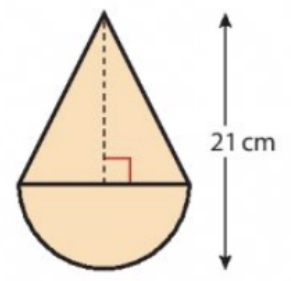
For these problems, you need to develop a systematic approach that breaks down complex shapes into manageable components.
Important
Key Strategies for Composite Shapes:
- Break down complex shapes into familiar components (cylinders, cones, hemispheres, spheres)
- Use the same radius for connecting parts (e.g., cone sitting on hemisphere)
- Apply conservation principles (e.g., volume is conserved when shapes are melted and recast)
- Set up equations when volumes are equal or in given ratios
Remember: For composite shapes, you add volumes of separate components. For hollow sections, you subtract the inner volume from the outer volume.
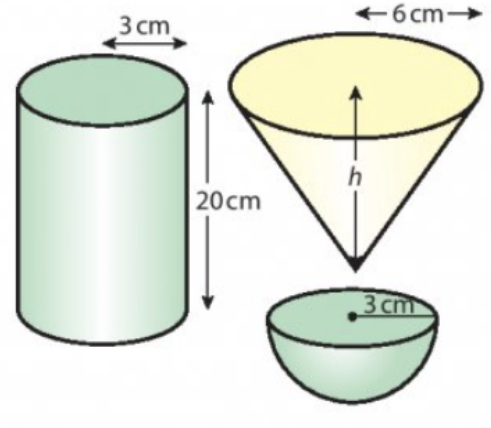
The key to success with composite shapes is recognising that complex problems become much simpler when you identify each component and calculate systematically.
Summary
Essential Volume Formulas
Make sure you know these formulas by heart:
- Cylinder:
- Cone:
- Sphere:
- Hemisphere:
Flow Rate Calculations:
- Volume per second =
- Time to fill =
- Always check units - convert between cm³ and litres when needed (1 litre = 1000 cm³)
Summary
Key Points to Remember:
- Flow rate problems: Volume per second equals the volume of a pipe segment with length equal to the flow speed
- Ratio problems: When linear dimensions are in ratio , volumes are in ratio
- Composite shapes: Break complex shapes into familiar components and calculate each volume separately
- Keep your formulas ready: Memorise the volume formulas for cylinder, cone, sphere, and hemisphere
- Unit conversion: Remember that 1 litre = 1000 cm³ for practical problems involving water flow