Rectangular Solids and Prisms (Leaving Cert Mathematics): Revision Notes
📚Revision Notes
Rectangular Solids and Prisms
What is a rectangular solid?
A rectangular solid (also called a cuboid) is a three-dimensional shape where all faces are rectangles. Think of a shoebox or a brick - these are perfect examples of rectangular solids.
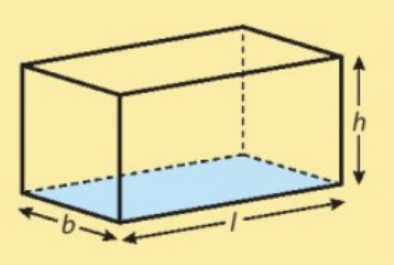
Key formulas for rectangular solids
For any rectangular solid with length , breadth , and height :
Volume formula:
Surface area formula:
Note
The surface area formula works because a rectangular solid has six faces that come in three pairs of identical rectangles. Each pair contributes twice its area to the total surface area.
What are prisms?
A prism is a three-dimensional shape that has the same cross-sectional area throughout its length. When you imagine slicing through a prism at any point along its length, you always get the same shape.
Types of prisms
Prisms can have different cross-sectional shapes:
- Rectangular prisms (like rectangular solids)
- Triangular prisms (with triangular cross-sections)
- Cylindrical prisms (with circular cross-sections)
- Irregular prisms (with any other uniform cross-section)
Volume formula for prisms
The volume formula for any prism is:
Or more simply:
Where is the area of the cross-section and is the length of the prism.
Working with composite cross-sections
Sometimes a prism has a cross-section made up of multiple shapes combined together. To find the total cross-sectional area, you calculate the area of each individual shape and add them together.
Example
Worked Example: Composite Prism
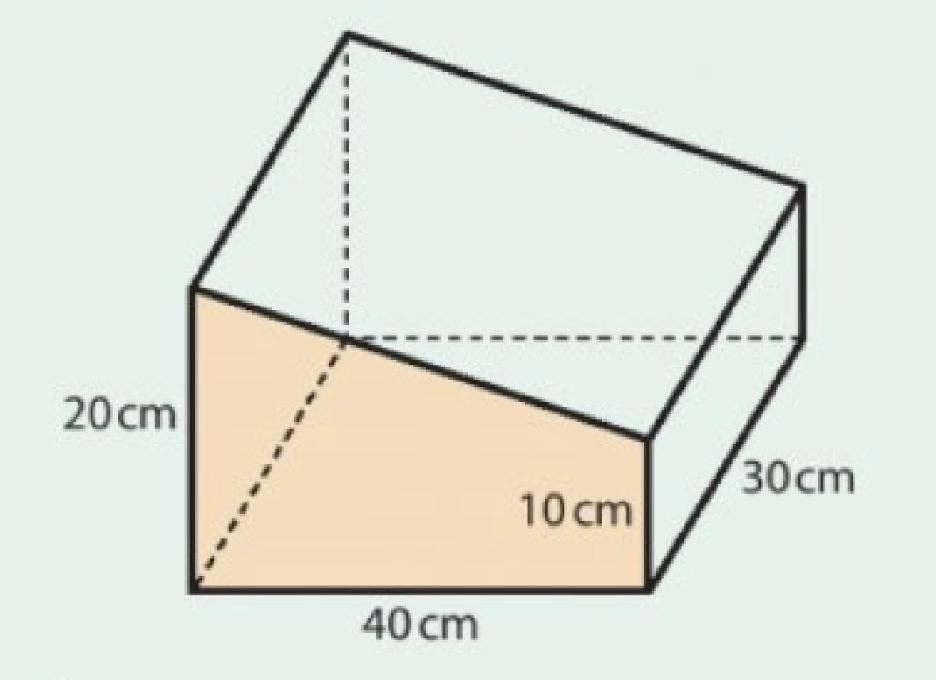
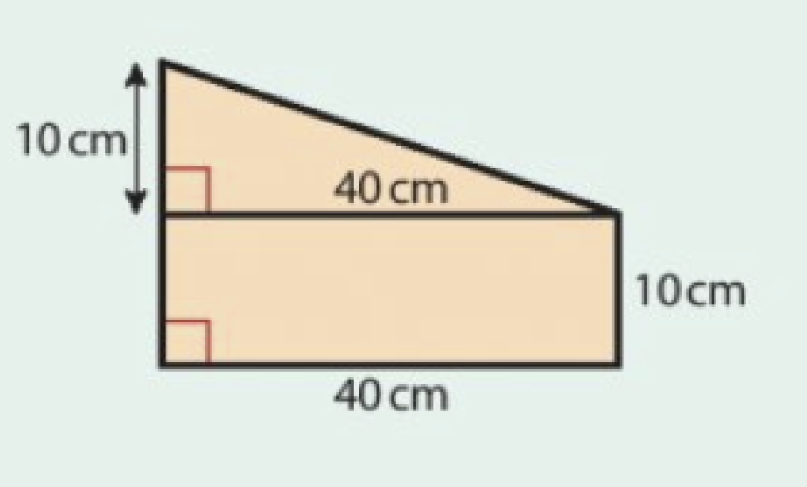
A prism is 30 cm long. Its cross-section consists of a rectangle (40 cm × 10 cm) with a triangle (base 40 cm, height 10 cm) on top.
Step 1: Calculate the rectangular area Area of rectangle = 40 × 10 = 400 cm²
Step 2: Calculate the triangular area Area of triangle = ½ × 40 × 10 = 200 cm²
Step 3: Find total cross-sectional area Total area = 400 + 200 = 600 cm²
Step 4: Calculate volume Volume = 600 × 30 = 18,000 cm³
Nets of 3D shapes
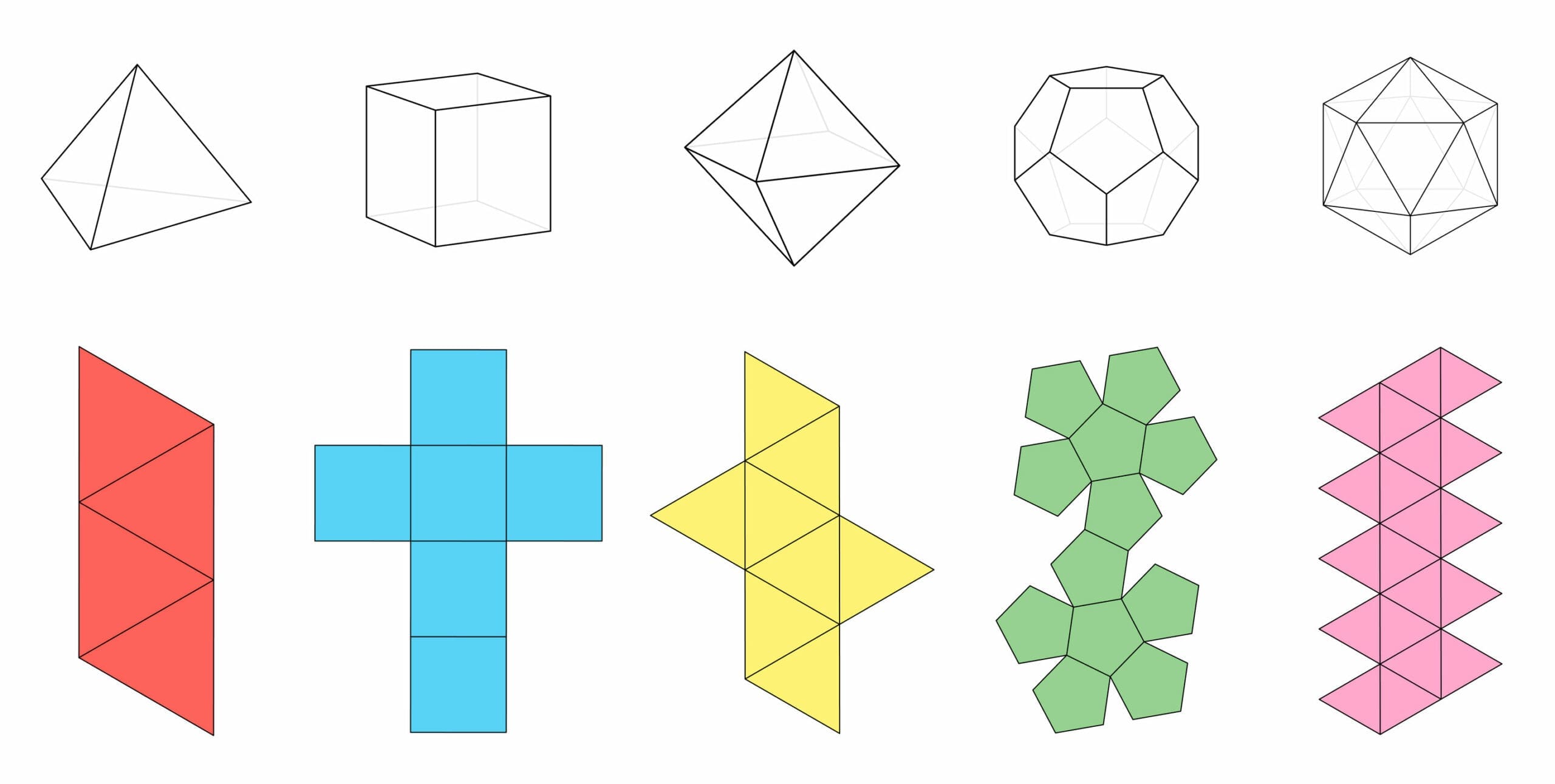
A net is a two-dimensional shape that can be folded to create a three-dimensional shape. When you unfold a cardboard box completely flat, you're looking at its net.
Note
Key Facts About Nets:
- Every 3D shape has at least one possible net
- Some shapes (like cubes) have multiple different net configurations
- A cube has 11 different possible nets
- To find the surface area of a shape, you can calculate the total area of its net
Example
Worked Example: Volume from a Net
From the net shown, we can identify this will fold into a rectangular box with dimensions 5 cm × 3 cm × 2 cm.
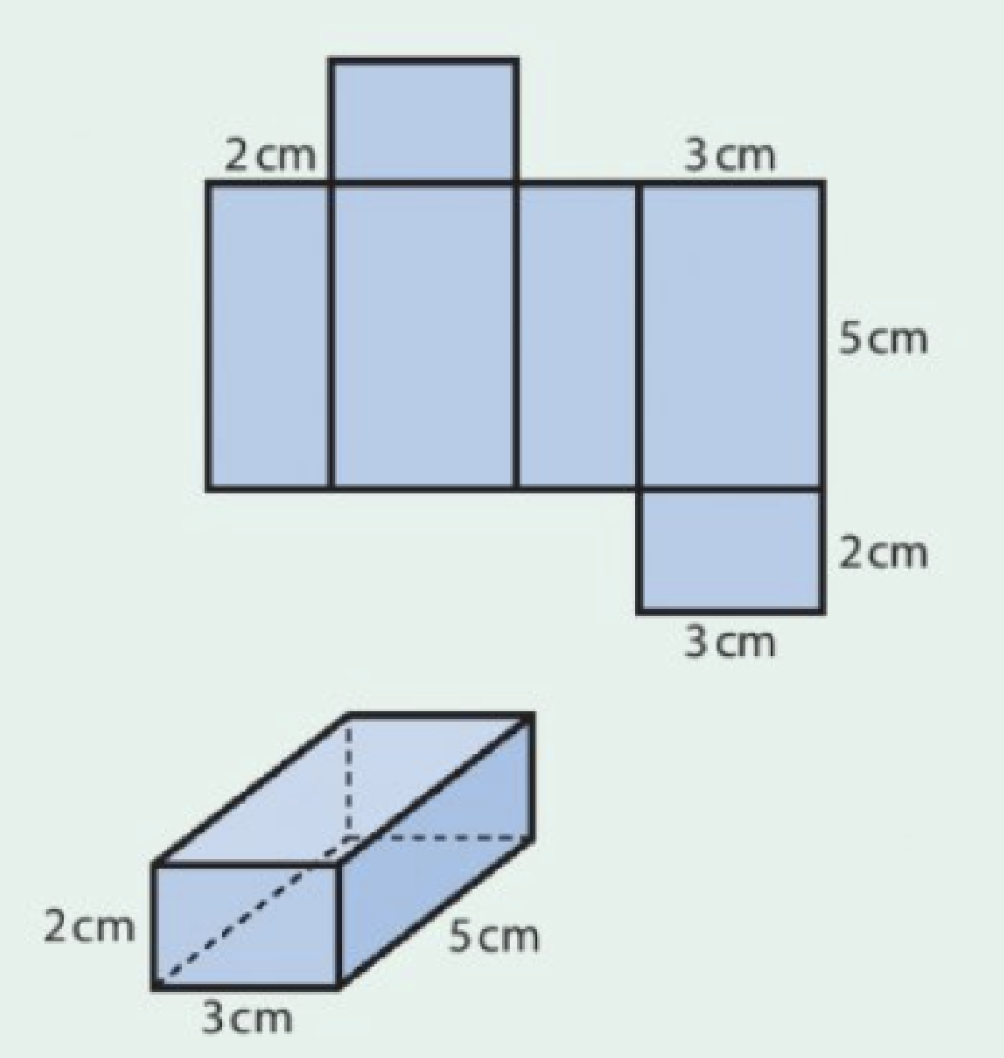
Volume calculation: Volume = length × breadth × height Volume = 5 × 3 × 2 = 30 cm³
Additional Worked Examples
Example
Worked Example: Triangular Prism
Calculate the volume of a triangular prism where the triangular base is equilateral with sides of 3 cm each, and the prism length is 6 cm.
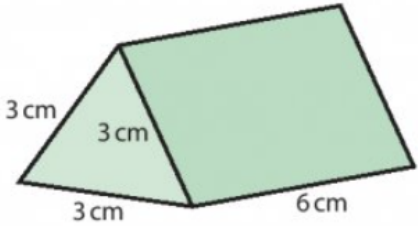
Step 1: Find the area of the equilateral triangle For an equilateral triangle with side length 3 cm: Height = cm Area = cm²
Step 2: Calculate volume Volume = Area of cross-section × length Volume = cm³ ≈ 23.4 cm³
Example
Worked Example: L-shaped Prism
Calculate the volume of an L-shaped prism with the dimensions shown.
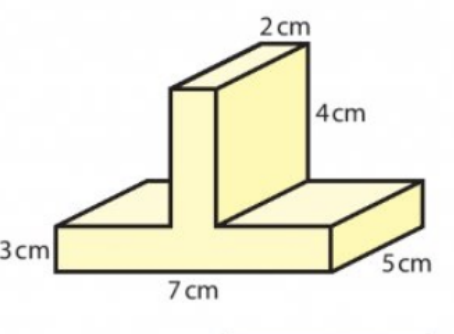
Step 1: Break down the L-shape into two rectangles
- Rectangle 1: 7 cm × 3 cm = 21 cm²
- Rectangle 2: 5 cm × 2 cm = 10 cm²
Step 2: Find total cross-sectional area Total area = 21 + 10 = 31 cm²
Step 3: Calculate volume (assuming length is 4 cm from the diagram) Volume = 31 × 4 = 124 cm³
Exam Tips
When tackling problems involving rectangular solids and prisms, remember these essential strategies:
- Always identify what type of shape you're dealing with first
- For composite shapes, break them down into simpler parts
- Double-check your units - volume is always in cubic units (cm³, m³, etc.)
- When working with nets, visualise how they fold to understand the 3D shape
Important
Common Mistakes to Avoid:
- Forgetting to add areas when dealing with composite cross-sections
- Mixing up length, breadth, and height in volume calculations
- Using incorrect units (area units for volume, or vice versa)
- Not showing all working steps clearly
Summary
Key Points to Remember:
- Volume of rectangular solid:
- Volume of any prism:
- A net is a 2D shape that folds into a 3D shape
- For composite cross-sections, add the areas of individual shapes
- Always check your units and show clear working steps