Net of a Cone (Leaving Cert Mathematics): Revision Notes
📚Revision Notes
Net of a Cone
What is a Net?
A net is a 2D representation of a 3D solid. It shows all the faces of the solid laid flat so that when folded, it forms the solid.
Net of a Cone
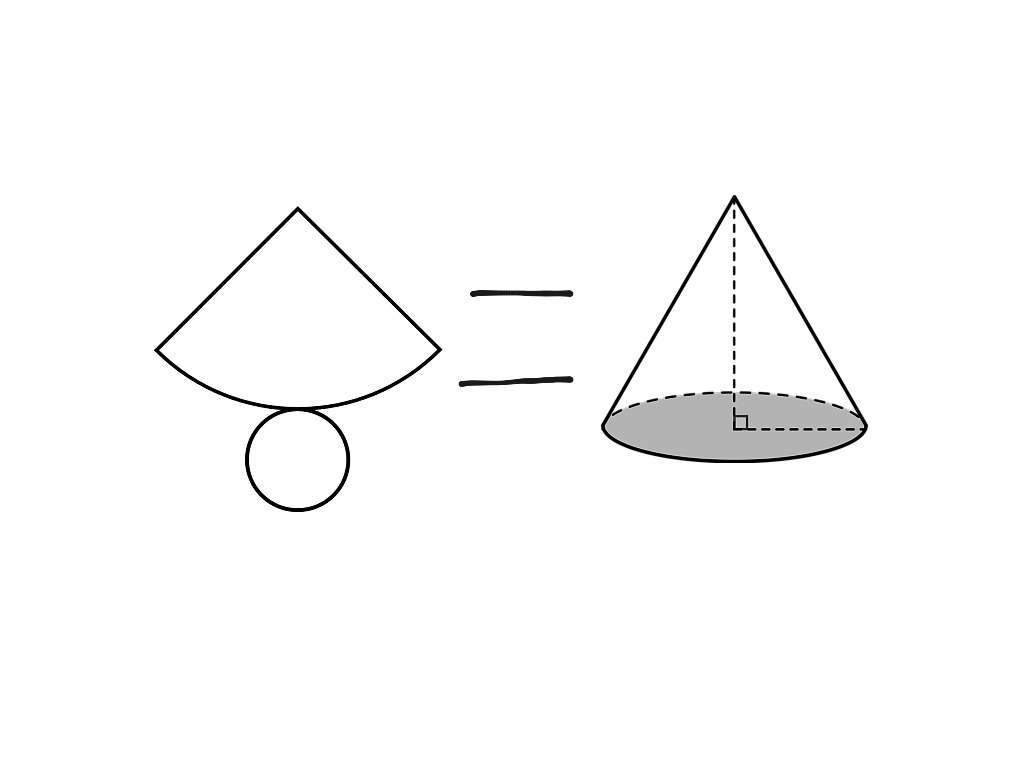
A cone has:
- A circular base.
- A curved surface that tapers to a point (vertex). The net of a cone consists of:
- One circle: This represents the base of the cone.
- One sector of a larger circle: This represents the curved surface of the cone. The radius of this larger circle equals the slant height of the cone.
Geometry of the Cone's Net
- Radius of the Base (): The radius of the smaller circle.
- Slant Height (): The radius of the larger circle (sector).
- Angle of the Sector (): Determined by the ratio of the cone's base circumference to the circumference of the larger circle:
Applications of the Cone's Net
Surface Area Calculation:
- Area of the base:
- Area of the curved surface:
- Total surface area:
Worked Example
Note
Example 1: Calculate the Surface Area
Problem: Find the total surface area of a cone with and
Solution:
Step 1: Area of the base:
Step 2: Area of the curved surface:
Step 3: Total surface area:
Approximate value:
Answer: The total surface area is 125.66 cm²
Summary
- Net of a Cone: Includes a circular base and a sector for the curved surface.
- Key Formulae:
- Curved Surface Area:
- Total Surface Area:
- Applications: Useful for geometry problems involving surface area and for creating accurate models of cones.