Net of a Cuboid (Leaving Cert Mathematics): Revision Notes
📚Revision Notes
Net of a Cuboid
What is a Net?
A net is a two-dimensional representation of a three-dimensional solid. For a cuboid, the net shows all its rectangular faces laid out flat, connected along their edges. When folded, the net forms the cuboid.
Net of a Cuboid
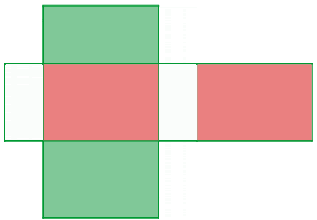
A cuboid has:
- 6 rectangular faces: Opposite faces are identical.
- 12 edges: Each edge represents a connection between two faces.
- 8 vertices: Points where edges meet. To create the net of a cuboid:
- Identify the dimensions of the cuboid (length , width , height ).
- Arrange six rectangles so they can fold into a 3D shape with the specified dimensions.
Note
Example Arrangements
- A cross-shaped layout with four rectangles in a row and two rectangles on opposite sides of one of the middle rectangles.
- A T-shaped arrangement with three rectangles forming the vertical stem and three rectangles branching off horizontally.
Applications of Nets
- Calculating Surface Area: The total area of all the rectangles in the net gives the surface area of the cuboid.
- Design and Construction: Nets are used in packaging design, where materials need to be cut and folded into the required 3D shape.
Worked Example
Note
Example 1: Calculate Surface Area Using a Net
Problem: A cuboid has dimensions l = 5 cm, w = 4 cm, h = 3 cm.
Find the surface area using its net.
Solution:
Step 1: Identify the areas of each pair of faces:
- Top and Bottom: 2 × (5 × 4) = 40 cm²
- Front and Back: 2 × (5 × 3) = 30 cm²
- Left and Right: 2 × (4 × 3) = 24 cm²
Step 2: Add the areas:
Answer: 94 cm²
Summary
- Net of a Cuboid: A 2D arrangement of its six rectangular faces.
- Surface Area Calculation: Add the areas of all rectangles in the net.
- Applications: Used in construction, design, and packaging.
- Practice creating nets to visualise and solve geometry problems effectively.