Maximum Values (Leaving Cert Mathematics): Revision Notes
📚Revision Notes
Maximum Values
What are maximum values?
In calculus, maximum values occur at the highest points on a curve or graph. These points are called turning points because the direction of the curve changes from increasing to decreasing at a maximum.
Important
The key principle to remember is that at any maximum or minimum turning point, the derivative equals zero:
This fundamental rule allows us to find maximum values by differentiating a function and setting the result equal to zero.
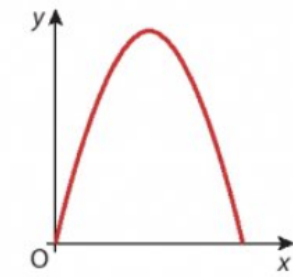
The diagram above shows a typical maximum point on a parabola where the derivative equals zero at the peak.
Why are maximum values important?
Maximum value problems appear frequently in real-life situations where we need to optimise something - finding the best possible result given certain constraints.
Note
Common applications include:
- Maximising profit in business situations
- Maximising area with limited materials
- Finding peak performance in engineering
- Optimising trajectories in physics
The beauty of calculus is that it gives us a systematic method to solve these problems rather than just guessing.
Step-by-step method for finding maximum values
Important
Method for Finding Maximum Values:
- Write down the function you want to maximise
- Differentiate the function with respect to the variable
- Set the derivative equal to zero and solve for the variable
- Substitute back into the original function to find the maximum value
- Check your answer makes sense in the context
Worked example: projectile motion
Let's examine a rocket fired into the air. The height h (in metres) after t seconds is given by:
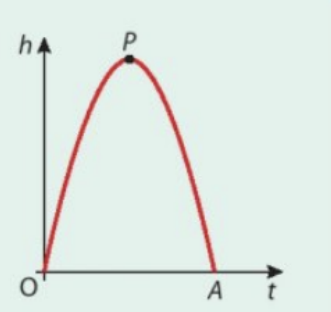
Example
Worked Example: Projectile Motion
Part (i): How long is the rocket in flight?
The rocket is in flight between when it leaves the ground (h = 0) and when it lands (h = 0 again).
Setting h = 0:
This gives us t = 0 (launch) or t = 14 (landing).
Therefore, the rocket is in flight for 14 seconds.
Part (ii): What is the maximum height?
To find the maximum height, we use our method:
- The function is:
- Differentiate:
- Set equal to zero: Solving: , so
- Substitute t = 7 back into the original equation:
The maximum height reached is 98 metres at t = 7 seconds.
Area optimisation problems
A common type of maximum value problem involves maximising area with constraints on perimeter or available materials.
Example
Worked Example: Area Optimisation
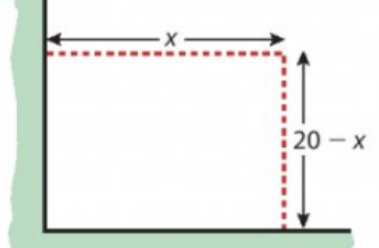
A farmer has 20 metres of fencing and wants to create a rectangular enclosure in the corner of a field (using the field boundaries for two sides).
If the width is x metres, then the length is (20 - x) metres.
The area is:
To find maximum area:
- Differentiate:
- Set equal to zero: , so
- Maximum area = square metres
Common exam question types
Note
Typical Maximum Value Problems:
- Projectile motion: Objects thrown or fired follow parabolic paths. Find when they reach maximum height and what that height is.
- Area problems: Given constraints on perimeter or materials, find dimensions that maximise area.
- Business optimisation: Find production levels that maximise profit or minimise cost.
- Geometric problems: Optimise dimensions of shapes like rectangles, triangles, or cylinders.
Exam tips
Important
Essential Exam Strategies:
- Always check your derivative calculation - this is where most errors occur
- Remember the context - negative values might not make physical sense
- Show all steps clearly - partial marks are awarded for method
- Substitute back to find the actual maximum value, not just where it occurs
- Use appropriate units in your final answer
Identifying maximum vs minimum
Understanding the shape of curves helps you identify whether you have found a maximum or minimum point.
Note
Visual Identification:
On a graph:
- Maximum: the curve goes up then down (∩ shape)
- Minimum: the curve goes down then up (∪ shape)
For quadratic functions:
- Negative coefficient of x²: gives a maximum (opens downward)
- Positive coefficient of x²: gives a minimum (opens upward)
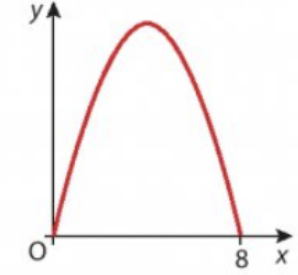
This parabola opens downward, so it has a maximum point at its vertex.
Remember!
Summary
Key Points to Remember:
- The derivative equals zero at all maximum and minimum points:
- Follow the systematic method: differentiate, set equal to zero, solve, then substitute back
- Maximum value problems appear in many real-life contexts - projectile motion, business optimisation, and area problems are the most common
- Check your answer makes sense in the context of the problem - negative times or impossible dimensions indicate an error
- Practice identifying whether you have a maximum or minimum by looking at the shape of the curve or the sign of the coefficient