Finding Unknown Coefficients (Leaving Cert Mathematics): Revision Notes
📚Revision Notes
Finding Unknown Coefficients
What are unknown coefficients?
Coefficients are the numerical values that appear in function equations. When we have a function like or , the letters , , and represent unknown coefficients that we need to find.
Finding unknown coefficients means determining these values when we're given information about specific points that lie on the function's graph. This is a fundamental skill in functions because it allows us to write the exact equation of a function from its graph or from given coordinate points.
Note
The key principle: if a point lies on the function, then substituting these coordinates into the function equation will give us a true mathematical statement.
Linear functions
A linear function has the form and represents a straight line when graphed. To find the unknown coefficients and , we need two pieces of information, typically two coordinate points that lie on the line.
For example, if lies on the line, this means that when , we get . This relationship allows us to create equations that we can solve to find the unknown values.
Note
Method for linear functions:
- Substitute the first coordinate pair into to create the first equation
- Substitute the second coordinate pair into to create the second equation
- Solve the two equations simultaneously to find and
Example
Worked Example: Finding coefficients of a linear function
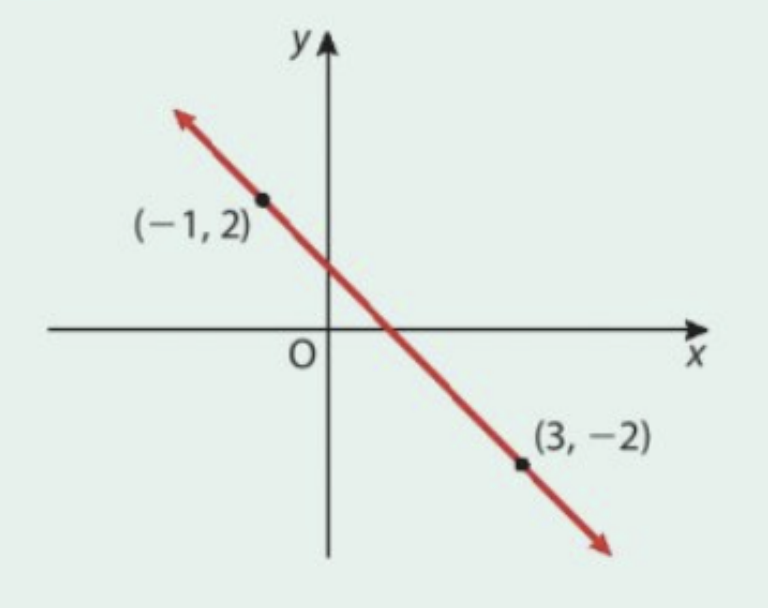
Find the values of and for the function that passes through the points and .
Solution:
Since lies on the line: ... (1)
Since lies on the line: ... (2)
Now we solve these simultaneously:
- From equation (2): , so
- Substitute into equation (1):
- Therefore: , so
- From :
Answer: and , so the function is .
Quadratic functions
A quadratic function contains a term in and has the general form . When graphed, quadratic functions create a smooth U-shaped curve called a parabola.
To find the three unknown coefficients , , and , we typically need three pieces of information, such as three coordinate points that lie on the parabola.
Note
Method for quadratic functions:
- Substitute each coordinate pair into to create three equations
- Solve the system of three equations simultaneously
- Often use elimination or substitution methods to find , , and
Example
Worked Example: Finding coefficients of a quadratic function
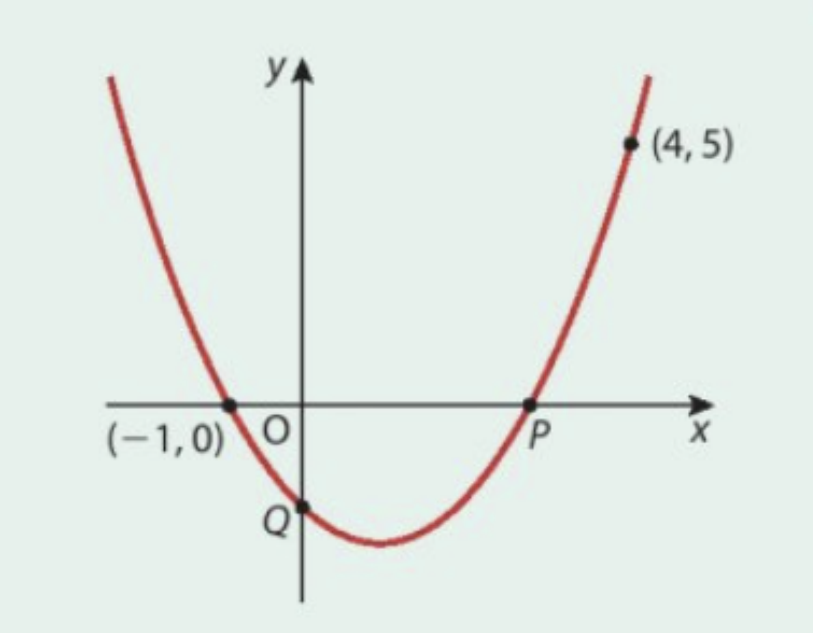
The graph shows a quadratic function . Find the values of and , and determine the coordinates of points and .
Solution:
From the graph, we can see that and lie on the curve.
Since lies on the curve: ... (1)
Since lies on the curve: ... (2)
Solving equations (1) and (2): From equation (1): Substitute into equation (2):
From :
Therefore:
Finding point P (x-intercept): Set : Factoring: So or Since we already know , point is .
Finding point Q (y-intercept): Set : So point is .
Key steps for finding unknown coefficients
Note
Essential Steps:
- Identify the function type - linear () or quadratic ()
- Use given information - coordinates, intercepts, or other properties
- Substitute coordinates - create equations by substituting known points
- Solve simultaneously - use elimination or substitution methods
- Check your answer - substitute back to verify the solution works
Exam tips
Important
Critical Exam Strategies:
- Always substitute coordinates carefully - make sure you put the -value and -value in the correct positions
- Label your equations - use (1), (2), (3) to keep track when solving simultaneously
- Show clear working - demonstrate each step of the simultaneous equation solution
- Check intercepts - use -intercepts and -intercepts to verify your final function
- Read graphs carefully - identify all given coordinate points before starting
Summary
Key Points to Remember:
- Coefficients are the unknown numerical values in function equations that we need to determine
- Linear functions need 2 pieces of information (usually 2 coordinate points) to find 2 unknowns
- Quadratic functions need 3 pieces of information to find 3 unknowns
- Substitute given coordinates into the function equation to create a system of equations
- Solve simultaneously using elimination or substitution methods to find the coefficient values