Corollaries of Similar Triangles (Leaving Cert Mathematics): Revision Notes
📚Revision Notes
Corollaries of Similar Triangles
Overview
The concept of similarity in triangles leads to several important geometric corollaries. These corollaries establish relationships between side lengths, parallel lines, and areas in similar triangles.
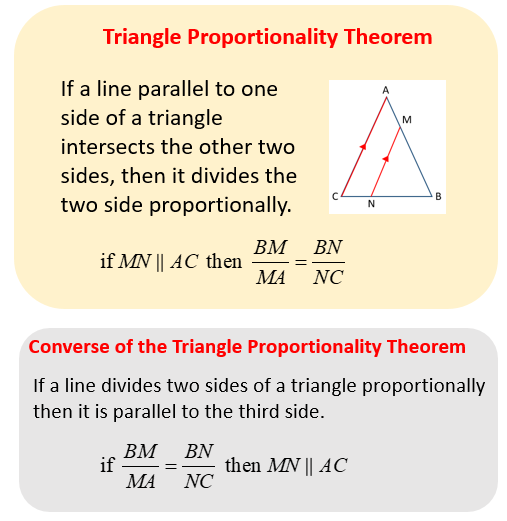
Corollary 5: Line Dividing Two Sides Proportionally
- Statement: If a line divides two sides of a triangle proportionally, it is parallel to the third side.
- Why It Works:
- By the basic proportionality theorem, a line that divides two sides proportionally creates smaller triangles that are similar to the original triangle.
- The parallel nature of the dividing line follows directly from this similarity.
Corollary 6: Ratio of Areas in Similar Triangles
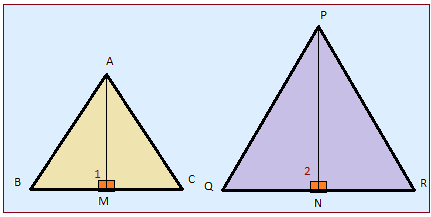
Statement: If two triangles are similar, the ratio of their areas is equal to the square of the ratio of their corresponding sides.
- Mathematically:
Why It Works:
- Since similar triangles have proportional sides, their heights are also proportional.
- The areas, which depend on both base and height, scale quadratically with the ratio of their corresponding sides.
Worked Examples
Note
Example 1: Line Dividing Two Sides Proportionally
Problem: In , a line intersects and , dividing them such that
Prove that
Solution:
By Corollary 5:
- If a line divides two sides of a triangle proportionally, it must be parallel to the third side.
- Therefore,
Answer:
Note
Example 2: Ratio of Areas in Similar Triangles
Problem: Two triangles and are similar, with corresponding side lengths , , and , .
Find the ratio of their areas.
Solution:
By Corollary 6:
The ratio of their areas is equal to the square of the ratio of their corresponding sides:
Answer: The ratio of the areas is
Summary
- Corollary 5: If a line divides two sides of a triangle proportionally, it is parallel to the third side.
- Corollary 6: In similar triangles, the ratio of their areas equals the square of the ratio of their corresponding sides.
- These corollaries are essential for solving problems involving proportionality and similarity in geometry.