Area of Triangles and Parallelograms (Leaving Cert Mathematics): Revision Notes
📚Revision Notes
Area of Triangles and Parallelograms
Area of triangles
The area of a triangle measures the space enclosed within its three sides. Understanding how to calculate this area is fundamental in geometry and appears frequently in Leaving Cert exams.
Triangle area formula
The area of any triangle can be calculated using the formula:
Where:
- Base is any side of the triangle
- Perpendicular height is the distance from the base to the opposite vertex, measured at a 90° angle to the base
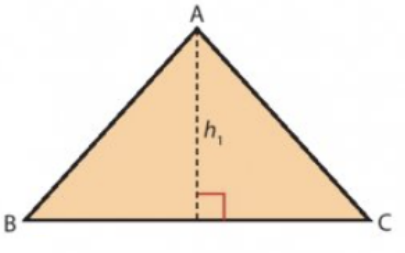
Key theorem about triangle area
Important
An important principle to remember is that the area of a triangle remains the same regardless of which side you choose as the base. When you change the base, the corresponding perpendicular height changes accordingly, but the final area calculation stays constant.
This means you can use whichever base and height combination is most convenient for your calculation.
Example
Worked Example: Triangle Area Calculation
Let's work through a comprehensive example to demonstrate the triangle area formula in practice.
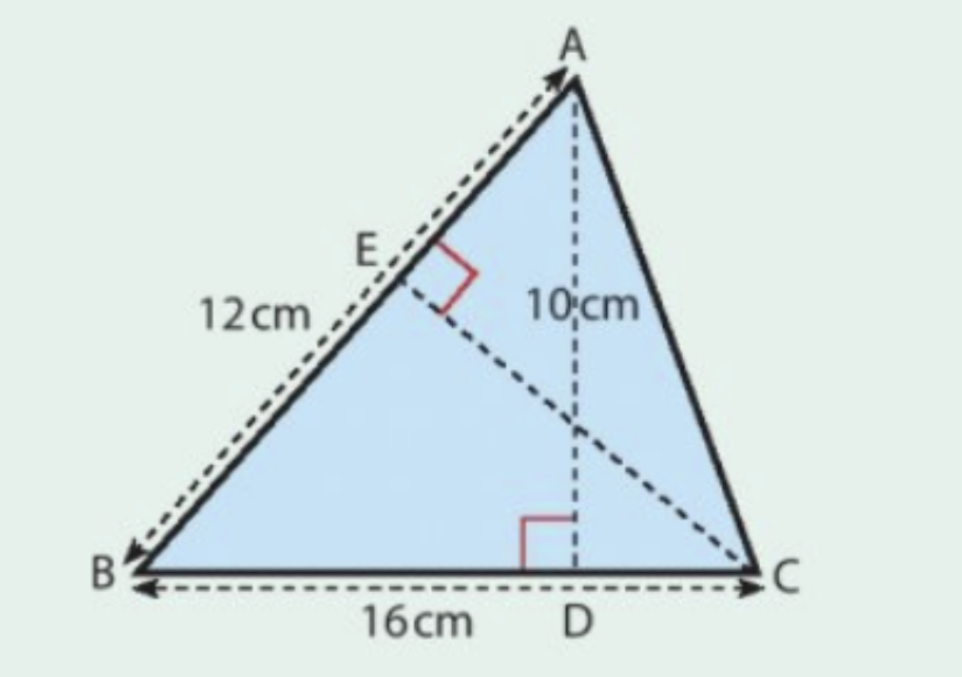
Given: Triangle ABC where |BC| = 16 cm, |AB| = 12 cm, and |AD| = 10 cm Find: (i) Area of triangle ABC, (ii) Length |EC|
Solution:
(i) Finding the area:
- Use the base |BC| = 16 cm and perpendicular height |AD| = 10 cm
- Area =
- Area = cm²
(ii) Finding |EC|:
- We can also express the area using base |AB| and height |EC|
- Area =
- cm
This example demonstrates how the same triangle area can be calculated using different base-height combinations.
Area of parallelograms
A parallelogram is a quadrilateral where opposite sides are parallel and equal in length. Understanding parallelogram area is crucial for many geometry problems.
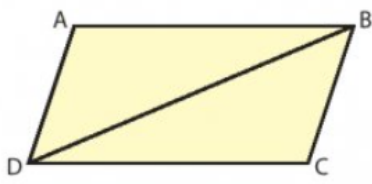
Understanding parallelogram structure
When you draw a diagonal in a parallelogram, it creates two triangles that have a special relationship.
Note
The diagonal creates two triangles that are congruent (identical in size and shape). This means:
- Both triangles have exactly the same area
- The diagonal bisects (cuts in half) the total area of the parallelogram
Parallelogram area formula
Since a parallelogram consists of two identical triangles, we can derive its area formula:
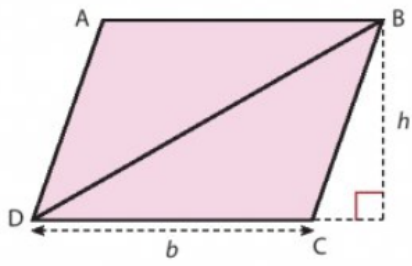
The perpendicular height is the shortest distance between the parallel sides, measured at a right angle to the base.
Example
Worked Example: Parallelogram Area Calculation
Let's solve a practical parallelogram problem step by step.
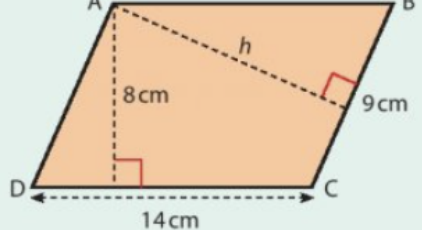
Given: Parallelogram ABCD with base = 14 cm, side length = 8 cm, and we need to find the perpendicular height when |BC| = 9 cm
Find: (i) Area of parallelogram ABCD, (ii) Perpendicular height from A to |BC|
Solution:
(i) Finding the area:
- Use base = 14 cm and perpendicular height = 8 cm
- Area = base × height = cm²
(ii) Finding the perpendicular height:
- We can also calculate area using |BC| as the base
- Area =
- Since we know the area is 112 cm²:
- cm
Key formulas summary
| Shape | Formula | Key Points |
|---|---|---|
| Triangle | Any side can be the base | |
| Parallelogram | Height must be perpendicular to base |
Common exam techniques and tips
Understanding the proper techniques for solving area problems will help you succeed in your exams.
Note
Essential Exam Tips
- Always identify the perpendicular height - it's not necessarily the side length of the triangle or parallelogram
- Use the most convenient base - choose the base that makes your calculation easiest
- Check your units - ensure all measurements are in the same units before calculating
- Show your working clearly - write down the formula, substitute values, then calculate
- Double-check by using alternative base-height combinations when possible
Summary
Key Points to Remember:
- Triangle area = - any side can serve as the base
- Parallelogram area = - the diagonal divides it into two equal triangles
- Perpendicular height is always measured at 90° to the chosen base, not along a slanted side
- The same area can be calculated using different base-height combinations - use whichever is most convenient
- Always include correct units (cm², m², etc.) in your final answer