Circle Theorems (Leaving Cert Mathematics): Revision Notes
📚Revision Notes
Circle Theorems
Introduction to circle theorems
Circle theorems are fundamental mathematical results that describe the special relationships between angles, lines, and points in circles. These theorems are essential tools for solving geometric problems involving circles and form the foundation of circle geometry.
Understanding circle theorems helps you solve problems involving tangents, chords, angles, and other circle properties with confidence.
Note
Circle theorems are interconnected - mastering one theorem often helps you understand and apply others more effectively. They form a cohesive system of geometric relationships.
Angles in semicircles
One of the most important circle theorems states that the angle in a semicircle is always a right angle.
This means that if you draw any triangle where one side is a diameter of a circle and the third vertex lies on the circle, the angle at that vertex will always be . This property is extremely useful in solving many circle problems.
Important
Semicircle Angle Theorem: For any triangle inscribed in a semicircle, where one side is the diameter, the angle opposite the diameter is always . This is written as where is the diameter.
Tangents and chords
Tangents
A tangent to a circle is a straight line that meets the circle at exactly one point. This single point where the tangent touches the circle is called the point of contact.
Key properties of tangents:
- They touch the circle at only one point
- They never cross or enter the circle
- They have special perpendicular relationships with radii
Note
Think of a tangent as a line that "just touches" the circle - like a ball rolling along the ground touches the ground at exactly one point.
Chords
A chord is a straight line segment that connects any two points on the circumference of a circle. Chords have important properties related to the centre of the circle.
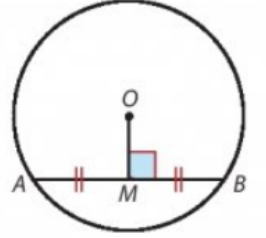
Theorem: The perpendicular from the centre of a circle to a chord bisects the chord.
This means if you draw a perpendicular line from the centre to any chord , it will meet the chord at its midpoint , so .
Important
Perpendicular Bisector Theorem: When you drop a perpendicular from the centre of a circle to any chord, it always cuts that chord exactly in half. This is one of the most frequently used theorems in circle geometry problems.
Key circle theorems
Theorem 1: Tangent perpendicular to radius
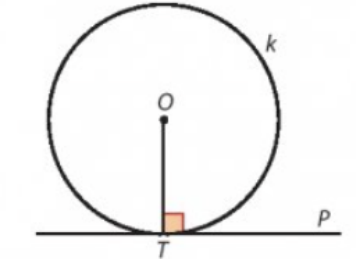
A tangent is perpendicular to the radius that goes to the point of contact.
This fundamental theorem tells us that at the point where a tangent touches a circle, the tangent line and the radius to that point meet at a angle. In mathematical notation: if is tangent to the circle at , then .
Important
Tangent-Radius Theorem: At every point where a tangent touches a circle, the tangent is perpendicular to the radius drawn to that point. This creates a right angle and is the foundation for many circle calculations.
Theorem 2: Perpendicular to radius creates tangent
If a point P lies on a circle, and a line ℓ is perpendicular to the radius to P, then ℓ is a tangent to the circle.
This is the converse of Theorem 1. It means that if you have a line perpendicular to a radius at the point where the radius meets the circle, that line must be a tangent.
Note
These two theorems are converses of each other - they work both ways. This gives us powerful tools for both proving lines are tangents and using the properties of known tangents.
Worked examples
Example
Worked Example 1: Finding chord length using perpendicular bisector
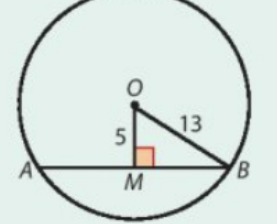
Problem: In the circle with centre , is perpendicular to chord . If and the radius , find .
Solution: Since is perpendicular to chord , triangle is right-angled at .
Using Pythagoras' theorem:
Since is the midpoint of (perpendicular from centre bisects chord):
Therefore:
Example
Worked Example 2: Finding angles with tangent and radius
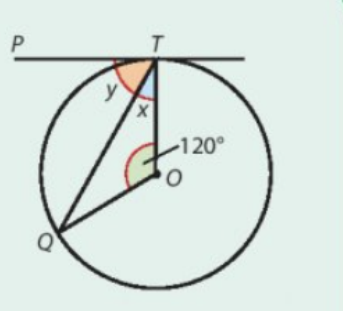
Problem: is a tangent to the circle with centre . If the central angle , find the measures of angles and .
Solution: Triangle is isosceles since . In an isosceles triangle, base angles are equal, so .
Using angle sum in triangle :
Since (radius perpendicular to tangent):
Therefore:
Example
Worked Example 3: Applying the perpendicular bisector theorem
Problem: In a circle with centre , chord cm and the perpendicular distance from to is cm. Find the radius of the circle.
Solution: Let be the point where the perpendicular from meets . Since the perpendicular from centre bisects the chord: cm
In right triangle :
Therefore, the radius is cm ≈ cm.
Corollaries and additional relationships
A corollary is a statement that follows directly from a proven theorem.
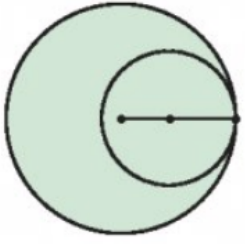
Corollary: If two circles intersect at only one point, then the centres of both circles and the point of contact are collinear (lie on the same straight line).
Note
This relationship is important when dealing with circles that touch each other externally or internally. The line connecting the centres always passes through the point where the circles touch.
Exam tips
Summary
Key Strategies for Circle Theorem Problems:
- Always identify whether you're dealing with tangents, chords, or radii
- Look for right angles - they often indicate where theorems apply
- Use the perpendicular bisector property when finding chord lengths
- Remember that radii to points of tangency are always perpendicular to tangents
- Apply Pythagoras' theorem in right triangles formed by radii and chords
- Draw clear diagrams and label all known measurements
- Work systematically through each step of your solution
Summary
Key Points to Remember:
- Tangents touch circles at exactly one point and are perpendicular to radii at the point of contact
- The perpendicular from a circle's centre to any chord bisects that chord
- Angles in semicircles are always 90°
- Isosceles triangles are formed when two radii create a triangle with a chord
- These theorems work together - use multiple theorems to solve complex problems