Triangles and Ratios (Leaving Cert Mathematics): Revision Notes
📚Revision Notes
Triangles and Ratios
Angles and sides in triangles
Understanding the relationship between angles and their opposite sides is fundamental in triangle geometry. This relationship helps us determine which sides are longest or shortest based on angle measurements.
Important
Key relationship: In any triangle, the largest angle is always opposite the longest side, and the smallest angle is always opposite the shortest side.
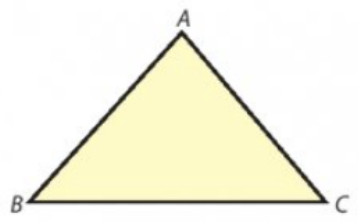
Angle-side theorem
Important
The angle opposite the greater of two sides is greater than the angle opposite the lesser side.
This means when you compare any two sides of a triangle, the angle facing the longer side will always be larger than the angle facing the shorter side.
Converse theorem
Important
The side opposite the greater of two angles is longer than the side opposite the lesser angle.
Note
Converse means the reverse or opposite statement. So when you compare any two angles in a triangle, the side facing the larger angle will always be longer than the side facing the smaller angle.
Triangle inequality
The triangle inequality is a fundamental rule that determines whether three lengths can form a triangle.
Important
Triangle inequality theorem: Two sides of a triangle are together greater than the third side.
This must be true for all three combinations of sides in any triangle:
- Side A + Side B > Side C
- Side A + Side C > Side B
- Side B + Side C > Side A
Note
The shortest distance between two points is always the straight line connecting them. This geometric principle explains why the triangle inequality must hold true.
Transversals
A transversal is a line that intersects two or more other lines. When transversals intersect parallel lines, they create important geometric relationships.
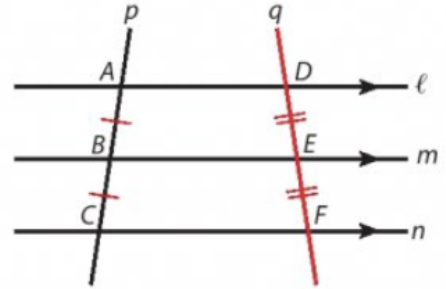
Parallel lines and equal segments theorem
Important
When three parallel lines cut off equal segments on one transversal line, they will cut off equal segments on any other transversal.
This means when parallel lines create equal spacing on one cutting line, they will create the same equal spacing on all other cutting lines.
Worked example 1
Three parallel lines are cut by two transversals x and y. On transversal x, we know |AB| = |BC|. On transversal y, |DE| = 6 cm. Find |EF|.
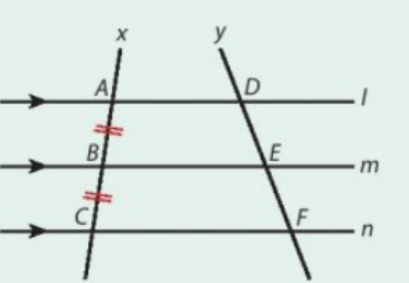
Example
Worked Example: Finding Equal Segments
Solution: Since the parallel lines cut equal segments on transversal x, they will also cut equal segments on transversal y.
Therefore: |DE| = |EF| So: |EF| = 6 cm
Line parallel to a side of a triangle
When a line is drawn parallel to one side of a triangle, it creates a special proportional relationship with the other two sides.
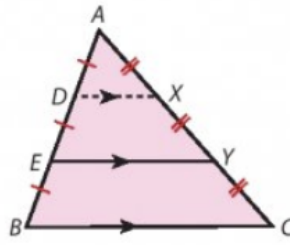
Parallel line theorem
Important
A line drawn parallel to one side of a triangle divides the other two sides in the same ratio.
This is an extremely useful theorem for solving triangle problems involving parallel lines and proportional segments.
Worked example 2
In the triangle shown, the arrows indicate parallel lines. Find the length of side marked x.
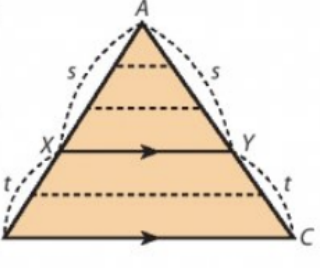
Example
Worked Example: Using Parallel Line Ratios
Given: The ratio is
Solution: Using cross multiplication:
Similar triangles
Similar triangles are triangles that have the same shape but different sizes. They have equal corresponding angles and proportional corresponding sides.
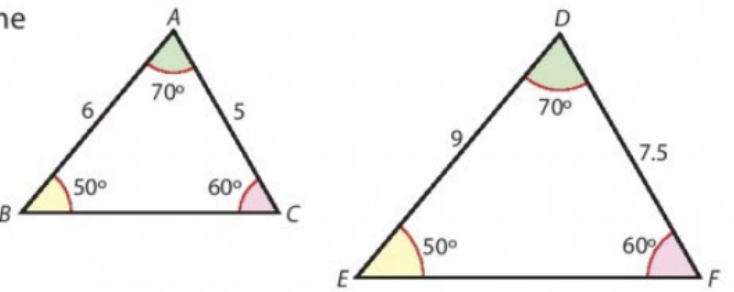
Properties of similar triangles
Two triangles are similar when:
- All corresponding angles are equal
- All corresponding sides are in the same ratio
Similar triangles theorem
Important
When two triangles ABC and DEF are similar, their corresponding sides are proportional:
Worked example 3
Two triangles are given with marked angles. Explain why they are similar and find the length marked x.
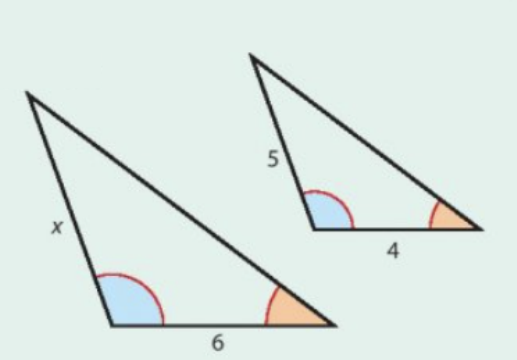
Example
Worked Example: Proving Similarity and Finding Unknown Lengths
Solution:
(i) Why are the triangles similar? Two angles in one triangle are equal to two angles in the other triangle. When two angles are equal, the third angles must also be equal (since angles in a triangle sum to 180°). Therefore the triangles are similar.
(ii) Finding x: Using the ratio of corresponding sides:
Cross multiplying: Therefore:
Note
Exam tip: Two triangles are similar when two angles in one triangle equal two angles in the other triangle.
Triangle similarity conditions
Two triangles are similar when:
- Two angles in one triangle are equal to two angles in the other triangle, OR
- All three sides are in the same ratio, OR
- Two sides are in the same ratio and the included angles are equal
Summary
Key Points to Remember:
-
In any triangle, the largest angle is opposite the longest side, and the smallest angle is opposite the shortest side
-
Triangle inequality: any two sides of a triangle must be greater than the third side
-
Parallel lines cut by transversals create equal segments - what's equal on one transversal is equal on all transversals
-
A line parallel to one side of a triangle divides the other two sides in the same ratio
-
Similar triangles have equal corresponding angles and proportional corresponding sides