Linear (Arithmetic) Sequences (Leaving Cert Mathematics): Revision Notes
📚Revision Notes
Linear (Arithmetic) Sequences
Introduction
Note
A sequence is a set of objects (usually numbers) listed in order.
Note
An arithmetic sequence is a sequence of numbers such that the difference between any two consecutive terms is constant. This constant difference is called the common difference, denoted as .
The first term of any arithmetic is denoted as , so in general, an arithmetic sequence is :
Each positional terms is denoted as where is the position of the term. So and so on.
The general term of any arithmetic sequence is
Note
General term of an arithmetic sequence : Page 22
Example
Note
List the first terms of arithmetic sequence with and .
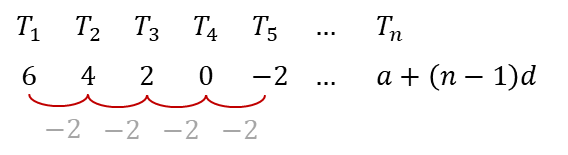
Example
Note
If are the first four consecutive terms in an arithmetic sequence, find and , and then find the general term.
Once and are known, we can find any term, .
-
-
The general term :
-
Example
Note
Which term is in the arithmetic sequence ?
First let's determine the common difference, which can be found by taking any term subtracted by the term before it, in general :
Now we are looking for the position of the term , so is the unknown variable :
Let . Use the general term formula :
must be a natural number, so getting anything that isn't a natural number indicates a mistake.
:::
Proving a Sequence is Arithmetic
To show that any sequence is arithmetic, we need to prove that the common difference is constant, in general, if a sequence is arithmetic then :
where is some constant.
Example
Note
Determine if the general term forms an arithmetic sequence.
We need (given to us already) and , so we can just sub in for .
Now determine if is constant :
is not constant, so the sequence formed from is not arithmetic.