Types of Data (Leaving Cert Mathematics): Revision Notes
📚Revision Notes
Types of Data
What is data?
Data is information that we collect to answer questions or solve problems. When we gather facts and figures to understand something better, we are collecting data.
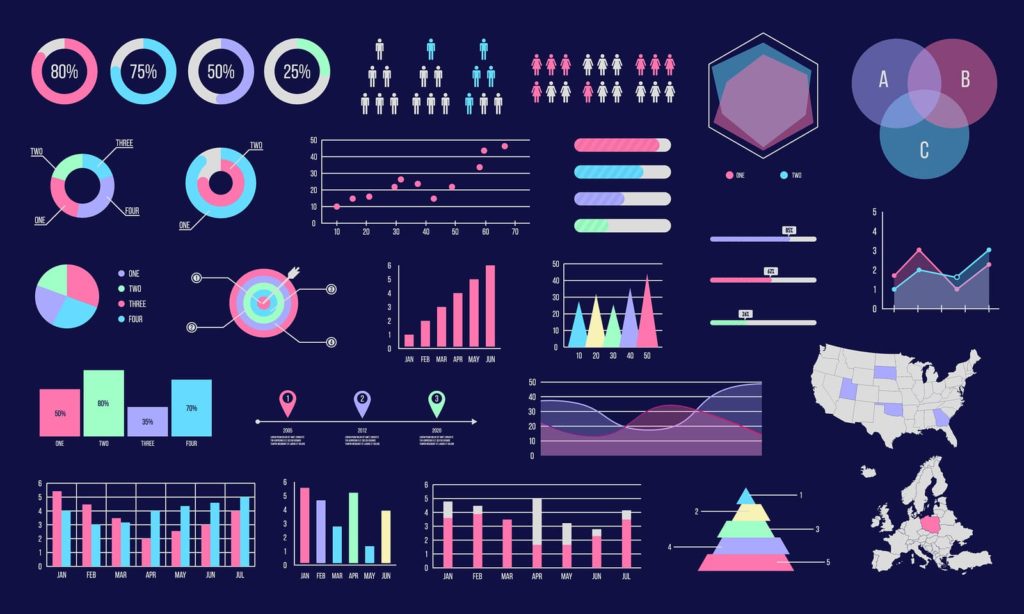
The branch of mathematics that deals with collecting, presenting and analysing data is called statistics. Statistics helps us make sense of the information around us by organising it into charts, graphs and tables that are easy to understand.
Understanding numerical data
When we ask questions like "How many students are in our class?" or "What is the temperature today?", the answers will always be numbers. This type of information is called numerical data because the answer is always expressed as a number.
Numerical data can be divided into two main categories: discrete data and continuous data.
Discrete data
Discrete data can only take certain specific values. These values are usually whole numbers that you can count individually. Think of discrete data as information that comes in separate, distinct pieces that cannot be broken down further.
Note
Characteristics of discrete data:
- Values are usually whole numbers
- You can count the items one by one
- There are gaps between possible values
- Often involves counting rather than measuring
Examples of discrete data:
- The number of students in a classroom
- The number of goals scored in a football match
- The number of books on a shelf
- The number of cars in a car park
- Shoe sizes (size 8, 9, 10 - you cannot have size 8.5 in most systems)
Continuous data
Continuous data can take any value within a given range. This type of data is measured rather than counted, and it can be broken down into smaller and smaller units with increasing precision.
Note
Characteristics of continuous data:
- Can take any value on a scale
- Often involves measuring rather than counting
- Values can include decimals and fractions
- There are no gaps between possible values
Examples of continuous data:
- Heights of students (could be 165.2 cm, 165.23 cm, etc.)
- Time taken to complete a race
- Temperature readings
- Weight of objects
- Speed of vehicles
How to distinguish between discrete and continuous data
Important
The key question to ask yourself is: "Can this value be measured more precisely?"
- If the answer is no (because you're counting individual items), then it's discrete
- If the answer is yes (because you could measure with more precision), then it's continuous
Worked examples
Example
Worked Example 1: Identifying data types
Classify each of the following as discrete or continuous:
(a) The number of coins in your pocket
- This is discrete because you count individual coins (1, 2, 3, etc.)
- You cannot have 2.5 coins
(b) The time taken to run 100 metres
- This is continuous because time can be measured to any precision
- Could be 12.3 seconds, 12.34 seconds, 12.345 seconds, etc.
(c) The number of tickets sold for a concert
- This is discrete because you count individual tickets
- You cannot sell 0.5 tickets
Example
Worked Example 2: Tricky cases
(a) Dress sizes
- This is discrete because dress sizes come in specific values (size 8, 10, 12, etc.)
- Even though they represent measurements, the sizes are fixed categories
(b) Age in years
- This can be tricky! If someone says "I am 16 years old", this appears discrete
- However, age is actually continuous because it increases gradually
- We just round it to the nearest year for convenience
Example
Worked Example 3: Variables in context
A mechanic is examining cars and records:
- Number of doors: Discrete (cars have 2, 4, or 5 doors - specific values)
- Number of seats: Discrete (specific whole numbers)
- Distance travelled: Continuous (can be measured to any precision)
Key definitions
Summary
Key Terms:
- Data: Information collected to answer questions or solve problems
- Statistics: The branch of mathematics dealing with collecting, presenting and analysing data
- Numerical data: Data that can be expressed as numbers (either by counting or measuring)
- Discrete data: Data that can only take specific, separate values (usually whole numbers)
- Continuous data: Data that can take any value within a range and can be measured to any level of precision
- Variable: Something that is measured or observed
Exam tips
Note
Helpful strategies for identifying data types:
- Look for counting vs measuring: If you're counting individual items, it's usually discrete. If you're measuring something that could be more precise, it's usually continuous
- Check for gaps: Discrete data has gaps between values; continuous data doesn't
- Consider precision: Can the measurement be made more precise? If yes, it's likely continuous
- Common discrete examples: Number of people, goals scored, exam marks (when given as whole numbers)
- Common continuous examples: Height, weight, time, temperature, speed
Remember!
Summary
Key Points to Remember:
-
Discrete data involves counting individual items and can only take specific values (usually whole numbers)
-
Continuous data involves measuring and can take any value within a range, limited only by the precision of your measuring instrument
-
The key test is to ask: "Could this be measured more precisely?" If yes, it's continuous; if no, it's discrete
-
Age, even when stated in whole years, is actually continuous data that we round for convenience
-
Understanding data types is crucial for choosing the right statistical methods and graphs to represent your information