The Shape of a Distribution (Leaving Cert Mathematics): Revision Notes
📚Revision Notes
The Shape of a Distribution
Introduction
When we create histograms to represent data, we often notice that different datasets produce different shapes. Understanding these shapes is crucial for interpreting data correctly and choosing the right statistical measures. The shape of a distribution tells us how the data is spread out and where most values are concentrated.
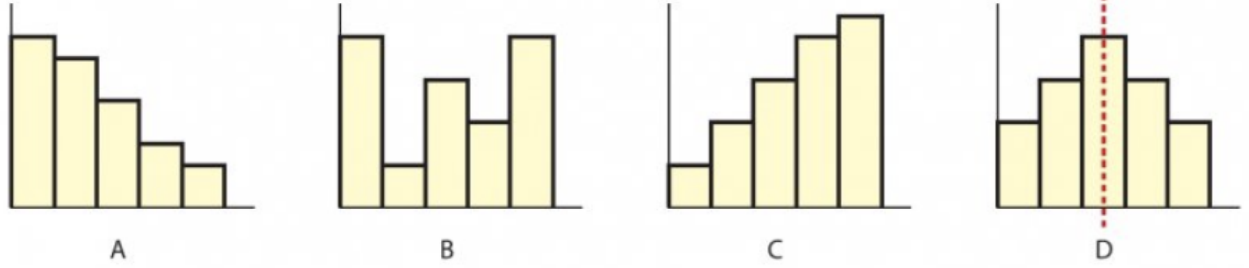
Histograms are extremely useful tools because they allow us to quickly see where data lies and get a clear picture of how it's distributed. Some distributions appear balanced and symmetrical, while others are skewed in one direction or another.
Note
Understanding distribution shapes is fundamental to statistical analysis. The shape determines which measures of central tendency are most appropriate and helps predict patterns in real-world data.
Types of distributions
Symmetrical distributions
A symmetrical distribution has a line of symmetry running through its centre. This means that if you were to fold the histogram in half along this line, both sides would match perfectly.
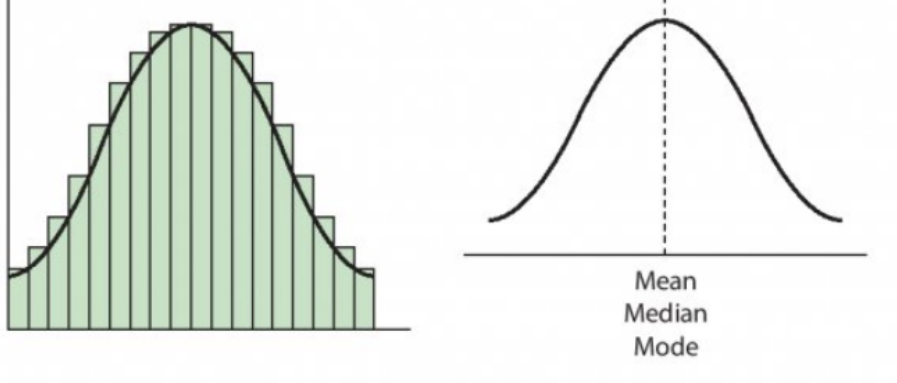
Key characteristics:
- Has an axis of symmetry down the middle
- Both sides of the distribution are mirror images
- Creates a bell-shaped curve when drawn as a smooth line
- The mean, median, and mode all have the same value
The most important type of symmetrical distribution is called the normal distribution. This is one of the most common and significant distributions in statistics. You'll encounter normal distributions frequently in real life.
Note
Real-life examples of symmetrical distributions:
- Heights of people in a large random sample
- Intelligence quotient (IQ) scores of a population
- Measurement errors in scientific experiments
Positive skew (right-skewed distributions)
A positive skew occurs when most of the data is concentrated at the lower values, with fewer observations at the higher values. This creates a long tail extending to the right of the distribution.
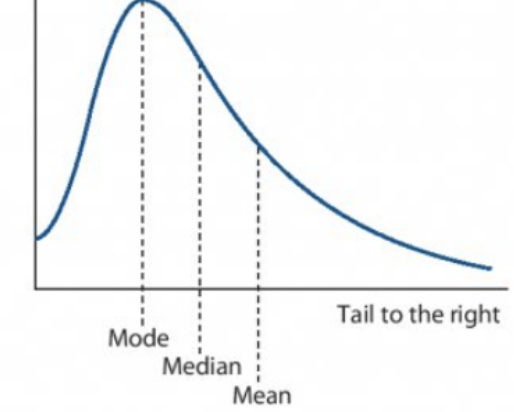
Key characteristics:
- Most data clustered at lower values (left side)
- Tail extends to the right
- The mean is pulled towards the tail (towards higher values)
Note
Memory tip: In a positive skew, most of the data is to the left, but the tail points right (positive direction).
Note
Real-life examples of positive skew:
- Number of children in families (most have 1-3 children, few have many)
- Age at which people first learn to ride a bicycle
- Age at which people marry
- Income distribution in most countries
Negative skew (left-skewed distributions)
A negative skew occurs when most of the data is concentrated at the higher values, with fewer observations at the lower values. This creates a long tail extending to the left of the distribution.
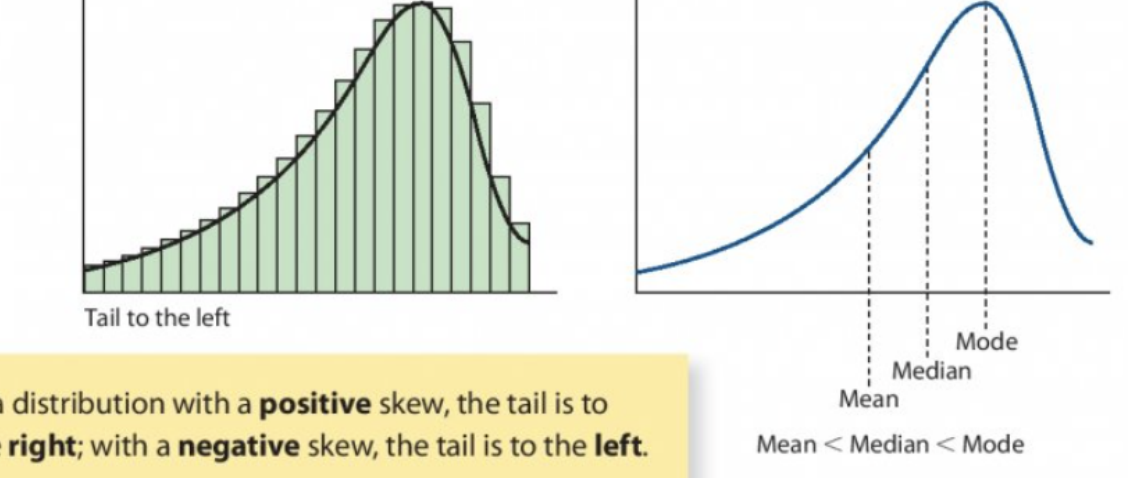
Key characteristics:
- Most data clustered at higher values (right side)
- Tail extends to the left
- The mean is pulled towards the tail (towards lower values)
Note
Memory tip: In a negative skew, the tail points left (negative direction).
Note
Real-life examples of negative skew:
- Ages at which people get their first pair of reading glasses (most people need them later in life)
- Heights of basketball players (most are tall, few are short)
- Exam scores when most students perform well
Relationship between mean, median and mode
Understanding how the mean, median, and mode relate to each other helps identify the type of distribution:
| Distribution Type | Relationship | Explanation |
|---|---|---|
| Symmetrical | All measures coincide at the centre | |
| Positive skew | Mean pulled right by the tail | |
| Negative skew | Mean pulled left by the tail |
Important
The mean is always pulled in the direction of the skew because it's affected by extreme values in the tail. The median is less affected, and the mode represents the peak of the distribution.
How to identify distribution shapes
Example
Step-by-Step Guide: Identifying Distribution Shapes
Step 1: Look for symmetry - Draw an imaginary line down the centre. Do both sides match?
Step 2: Find the peak - Where is the highest point (mode) located?
Step 3: Check for tails - Does one side extend much further than the other?
Step 4: Identify tail direction - If there's a long tail, which way does it point?
Note
Quick identification guide:
- Bell-shaped and balanced → Symmetrical (normal)
- Peak on left, tail on right → Positive skew
- Peak on right, tail on left → Negative skew
Exam tips
Important
Essential exam strategies:
- Always state the direction of skew clearly: "positive skew" or "right skew" (both are correct)
- Remember the tail rule: The skew is named after the direction the tail points
- Use the mean-median-mode relationships to check your identification
- Give real-life examples when asked - they demonstrate understanding
- Look carefully at histogram scales - don't just count bars, consider their heights
- In exam questions, explain your reasoning - don't just name the distribution type
Important
Common mistakes to avoid:
- Confusing positive and negative skew directions
- Forgetting that the mean follows the tail
- Mixing up which measure of central tendency is most affected by skew
- Not considering the scale when interpreting histograms
Summary
Key Points to Remember:
-
Symmetrical distributions have a line of symmetry with , commonly seen in heights and IQ scores
-
Positive skew has most data at lower values with a tail to the right, where
-
Negative skew has most data at higher values with a tail to the left, where
-
The mean always chases the tail - it gets pulled in the direction of the skew due to extreme values
-
"Tail tells the tale" - the direction of the longest tail determines the type of skew