Solving Right-Angled Triangles (Leaving Cert Mathematics): Revision Notes
📚Revision Notes
Solving Right-Angled Triangles
What is solving right-angled triangles?
Solving right-angled triangles means using trigonometric ratios to find unknown sides or unknown angles in a right-angled triangle. This is one of the most practical applications of trigonometry, allowing us to calculate measurements that would be difficult to measure directly.
When we have a right-angled triangle, we can use the relationships between the sides and angles to find missing information. We need at least two pieces of information (such as one side and one angle, or two sides) to solve for the unknown parts.
Note
Understanding how to solve right-angled triangles is essential for many real-world applications, including construction, navigation, engineering, and physics problems. The skills you learn here will be applied in contexts ranging from calculating building heights to determining satellite positions.
Key trigonometric ratios
Before solving right-angled triangles, we must remember the three fundamental trigonometric ratios. For any angle θ in a right-angled triangle:
- Sine (sin):
- Cosine (cos):
- Tangent (tan):
The SOH-CAH-TOA mnemonic helps us remember these ratios:
- SOH: Sine = Opposite ÷ Hypotenuse
- CAH: Cosine = Adjacent ÷ Hypotenuse
- TOA: Tangent = Opposite ÷ Adjacent
Important
Always ensure you can correctly identify which side is the opposite, which is the adjacent, and which is the hypotenuse relative to the angle you're working with. The hypotenuse is always the longest side (opposite the right angle), but the opposite and adjacent sides change depending on which angle you're considering.
Finding unknown sides
When we know an angle and one side of a right-angled triangle, we can find any other side using the appropriate trigonometric ratio.
Step-by-step method:
- Identify what you know (angle and one side) and what you want to find
- Choose the correct trigonometric ratio based on which sides are involved
- Set up the equation using the ratio
- Solve for the unknown side
- Calculate using your calculator and round to the required number of decimal places
Example
Worked Example: Finding a side using tangent
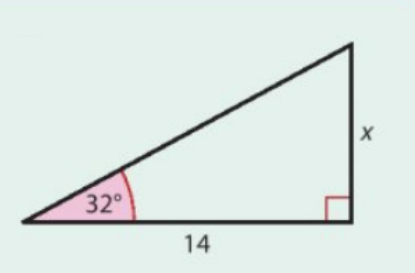
In the triangle shown above, we need to find the length of side x when we know the angle is 32° and the adjacent side is 14.
Step 1: Identify known and unknown values
- Known: angle = 32°, adjacent side = 14
- Unknown: opposite side = x
Step 2: Choose the trigonometric ratio Since we have the adjacent side and want to find the opposite side, we use tangent.
Step 3: Set up the equation
Step 4: Solve for x
Step 5: Calculate
Therefore, x = 8.75 (correct to two decimal places)
Finding unknown angles
When we know two sides of a right-angled triangle, we can find any angle using inverse trigonometric functions. These are written as , , or .
Example
Worked Example: Finding an angle using inverse tangent
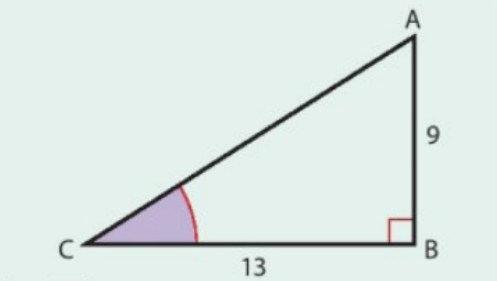
In the triangle shown above, we have sides AB = 9 and BC = 13, and we need to find angle ACB.
Step 1: Identify the relationship Since we know the opposite and adjacent sides relative to angle ACB, we use inverse tangent.
Step 2: Set up the equation
Step 3: Use inverse tangent to find the angle
Step 4: Calculate
Step 5: Round to required accuracy (correct to the nearest degree)
Calculator tip: Use the sequence SHIFT + tan + 9 ÷ 13 + = to calculate this.
Calculator usage and accuracy
When using your calculator for trigonometric calculations, accuracy and proper setup are crucial:
Note
Calculator Settings and Accuracy Guidelines:
- For trigonometric ratios (sin, cos, tan): Write values correct to 4 decimal places
- For final answers: Follow the rounding instructions given in the question
- Common rounding requirements:
- Sides: to 1 or 2 decimal places
- Angles: to the nearest degree
Important
Always ensure your calculator is in degree mode (not radians) for these problems. This is one of the most common sources of incorrect answers in trigonometry problems.
Types of problems you'll encounter
Finding the hypotenuse
When finding the hypotenuse, you often need to rearrange the trigonometric ratio. For example, if you know an adjacent side and an angle:
Rearranging:
So if , then
Multiple triangle problems

Some problems involve multiple triangles or require you to find several unknown values. Always:
- Draw and label diagrams clearly
- Identify which triangle you're working with
- Use the correct trigonometric ratio for each calculation
Note
When dealing with complex diagrams containing multiple triangles, take time to isolate each right-angled triangle you need to work with. Label each triangle separately and solve them one at a time to avoid confusion.
Exam tips
Successful problem-solving in trigonometry requires a systematic approach and attention to detail:
- Always draw a diagram if one isn't provided - this helps you visualise the problem
- Label your diagram with all known information before starting calculations
- Check your angle orientation - make sure you know which side is opposite and which is adjacent to your given angle
- Show your working clearly - write down the trigonometric ratio you're using
- Don't round intermediate steps - only round your final answer
- Double-check units - angles should be in degrees, lengths should match the question's units
Important
Common Mistakes to Avoid:
- Mixing up opposite and adjacent sides
- Forgetting to use inverse functions when finding angles
- Rounding too early in calculations
- Using the wrong trigonometric ratio
- Having calculator in radian mode instead of degree mode
- Not showing sufficient working steps in exams
Summary
Key Points to Remember:
- SOH-CAH-TOA helps you choose the correct trigonometric ratio
- Use tan, sin, or cos when you know an angle and want to find a side
- Use tan⁻¹, sin⁻¹, or cos⁻¹ when you know two sides and want to find an angle
- Always check your calculator is in degree mode before starting calculations
- Round only your final answer to the accuracy requested in the question
- Draw and label diagrams to help visualise the problem and avoid mistakes
Master these fundamentals and you'll be able to solve any right-angled triangle problem with confidence!