Scales (Leaving Cert Music): Revision Notes
📚Revision Notes
Scales
What are Scales?
- Definition: A scale is a sequence of notes ordered by pitch, typically moving in ascending and descending steps.
- Scales are foundational to music theory, aiding in composition, performance, and understanding of tonality.
Importance in the Exam
- Composing: Scales form the basis for melodies and harmonies.
- Performing: Knowledge of scales improves fluency and technique on your instrument or voice.
- Listening: Understanding scales helps identify keys, modulations, and melodic patterns in prescribed works and aural exercises.
Types of Scales
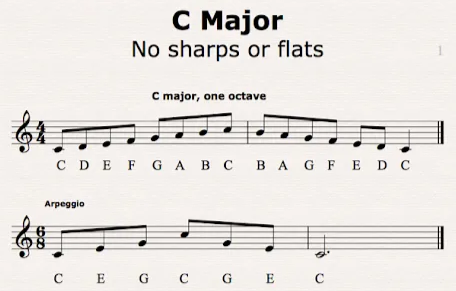
Major Scales
- Structure: A series of whole and half steps in the pattern: T-T-S-T-T-T-S (T = tone, S = semitone).
- Key Examples: C Major (no sharps/flats), G Major (F#), D Major (F#, C#).
Minor Scales
- Three types of minor scales:
- Natural Minor: Pattern: T-S-T-T-S-T-T (e.g., A Minor has no sharps/flats).
- Harmonic Minor: Raises the 7th note by a semitone (e.g., A Harmonic Minor: G#).
- Melodic Minor: Raises both the 6th and 7th notes by a semitone ascending but reverts to natural minor descending.
Pentatonic Scales
- Consists of five notes, often used in traditional Irish music and folk genres.
- Example: C Pentatonic Major: C, D, E, G, A.
Chromatic Scales
- A scale consisting of consecutive semitones, using all 12 notes within an octave.
Modes
- Scales with unique step patterns, derived from the diatonic scale.
- Examples: Dorian (e.g., D-D on white keys of a piano), Mixolydian (e.g., G-G).
Key Skills for Mastering Scales
Technique
- Play scales smoothly with consistent tone and rhythm.
- Use correct fingerings for your instrument or warm-up vocal exercises for singers.
Recognition
- Understand the interval patterns for each scale type.
- Identify scales aurally in listening tasks or prescribed works.
Context
- Relate scales to their corresponding key signatures.
- Recognise their role in forming melodies and harmonies.
Preparation Tips
Practise Regularly
- Start with simpler scales (e.g., C Major) before progressing to more complex ones.
- Use both ascending and descending patterns.
Use Patterns
- Memorise the tone-semitone patterns for each scale type.
- Practise scales in all 12 keys to build confidence.
Incorporate Aural Work
- Train your ear to identify scales by listening to examples and playing them back.
Note
Common Mistakes
- Incorrect Fingering: Using inefficient fingerings slows down fluency.
- Skipping Descending Patterns: Many students focus on ascending only, but exams often require both directions.
- Confusing Minor Types: Mixing up harmonic and melodic minor scales is a frequent issue.
- Ignoring Context: Practising scales without understanding their relevance to keys and pieces.
Note
Key Takeaways
- Scales are essential for improving performance, composition, and listening skills.
- Focus on proper technique, fluency, and understanding the tonal structure of each scale.
- Practise regularly and incorporate both aural and theoretical exercises for a well-rounded approach.
- Mastery of scales ensures confidence in all aspects of the Leaving Certificate Music syllabus!