Analysing Skill and Technique (Leaving Cert Physical Education): Revision Notes
📚Revision Notes
Analysing Skill and Technique
Biomechanics (analysing skill and technique) is used to:
- Improve performance e.g. improve economy of movement.
- Reduce the risk of injury e.g. lessen impact on joints
Note
Axis: a straight line at rights angles to the plane, about which the body rotates.
Note
Biomechanics is the study of the structure, function and movement of a living body.
Plane: an imaginary flat surface running through the body. Planes of movement are the three-dimensional spaces in which the body moves.
- Biomechanics
- The anatomical position
- Planes of movement
- Axes of movement
- Levers
- Movement
- Vectors and scalars
- Newton's laws of motion
- Quality/effectiveness
- Economy of movement
- Creative application of skill.
1. Biomechanics
Sports biomechanics analyse the interactions between muscles, bones, ligaments and tendons and how they relate to sporting movement.
The following topics are discussed below:
- The anatomical position
- Planes of movement
- Axes of movement
- Levers
The Anatomical Position
The anatomical position provides a standard starting point from which the anatomy of the moving body can be described.
- The body stands upright with the face directed forwards, arms relaxed at the sides, and palms facing outward.
- A standard stance allows for consistent and clear communication when discussing body movements.
Planes of Movement
The three-dimensional spaces in which the body moves.
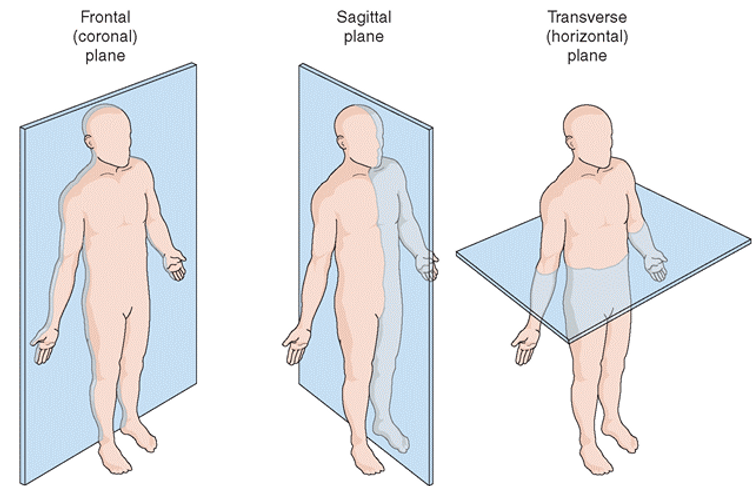
A plane is an imaginary flat surface running through the body. Three reference planes are used in anatomy:
Sagittal Plane: divides the body into left and right halves, running perpendicular to the floor and allowing movements such as flexion and extension e.g. running or bicep curls.
Frontal Plane: divides the body vertically into front and back halves of equal mass, enabling lateral movements like abduction and adduction e.g. a cartwheel
Transverse Plane: divides the body into upper and lower halves of equal mass, facilitating rotational movements e.g. an ice skater performing a pirouette.
Note
Most movements are multiplanar but are often described by their gross action, which is the main movement used.
Note
Memory technique: Think of SAGITTAL dividing the body into left and right SIDES. Think FRONTAL dividing the body into FRONT and back. Think TRANVERSE dividing the body into TOP and bottom.
Axes of Movement
Axis: straight lines at right angles to the plane around which the body rotates.
There are three axes of movement that the body and body parts rotate around.
- Sagittal Axis
- Frontal Axis
- Vertical Axis The sagittal axis or anteroposterior axis runs through the body from front to back. Think of a rod going through the belly button and exiting the lower back. E.g. a cartwheel.
The frontal axis runs through the centre of the body, from right to left. E.g. a somersault.
The vertical or longitudinal axis runs through the centre of the body from top to bottom e.g. a pirouette.
Relationship Between Planes and Axes
Each of the three axes run perpendicular to a plane of movement. This relationship means that movement in each of the three planes is around one of the three axes:
- Frontal plane rotates around the sagittal axis.
- Sagittal plane rotates around the frontal axis.
- Transverse plane rotates around the vertical axis.
Levers
Note
Lever: a rigid body that moves around a fixed point (fulcrum). In the body they are formed from bones, joints and muscles and allow us to move.
A fulcrum is a fixed pivot point e.g. a joint in the body.

An effort applied to a lever moves a load.
The effort is the source of the energy e.g. a muscle in the body.
The load is the weight or resistance to be moved e.g. the body part being moved and any additional objects/resistance.
The classification is determined by the sequence in which the fulcrum, effort, and load are arranged.
- First class levers
- Second class levers
- Third class levers
1. First Class Levers
The fulcrum is between the load and the effort. These levers can be found in the neck, where the load is the weight of the head, and the effort is the neck muscles.
Example:
- A soccer player heading a ball.
2. Second Class Levers
The load is between the fulcrum and the effort. These levers can be found in the human body at the ancle, where the ball of the foot acts as the fulcrum, the body weight is the load, and the calf muscles provide the effort.
Example:
- Performing a calf raise.
3. Third Class Levers
The effort is between the fulcrum and the load. This is the most common type of lever in the human body. An example is the elbow joint where the fulcrum is the elbow, the effort is provided by the biceps, and the load is the weight of the forearm and any object it is holding.
Example:
- Flexing the elbow to lift a weight.
Mechanical Advantage and Disadvantage
Note
Mechanical advantages and disadvantages explain how levers in the human body function to maximise efficiency and performance in sports.
The load arm: the distance from the load to the fulcrum.
The effort arm: the distance from the effort to the fulcrum.
Mechanical Advantage
When a lever's effort arm is longer than its load arm.
It allows a greater load to be moved with less effort.
Mechanical Disadvantage
When a lever's effort arm is shorter than its load arm.
More force is required to move the load but it allows it to move further and faster.
The efficiency of the lever system is expressed as the mechanical advantage. Levers with mechanical advantage can move large loads with a small amount of effort-they have a high load-force-to-effort ratio.
Note
DIAGRAM: 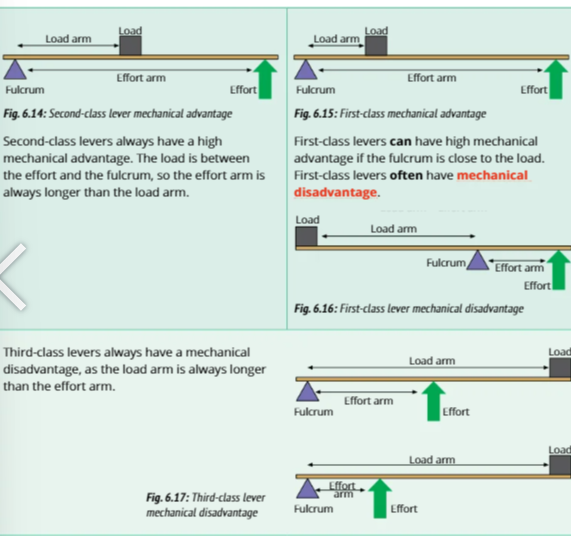
Summary of Lever Classes
| First class | Second class | Third class | |
|---|---|---|---|
| Middle | Fulcrum is in the middle | Load is in the middle | Effort is in the middle |
| Advantages | A large load can sometimes be lifted with little effort due to the effort arm being longer than the load arm. | A large load can always be lifted with little effort due to the effort arm being longer than the load arm. | Fast movement and an increased range of motion. |
| Disadvantages | Limited flexibility and slower movement. | Limited flexibility and slower movement. | It cannot lift as large a load as the effort arm is shorter than the load arm. |
Scalar and Vector Quantities
Note
Vector quantity: has magnitude (size) and acts in a particular direction. Scalar quantity: has magnitude (size) but no direction.
Vectors
Quantities that have both magnitude and direction, such as displacement, velocity, and acceleration.
Example:
- A football being kicked in a specific direction.
Scalars
Quantities that have only magnitude, such as time, mass, and temperature; direction is not important.
Example:
- The duration of a race.
Newton's Laws of Motion
Motion is the action of changing location or position. It is described in terms of displacement, distance, velocity, acceleration, speed and time.
Speed: how fast a body is moving in relation to time.
Velocity: the speed of a body in a particular direction. (vector quantity)
Acceleration: the rate of change of a body's velocity. (vector quantity)
Deceleration: rate of decrease of a body's velocity.
- Law of Inertia
- Law of Acceleration
- Law of Action-Reaction
1. Newton's 1st Law – Law of Inertia
Inertia: the resistance of any physical object to a change in its velocity.
Note
Newton's 1st Law: Law of Inertia An object at rest will remain at rest unless acted upon by an outside force. A body in motion will remain in motion with constant speed and in the same direction unless acted upon by an outside force.
Example:
- A soccer ball remains stationary until kicked.
2. Newton's 2nd Law – Law of Acceleration
Note
Newton's 2nd Law: Law of Acceleration The velocity of a body is changed only when acted upon by an additional force. The acceleration or deceleration is produced proportional to and in the same direction of the force.
Example:
- The harder a tennis ball is hit, the faster it moves.
3. Newton's 3rd Law – Law of Action-Reaction
Note
Newton's 3rd Law: Law of Action-Reaction For every action, there is an equal and opposite reaction.
Example:
- Swimmers push against the water, propelling themselves forwards. The water acts as a counterforce to oppose the action of the swimmer.
Economy of Movement
Economy of movement refers to how efficiently an athlete uses energy while performing a skill.
Factors such as energy expenditure and technique execution affect economy of movement.
- Energy expenditure: efficient athletes use less energy, sustaining efforts longer and conserving oxygen. High endurance activities like running and cycling require well-trained aerobic systems for better energy use, reducing fatigue.
- Technique execution: effective skill execution minimises energy wastage. Athletes with perfected techniques sustain efforts longer. For example, in long jump, accurate take-off optimises flight and distance.
- Being more energy efficient enables performers to train longer and more frequently.
- It reduces the risk of injury and allows athletes to perform skills to a higher standard. External factors such as gravity, friction and the weather also affect economy of movement. Performers have little control over these.
- Inertia: The resistance a body has to changes in its state of motion.
- Gravity: The downward force that constantly accelerates an athlete's body towards the Earth.
- Friction: The force that resists motion between two surfaces in contact.
- Fluid forces: Slows down athletes or objects in motion, such as hydrodynamic resistance in water and aerodynamic resistance in air.
Note
Creative application of skill: Involves using skills in innovative ways to achieve high performance and aesthetic appeal e.g. a basketball player's no-look pass.