Heating Effect of an Electric Current (Leaving Cert Physics): Revision Notes
📚Revision Notes
Electrical Energy and Domestic Electric Circuits
High voltage transmission of electrical energy
When electrical energy travels long distances from power stations to our homes, it faces a significant challenge: energy loss during transmission. The solution lies in using very high voltages for long-distance power transmission.
The key principle behind this approach is understanding power losses in transmission lines. When current flows through any conductor, energy is lost as heat according to the relationship:
Where is the current and is the resistance of the transmission wires.
Important
Since electrical power is given by (voltage × current), we can see that for the same amount of power, using a higher voltage allows us to use a much smaller current. Because power losses depend on the current squared, even a small reduction in current leads to dramatically reduced energy losses.
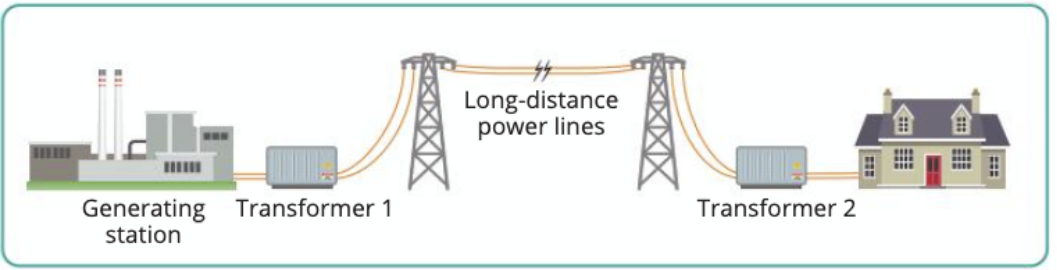
The transmission system works using transformers at both ends. Transformer 1 steps up the voltage to several hundred kilovolts for long-distance transmission, greatly reducing the current and therefore the losses. Transformer 2 steps the voltage back down to safer levels for use in homes and businesses.
Domestic electrical circuits and supply
Mains electricity in Ireland and the EU is supplied at 230V AC (alternating current). This voltage can be dangerous, so understanding how domestic electrical systems work is crucial for safety.
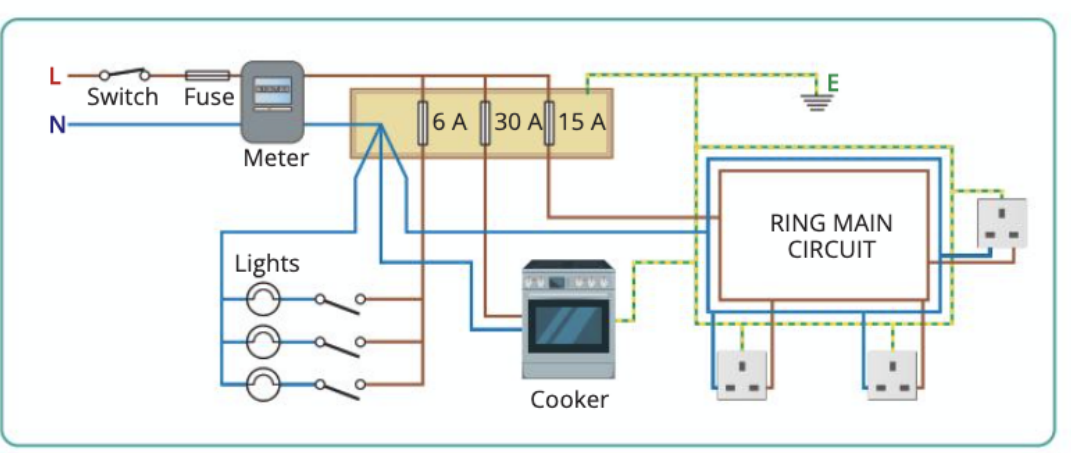
Your home's electrical system starts with an electricity metre, followed by a main switch and fuse, then a distribution box (consumer unit) containing various circuit breakers rated for different currents (typically 6A, 15A, 30A, etc.).
House wiring layout
Two main wires enter your house from the mains supply:
- Live wire: Carries a voltage that varies between approximately +325V and -325V (RMS value 230V). This wire is extremely dangerous and contact with it can be fatal.
- Neutral wire: Should be at or very near zero volts, at the same potential as Earth.
Power flows to various appliances through these wires. The live wire provides the energy, while the neutral wire completes the circuit back to the electrical supply.
Different types of circuits
Note
Lighting circuits: Since lights don't consume much current, several lights may be connected to the same fuse. Each light has its own switch in the live wire, and they're connected in parallel so that if one bulb fails, the others aren't affected.
Note
Ring main circuits: Sockets are usually connected in a ring configuration, with the live wire forming a complete loop. Both sides of the ring connect to the same socket, and the neutrals follow a similar path at the distribution box.
Note
High-current appliances: Equipment that draws large currents, such as electric cookers, immersion heaters, or electric showers, have separate live and neutral wires coming directly from the distribution box, each with its own dedicated fuse.
Electrical safety and protection systems
The danger of electrocution
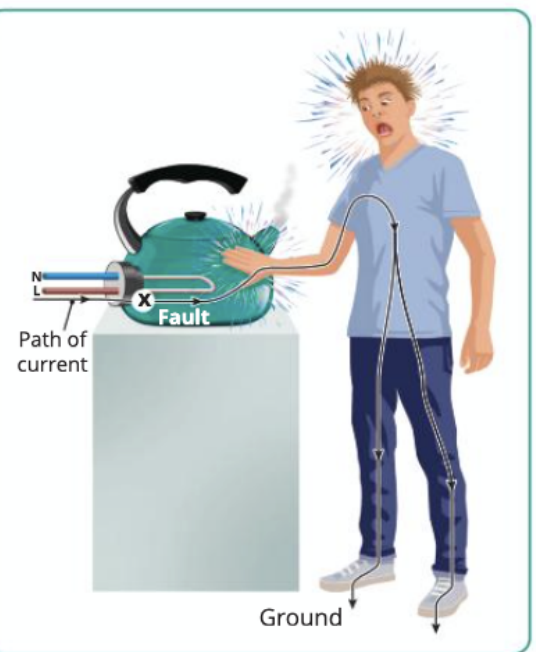
The human body conducts electricity, and when current flows through it, severe injury or death can result. The danger depends on the path the current takes through the body.
Important
A current flowing across the chest (from one hand to the other, or from hand to foot) can pass through the heart, which is particularly dangerous. Even currents from hand to same-side foot may not be fatal but can still cause severe injury, burns, and potentially permanent damage.
Earthing systems
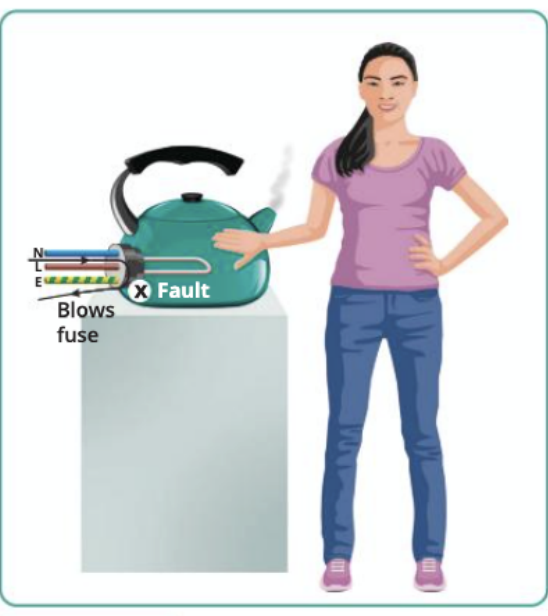
All electrical equipment with exposed metal parts must be earthed. This means connecting all metal components (such as the yellow/green wires in appliances, metal taps, metal water tanks, and metal house structures) to Earth potential.
Note
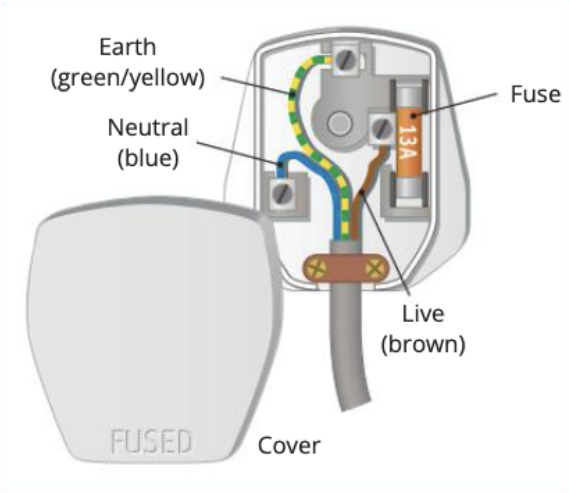
The earth wire (green/yellow striped) in a plug connects the metal casing of an appliance to Earth. If a fault occurs causing the live wire to touch the metal casing, current flows through the earth wire rather than through anyone who might touch the appliance. This creates a large current that blows the fuse, disconnecting the faulty appliance from the mains.
Fuses
A fuse is essentially a piece of wire that melts when a current of a certain size passes through it. The fuse is connected in series with the appliance, so when it blows, it breaks the circuit and prevents dangerous currents from flowing.
Fuses protect appliances in two main ways:
- They prevent damage from excessive current that might occur during electrical faults
- They provide safety by disconnecting faulty equipment before dangerous currents can flow through people
Important
Critical Safety Rule: A fuse should always be connected in the live wire. This ensures that when it blows, it disconnects the appliance completely from the dangerous live supply.
Miniature circuit breakers (MCBs)
Miniature circuit breakers are modern alternatives to traditional fuses in distribution boxes. They operate faster than fuses and can be reset by simply flicking a switch, rather than requiring replacement.
MCBs work using electromagnetic principles:
- When current exceeds the rated value, a bimetallic strip heats up and bends, causing the switch to trip
- For short circuits, the rapid current increase generates a strong magnetic field in a solenoid, which immediately attracts an iron bar and trips the switch almost instantaneously
Residual current devices (RCDs)
RCDs provide additional protection beyond what fuses and MCBs can offer. They're designed to safeguard humans from electrocution by monitoring the difference in current between the live and neutral wires.
Under normal circumstances, the current flowing through the live wire should exactly equal the current returning through the neutral wire. If someone touches a live wire, some current flows through their body to earth instead of returning through the neutral wire. The RCD detects this difference and disconnects the circuit extremely quickly (usually in less than 30 milliseconds).
Important
RCD Limitation: An RCD cannot protect you if you come into contact with both live and neutral wires at the same time, as the current balance would appear normal to the device.
Energy measurement and electrical calculations
The kilowatt-hour
The joule is the standard scientific unit of energy, but it's too small for practical use when dealing with domestic electricity. Instead, we use the kilowatt-hour (kWh).
The kilowatt-hour is the amount of energy used by a 1000W appliance operating for one hour.
The relationship between kilowatt-hours and joules is:
Energy calculations use the formula:
Worked examples of electrical calculations
Example
Worked Example 1 - Fuse Selection:
If an electric kettle has a power rating of 2000W and operates on 230V mains:
- Current drawn:
- Therefore, a 13A fuse would be suitable (next size up from calculated current)
Example
Worked Example 2 - Total Power Calculation:
An electric cooker has four 500W plates, a 2kW grill, and a 3kW oven, all operating on 230V:
- Total power:
- Current drawn:
- A 40A fuse would be suitable
Example
Worked Example 3 - Energy Consumption:
How many joules of energy does a 1000W heater consume in 1 hour?
- Energy = power × time =
- This equals exactly 1 kilowatt-hour
Summary
Key Points to Remember:
- High voltage transmission reduces power losses because power loss = , and higher voltage means lower current for the same power
- The live wire is dangerous (around 230V), while the neutral wire should be at Earth potential (0V)
- Earthing connects all metal parts to Earth potential, so if a fault occurs, current flows through the earth wire instead of through people
- Fuses protect by melting when excessive current flows, and must always be connected in the live wire
- RCDs detect imbalances between live and neutral currents and can disconnect circuits in milliseconds to prevent electrocution
- The kilowatt-hour (kWh) is the practical unit for domestic energy, equal to joules