Elasticity and Hooke's Law (Leaving Cert Physics): Revision Notes
📚Revision Notes
Elasticity and Hooke's Law
What is elasticity?
When you stretch a rubber band or compress a spring, these objects try to return to their original shape once you release them. This property is called elasticity. Any object that can change shape when a force is applied and then return to its original form shows elastic behaviour.
However, there's a limit to how much you can stretch or compress something before it becomes permanently damaged. This boundary is called the elastic limit. If you stretch a spring too far, it won't return to its original length - it has exceeded its elastic limit and become permanently deformed.
Note
Think of elasticity like this: within certain limits, objects behave like they have a "memory" of their original shape and will always try to return to it.
Understanding Hooke's law
Hooke's Law is one of the most important principles in physics for understanding elastic behaviour. It tells us that when you stretch or compress an elastic object (like a spring), the restoring force is directly proportional to how much you've displaced it from its natural position.
The mathematical relationship is:
Where:
- = restoring force (in Newtons)
- = spring constant (in N m⁻¹)
- = displacement from natural length (in metres)
The spring constant () tells us how stiff the spring is. A large spring constant means the spring is very stiff and needs a lot of force to stretch it. A small spring constant means the spring stretches easily.
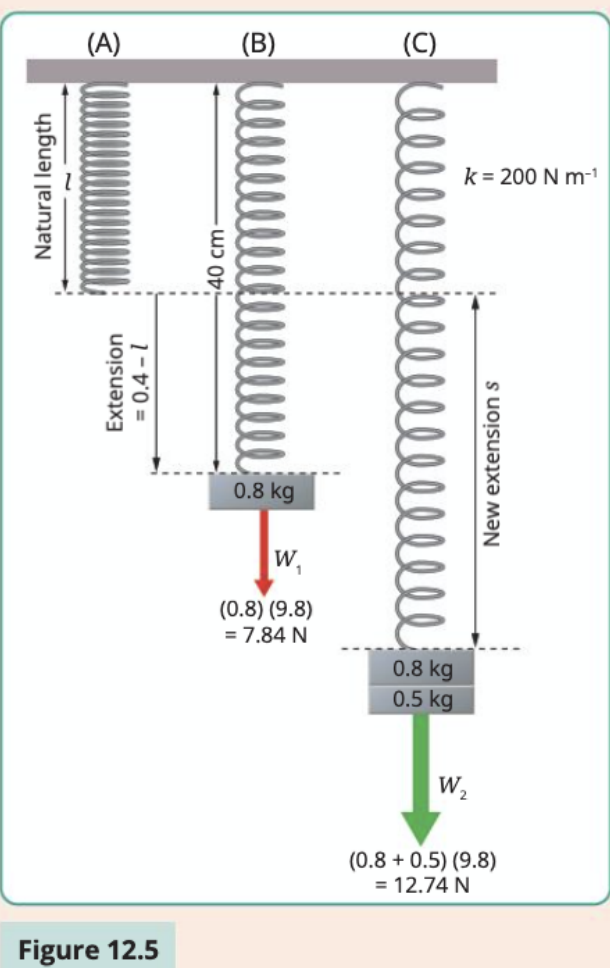
This diagram shows how Hooke's Law works in practice. When no mass is attached (A), the spring hangs at its natural length. Add a 0.8 kg mass (B), and the spring extends by a specific amount. Add more mass (C), and it extends further. Notice that the extension is directly proportional to the applied force.
Working with spring calculations
Let's look at how to solve problems involving springs and Hooke's Law.
Example
Worked Example: Calculating Restoring Force
A spring with spring constant is stretched 10 cm beyond its natural length. What is the restoring force?
Solution: Step 1: Convert displacement to metres:
Step 2: Apply Hooke's Law:
Step 3: Calculate:
Important
The negative sign in Hooke's Law () indicates that the restoring force always acts in the opposite direction to the displacement. When you stretch a spring to the right, it pulls back to the left.
Work done in stretching springs
When you stretch a spring, you're doing work against the restoring force. This work gets stored as elastic potential energy in the spring.
The work done in stretching a spring through a distance is:
This work becomes the elastic potential energy stored in the spring:
Important
Notice that the energy depends on the square of the displacement. This means if you double the stretch, you store four times as much energy!
Note
Why is it ½kx² and not just kx?
The force needed to stretch a spring isn't constant - it increases as the spring gets longer. At the start, you need very little force, but by the end, you need the full force . The average force during stretching is , so the total work is .
Energy changes in oscillating systems
When a spring-mass system oscillates, it demonstrates beautiful energy transformations. The total mechanical energy remains constant, but it continuously converts between two forms:
- Kinetic energy - energy of motion
- Elastic potential energy - energy stored in the deformed spring
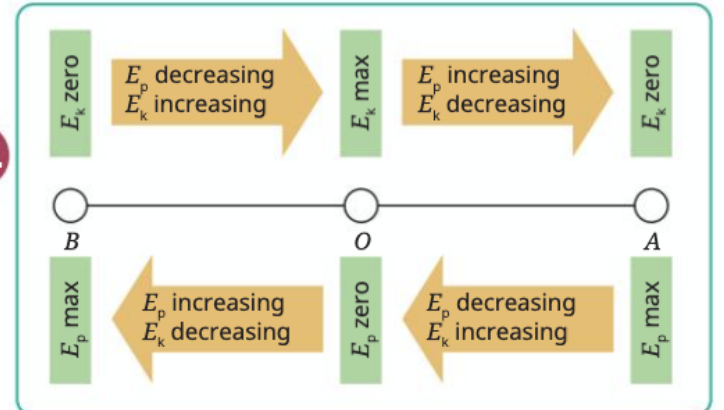
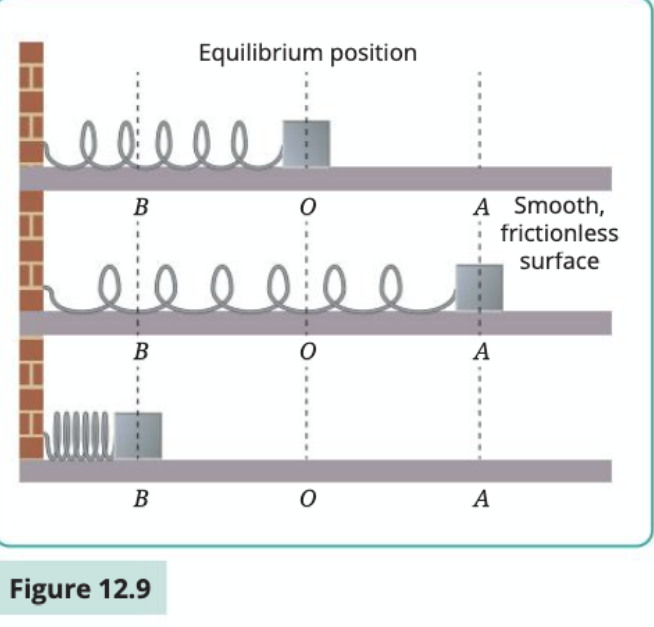
At the equilibrium position (centre), the mass moves fastest, so kinetic energy is maximum and potential energy is zero. At the turning points (maximum displacement), the mass momentarily stops, so kinetic energy is zero and potential energy is maximum.
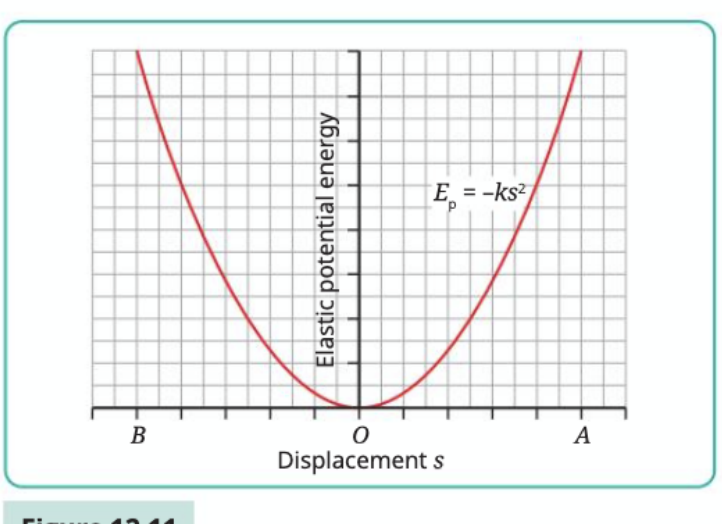
This graph shows how elastic potential energy varies with displacement. The parabolic shape tells us that energy increases as the square of displacement, regardless of direction.
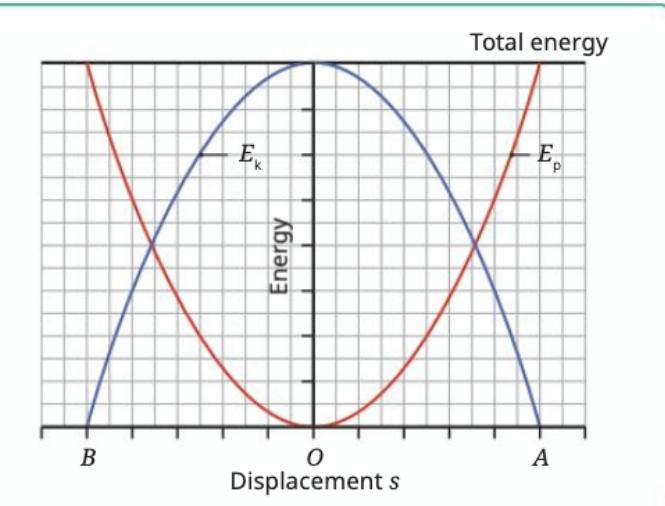
This combined energy diagram shows the complete picture: as potential energy decreases, kinetic energy increases by exactly the same amount, keeping total energy constant. This is a perfect example of conservation of energy in action.
Key applications and exam tips
Note
Common exam calculations:
- Finding spring constants from force and extension data
- Calculating elastic potential energy stored in springs
- Determining natural lengths from extended lengths
- Energy transformations in oscillating systems
Important relationships to remember:
- Spring constant: (gradient of force-extension graph)
- Extension caused by weight:
- Energy is proportional to displacement squared
- In oscillations, energy constantly transforms but total energy stays the same
Important
Exam strategy:
- Always convert units (cm to m, g to kg)
- Draw clear diagrams showing forces and displacements
- Remember the energy formula uses ½, not just kx
- Check your signs - restoring forces oppose displacement
Summary
Key Points to Remember:
- Hooke's Law states that restoring force is proportional to displacement:
- Elastic potential energy stored in a spring:
- Springs only obey Hooke's Law within their elastic limit - exceed this and they become permanently deformed
- In oscillating systems, kinetic and potential energy continuously interchange while total mechanical energy remains constant
- The spring constant tells us stiffness - larger k means stiffer spring, smaller k means more flexible spring