Force, Mass, and Momentum (Leaving Cert Physics): Revision Notes
📚Revision Notes
Collisions in Two Dimensions
When objects collide at angles rather than head-on, we need to analyse the collision in two dimensions. This is more complex than one-dimensional collisions because we must consider motion in both horizontal and vertical directions simultaneously.
Understanding two-dimensional collisions
In real life, most collisions don't happen in straight lines. Cars crash at intersections, snooker balls hit at angles, and spacecraft change direction using thrust. To solve these problems, we use vector analysis to break down the motion into perpendicular components.
Important
The key principle remains the same: momentum is conserved. However, in two dimensions, we must apply conservation of momentum separately to each direction (usually x and y axes).
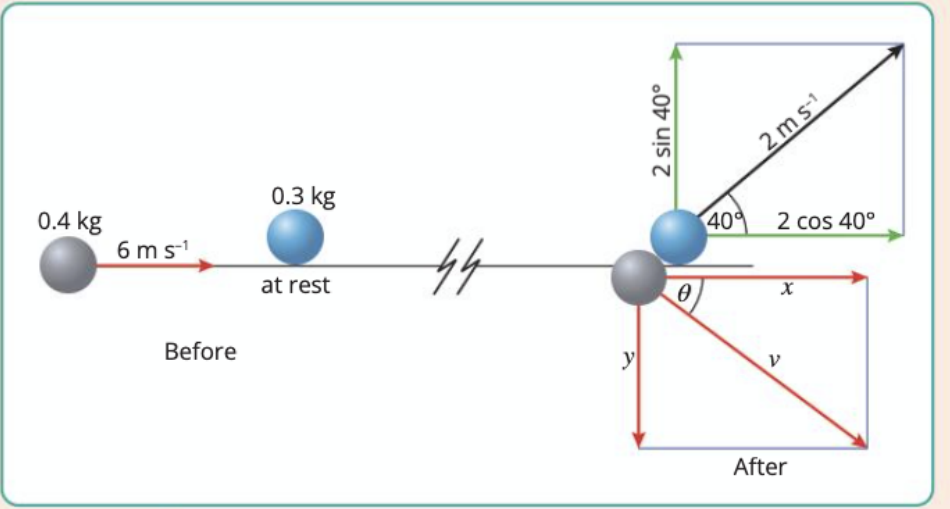
This diagram shows a typical oblique collision where one sphere strikes another at an angle, causing both objects to move in different directions after impact.
Method for solving two-dimensional collision problems
Follow these systematic steps when tackling 2D collision problems:
Note
Step 1: Set up coordinate system
- Choose convenient x and y axes (usually horizontal and vertical)
- Identify the directions of motion before and after collision
Note
Step 2: Resolve velocities into components
- Break down each velocity vector into x and y components
- Use trigonometry: and
Note
Step 3: Apply conservation of momentum
- For x-direction: Total momentum before = Total momentum after
- For y-direction: Total momentum before = Total momentum after
- Write separate equations: and
Note
Step 4: Solve the system of equations
- Use the two momentum equations to find unknown velocities
- Calculate magnitude and direction of resultant velocities if needed
Note
Step 5: Find magnitude and direction
- Magnitude:
- Direction:
Worked example approach
Example
Worked Example: Two-Object Collision Analysis
Consider a collision between two objects where:
- Object 1 (mass ) moves horizontally with initial velocity
- Object 2 (mass ) is initially at rest
- After collision, both objects move at different angles
Applying conservation of momentum:
X-direction:
Y-direction:
These equations can be solved simultaneously to find the unknown velocities and angles.
Applications to spacecraft and rockets
Conservation of momentum in two dimensions also explains how rockets and spacecraft change direction. When a spacecraft ejects mass in one direction, it gains momentum in the opposite direction.
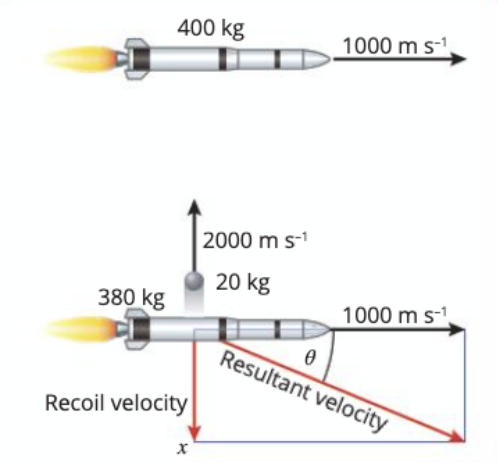
For rocket propulsion:
- The spacecraft and ejected fuel form a system
- Momentum is conserved in both x and y directions
- The spacecraft's final velocity depends on the mass ejected and its velocity relative to the craft
Connection to Newton's laws
Two-dimensional collisions follow Newton's laws of motion:
Note
Newton's First Law: Objects continue moving in straight lines unless acted upon by external forces.
Newton's Second Law: The force during collision equals the rate of change of momentum ().
Newton's Third Law: Action and reaction forces are equal and opposite during the collision.
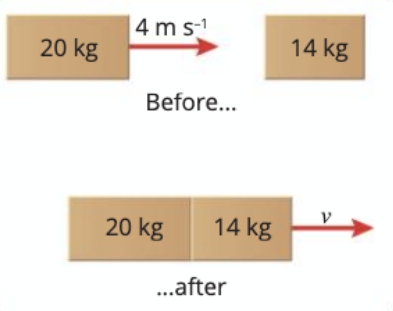
This diagram shows an inelastic collision where objects stick together after impact, demonstrating how momentum conservation applies even when kinetic energy is not conserved.
Key considerations for exam success
To succeed in solving two-dimensional collision problems, you should always:
- Always draw a clear diagram showing the situation before and after collision
- Label all masses, velocities, and angles clearly
- Set up your coordinate system consistently
- Remember that momentum is a vector quantity — direction matters
- Check your answers make physical sense (e.g., objects shouldn't gain impossible speeds)
- Practice resolving vectors into components — this is crucial for success
Types of two-dimensional collisions
Oblique elastic collisions
- Kinetic energy is conserved as well as momentum
- Objects bounce off each other at specific angles
- More complex calculations involving both momentum and energy conservation
Inelastic collisions at angles
- Objects may stick together or deform
- Only momentum is conserved, not kinetic energy
- Simpler calculations as final velocities are related
Summary
Key Points to Remember:
- Momentum is conserved in both x and y directions separately — treat each direction as an independent equation
- Always resolve vector quantities into components before applying conservation laws
- Draw clear before-and-after diagrams to visualise the problem and avoid mistakes
- Use trigonometry to find magnitudes and directions of resultant velocities after solving
- Newton's laws apply to collisions — forces during impact follow the same physical principles as other motion