Momentum and Newton's Laws of Motion (Leaving Cert Physics): Revision Notes
📚Revision Notes
Momentum and Newton's Laws of Motion
What is momentum?
Momentum is a fundamental concept in physics that describes the quantity of motion an object possesses. Think of it as a measure of how difficult it would be to stop a moving object. A heavy lorry travelling at high speed has much more momentum than a bicycle moving at the same speed.
The momentum of any object is calculated using a simple formula:
Momentum = Mass × Velocity
In mathematical terms:
Where:
- represents momentum
- represents mass
- represents velocity
Since velocity is a vector quantity (it has both magnitude and direction), momentum is also a vector quantity. This means momentum has both size and direction.
Important
Key Definition: The momentum of a body is, by definition, equal to its mass multiplied by its velocity: momentum = mass × velocity,
Units of momentum
The SI unit for momentum is the kilogramme metre per second (kg m s⁻¹).
Here's a useful reference table for the key quantities:
| Quantity | Symbol | Unit | Unit in terms of basic units |
|---|---|---|---|
| Force | F | newton (N) | kg m s⁻² |
| Mass | m | kilogramme (kg) | kg |
| Momentum | p | kilogramme metre per second | kg m s⁻¹ |
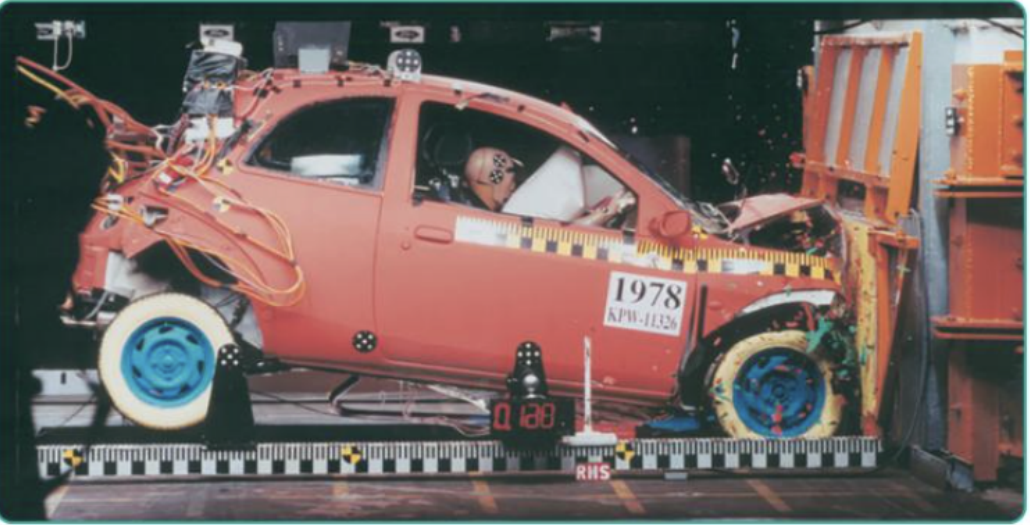
The crash test shown demonstrates the importance of momentum in vehicle safety. When a car suddenly stops during a collision, the momentum of both the car and its occupants must be reduced to zero, which is why safety features like airbags and crumple zones are so crucial.
Newton's first law of motion
Newton's first law, also known as the law of inertia, provides the foundation for understanding motion.
Important
Newton's First Law: Every body will remain in a state of rest or will carry on travelling with a constant velocity unless a net external force acts on it.
This means:
- An object at rest will stay at rest
- An object moving at constant velocity will continue moving at constant velocity
- Changes in motion only occur when a net external force acts on the object
Inertia is the tendency of objects to resist changes in their motion. More massive objects have greater inertia, which is why it's harder to push a car than a bicycle.
Real-world examples of the first law
Note
Everyday Examples of Inertia:
- A book resting on a table stays there until someone picks it up
- A passenger in a car continues moving forwards when the car brakes suddenly (hence the need for seatbelts)
- A spacecraft in deep space continues travelling in a straight line without using fuel
Newton's second law of motion
Newton's second law describes the relationship between force, mass, and acceleration. It can be expressed in two ways:
The acceleration form
Force = Mass × Acceleration
This tells us that the acceleration of an object is directly proportional to the applied force and inversely proportional to its mass.
The momentum form
Force = Rate of change of momentum
Where represents the change in momentum and represents the time taken for that change.
Important
Critical Connection: The equation is actually a special case of the momentum form, which applies when mass remains constant.
Key insights from the second law
- Larger forces produce greater accelerations
- More massive objects need larger forces to achieve the same acceleration
- The same force will produce different accelerations depending on the object's mass
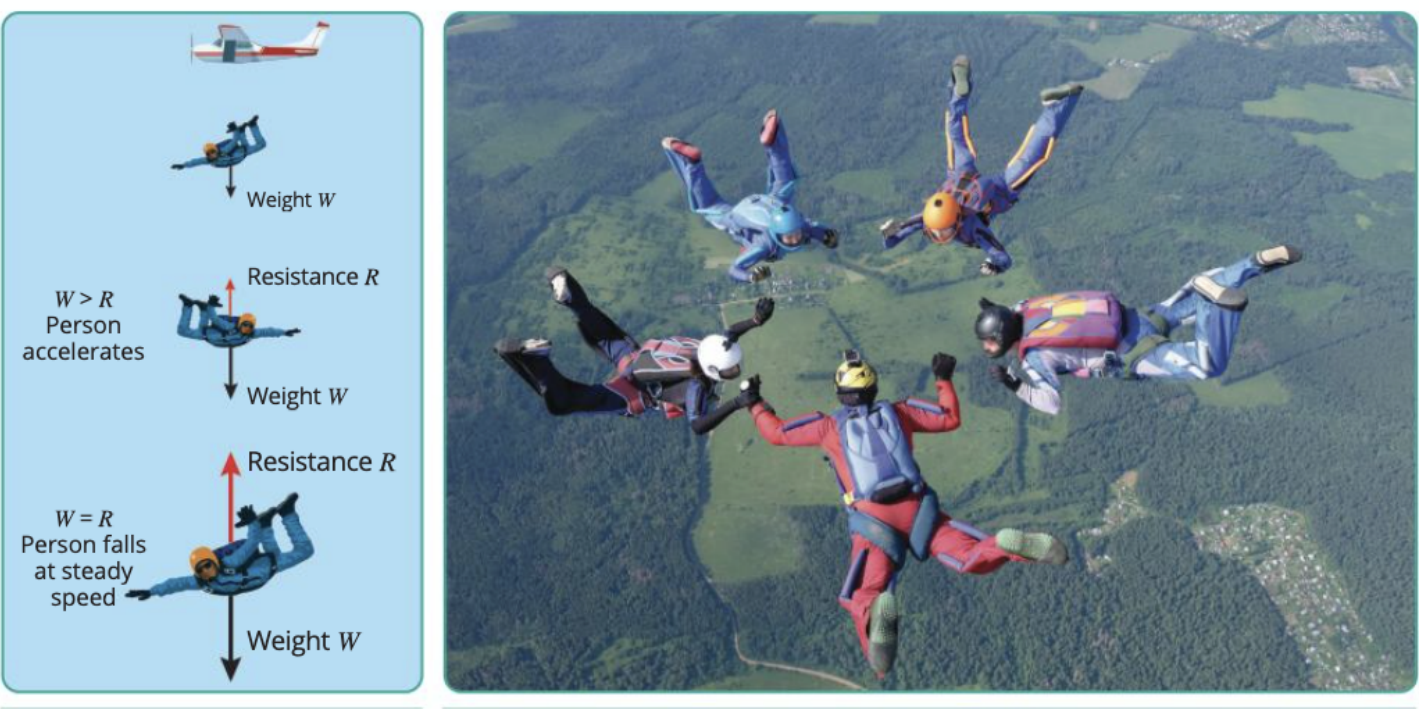
Terminal velocity
Terminal velocity occurs when a falling object reaches a constant speed. This happens when the upward force of air resistance becomes equal to the downward force of gravity (the object's weight).
Note
At Terminal Velocity:
- Weight (W) = Air resistance (R)
- Net force = 0
- Acceleration = 0
- Velocity remains constant
Skydivers demonstrate this principle perfectly. Initially, they accelerate downwards due to gravity, but as their speed increases, air resistance also increases. Eventually, these forces balance out, and they fall at terminal velocity.
Newton's third law of motion
Newton's third law reveals a fundamental truth about forces in nature.
Important
Newton's Third Law: Forces always occur in pairs. For every action force, there is an equal and opposite reaction force.
Key points about action-reaction pairs:
- The forces are equal in magnitude but opposite in direction
- The forces act on different objects
- The forces occur simultaneously
- Both forces are of the same type (e.g., both gravitational or both contact forces)

The space shuttle launch provides an excellent example of Newton's third law. The rocket engines push hot gases downwards (action), and the gases push the rocket upwards (reaction). The tremendous force of the exhaust gases being expelled downwards creates an equal upward force that lifts the shuttle.
More examples of the third law
- When you walk, you push backwards on the ground, and the ground pushes you forwards
- A car's wheels push backwards on the road, and the road pushes the car forwards
- When you sit in a chair, you push down on the chair, and the chair pushes up on you
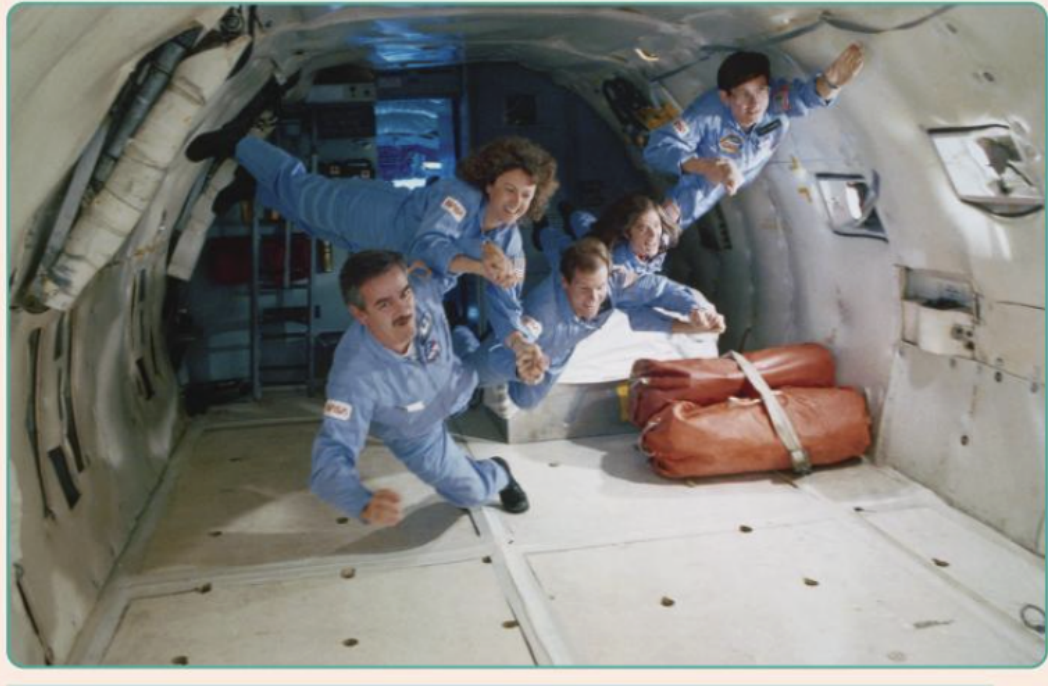
Astronauts floating in zero gravity demonstrate how Newton's laws work in space. Without the force of gravity or air resistance, objects continue moving in straight lines (first law) and small forces can produce noticeable accelerations (second law).
Worked example: momentum calculation
Example
Worked Example: Calculating Momentum
Question: A bus has a mass of 20,000 kg and is moving at 4 m s⁻¹ eastwards. Find its momentum.
Solution: Using
- east
The momentum is 80,000 kg m s⁻¹ in the eastward direction.
Exam tips
Note
Essential Exam Tips:
- Always include direction when dealing with momentum (it's a vector quantity)
- Remember that is just a special case of
- In questions about terminal velocity, look for situations where forces are balanced
- For Newton's third law, identify the two objects involved and the direction of forces
- Units are important: momentum is always in kg m s⁻¹, force in newtons (N)
Remember!
Summary
Key Points to Remember:
- Momentum is mass multiplied by velocity () and is measured in kg m s⁻¹
- Newton's first law: Objects at rest stay at rest, and objects in motion stay in motion, unless acted upon by an external force
- Newton's second law: Force equals mass times acceleration () or force equals rate of change of momentum ()
- Newton's third law: For every action, there is an equal and opposite reaction - forces always occur in pairs
- Terminal velocity occurs when air resistance equals weight, resulting in constant velocity with zero acceleration