Projectiles (Leaving Cert Physics): Revision Notes
📚Revision Notes
Projectiles
What is projectile motion?
Projectile motion occurs when an object is thrown or launched into the air and follows a curved path under the influence of gravity alone. Any object that moves through the air in this way is called a projectile. Examples include a football being kicked, a basketball being shot, or a stone being thrown.
Note
The key insight that Galileo discovered in the early 1600s was that projectile motion can be understood by breaking it down into two separate, independent motions: horizontal motion and vertical motion.
Key principles of projectile motion
Important
Independence of horizontal and vertical motion
The most important concept in projectile motion is that horizontal and vertical motions are completely independent of each other. This means:
- What happens in the horizontal direction doesn't affect the vertical motion
- What happens in the vertical direction doesn't affect the horizontal motion
- We can analyse each direction separately using different rules
Horizontal motion characteristics
For the horizontal direction:
- No forces act horizontally (ignoring air resistance)
- The horizontal velocity remains constant throughout the entire flight
- Horizontal acceleration = 0
- Distance = velocity × time
Vertical motion characteristics
For the vertical direction:
- Gravity acts downward with acceleration
- The vertical velocity changes continuously due to gravity
- We use the standard kinematic equations with (negative because gravity acts downward)
Trajectory characteristics
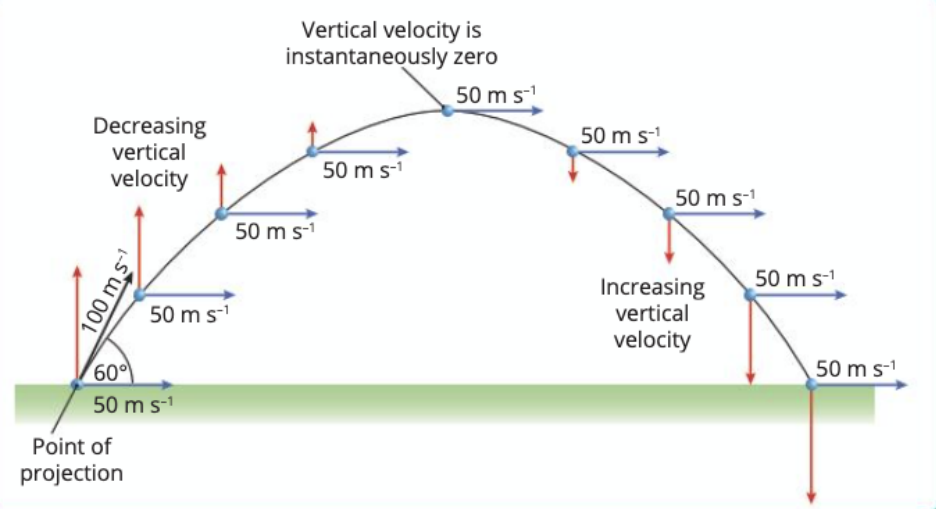
All projectiles follow a parabolic path when launched at an angle. The shape of this curve depends on the initial velocity and launch angle.
Note
Key features of the trajectory:
- At launch: Object has both horizontal and vertical velocity components
- At the peak: Vertical velocity becomes zero (but horizontal velocity remains the same)
- At landing: Vertical velocity has the same magnitude as at launch but points downward
- Throughout flight: Horizontal velocity never changes
Problem-solving approach
Step 1: Resolve the initial velocity
When a projectile is launched at an angle with initial speed , we must find the horizontal and vertical components:
- Horizontal component:
- Vertical component:
Step 2: Apply equations separately
For horizontal motion (acceleration = 0):
- (velocity stays constant)
- (distance = velocity × time)
For vertical motion (acceleration = ):
Step 3: Combine results when needed
To find the resultant velocity at any time:
- Magnitude:
- Direction:
Common calculations
Time of flight
For a projectile that lands at the same height it was launched from:
- At landing, the vertical displacement is zero
- Use:
- This gives: (ignoring at launch)
Maximum height
The highest point is reached when the vertical velocity becomes zero:
- Use:
- At maximum height:
- Therefore:
Horizontal range
The total horizontal distance travelled:
- Range = horizontal velocity × time of flight
Worked example method
Example
Worked Example: Systematic Problem-Solving Approach
When solving projectile problems, follow these steps:
- Identify what you know: initial speed, angle, time, or position
- Find the components: resolve initial velocity into horizontal and vertical parts
- Choose appropriate equations: use kinematic equations for vertical motion, simple motion equations for horizontal
- Calculate step by step: work through each component separately
- Combine if needed: find resultant velocity or direction using vector addition
Sample Calculation: If a ball is projected at 30 m s⁻¹ at 40° to the horizontal:
- Horizontal component:
- Vertical component:
- Maximum height:
Summary
Key Points to Remember:
-
Independence principle: Horizontal and vertical motions are completely separate - solve them independently then combine results
-
Horizontal motion: Velocity stays constant throughout the flight (no horizontal forces acting)
-
Vertical motion: Follows standard kinematic equations with gravity ()
-
Parabolic trajectory: All projectiles follow a curved, parabolic path when launched at an angle
-
Problem-solving strategy: Always start by resolving the initial velocity into horizontal and vertical components using trigonometry