Polarisation and Dispersion (Leaving Cert Physics): Revision Notes
📚Revision Notes
Polarisation and Dispersion
What is polarisation?
Light is a transverse electromagnetic wave, which means it vibrates perpendicular to the direction it travels. When light vibrates in all possible directions, we call it unpolarised light. However, when light vibrates in only one plane, we say it is polarised or plane-polarised.
Note
Polarised light is light with waves that are vibrating in one plane only.
When a filament light bulb produces light, electrons in the filament create electromagnetic waves that vibrate in many different directions. This makes the light unpolarised because the electric field vectors are vibrating in many different planes simultaneously.
How polarising filters work
Polarising filters are special materials that can control which direction light waves can pass through. Think of them like a fence with vertical slats - only waves vibrating vertically can pass through.
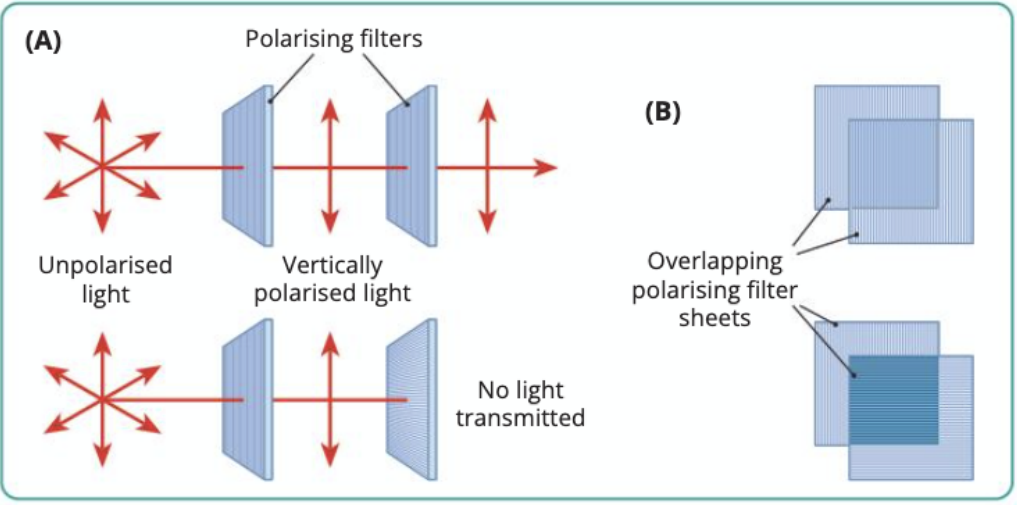
When unpolarised light hits a polarising filter, only the light waves vibrating in one particular direction can pass through. The filter blocks all the waves vibrating in other directions. This process transforms unpolarised light into polarised light.
Important
Key principle: If you place two polarising filters at right angles to each other (perpendicular), ideally no light gets through the second filter. This happens because the first filter only lets through vertically polarised light, but the second filter only allows horizontally polarised light to pass - since there's no horizontally polarised light left, no light gets through.
Note
This demonstrates that light behaves as a transverse wave, because only transverse waves can be polarised in this way.
Polarisation by reflection
When light reflects off glass, water, or other surfaces, the reflected light becomes partially plane-polarised. This means that reflected light has more waves vibrating in one direction than in others.
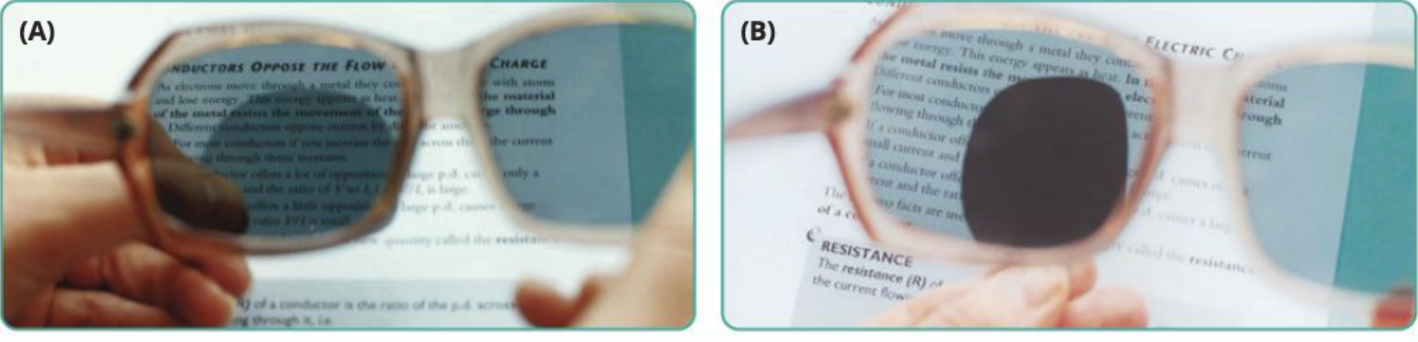
Polaroid filters take advantage of this property. These are materials that only allow light vibrating in one direction to pass through, effectively blocking much of the reflected light.
Note
Practical Applications of Polarising Filters:
- Polaroid sunglasses reduce glare by blocking horizontally polarised reflected light
- Camera filters can reduce reflections from windows and water surfaces
- Car windscreens sometimes use polarising filters to reduce glare
When you hold a piece of polaroid material in front of polaroid sunglasses and rotate it by 90°, ideally no light gets through because the two polarising directions are perpendicular to each other.
Dispersion
Dispersion is the process where white light gets separated into its component colours. This happens because different wavelengths (colours) of light are refracted by different amounts when passing through materials.
Dispersion using prisms
When white light passes through a triangular glass prism, it spreads out into a rainbow of colours. This occurs because the refractive index of glass varies slightly for different wavelengths.
.webp)
The refractive index is different for each wavelength, so each colour is refracted through a different angle. Red light is refracted the least and violet light is refracted the most. This is why red appears at one end of the spectrum and violet at the other.
Important
Important: When light is dispersed by a prism, red is refracted the least and violet the most. This creates the familiar rainbow pattern we see.
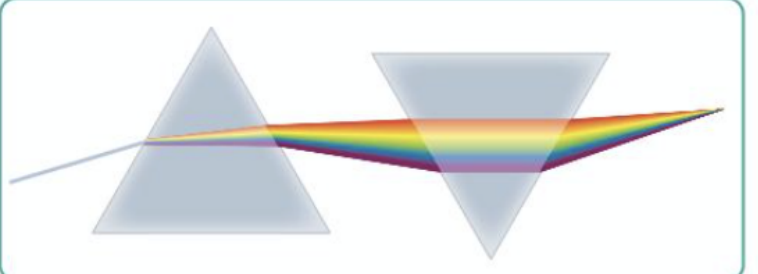
You can recombine the dispersed colours back into white light using a second prism positioned upside down relative to the first one.

We can observe this same effect in nature when sunlight passes through water droplets in the atmosphere, creating rainbows after rain showers.
Dispersion using diffraction gratings
A diffraction grating consists of many thousands of parallel lines ruled very close together (typically 400-600 lines per millimetre). When white light passes through a diffraction grating, it creates multiple spectra (orders) at different angles.
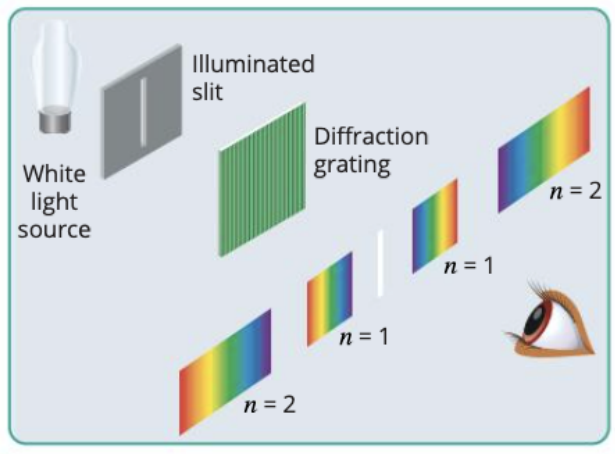
The grating equation helps us calculate the angles at which different colours appear:
Where:
- = spacing between grating lines
- = angle of diffraction
- = order of diffraction (1, 2, 3...)
- = wavelength of light
Example
Worked Example: Calculating Diffraction Angles
For a diffraction grating with 400 lines per mm:
For violet light ( m) in the first order ():
For red light ( m):
This shows that red light deviates more than violet when dispersed by a diffraction grating, which is opposite to what happens with a prism.
Key differences between prism and grating dispersion
| Property | Prism Dispersion | Grating Dispersion |
|---|---|---|
| Red light deviation | Least deviation | Most deviation |
| Violet light deviation | Most deviation | Least deviation |
| Number of spectra | One spectrum | Multiple spectra (orders) |
| Brightness | Bright spectrum | Dimmer but purer spectra |
Summary
Key Points to Remember:
- Polarised light vibrates in one plane only, while unpolarised light vibrates in all directions
- Polarising filters only allow light vibrating in one specific direction to pass through
- When two polarising filters are perpendicular, no light gets through - this demonstrates light is a transverse wave
- Dispersion separates white light into its component colours due to different refractive indices
- With prisms: red bends least, violet bends most
- With diffraction gratings: red deviates most, violet deviates least
- The grating equation helps calculate diffraction angles for different wavelengths