Basic Properties of Magnets (Leaving Cert Physics): Revision Notes
📚Revision Notes
Basic Properties of Magnets
Magnets are fascinating objects that have been known to humans for over 2400 years. The ancient Greeks discovered that a particular type of iron ore, called lodestone, could attract small pieces of iron. Today, we understand much more about how magnets work and use them in countless applications.
Note
The word "magnet" comes from the ancient Greek region of Magnesia, where lodestone was first discovered. This natural magnetic material was one of humanity's first encounters with magnetism.
What makes a material magnetic?
When we talk about magnetic materials, we're referring to ferromagnetic substances. These are materials that are strongly attracted to magnets and can become magnetised themselves. The main ferromagnetic materials you need to know are:
- Iron (Fe)
- Steel (an alloy containing iron)
- Nickel (Ni)
- Cobalt (Co)
Other materials like wood, plastic, copper, and aluminium are non-magnetic and show no attraction to magnets.
Important
Common Mistake Alert: Students often think that all metals are magnetic. This is not true! Only ferromagnetic materials (iron, steel, nickel, cobalt) are attracted to magnets. Many metals like copper, aluminium, and gold are completely non-magnetic.
The five basic properties of magnets
Property 1: A magnet attracts certain materials to it
Magnets only attract ferromagnetic materials. You can test this by bringing a bar magnet close to various objects - it will attract iron nails, steel paper clips, and nickel coins, but will have no effect on wooden pencils or plastic rulers.
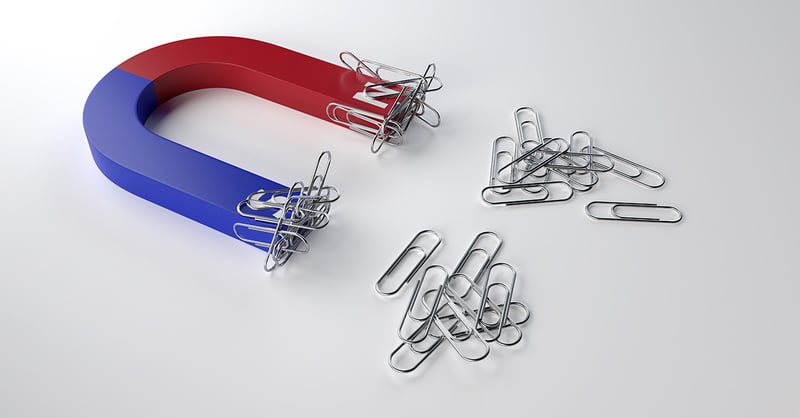
This image shows paper clips being attracted to a bar magnet, clearly demonstrating this fundamental property.
Example
Simple Test: Identifying Magnetic Materials
Take a bar magnet and test these common items:
- Paper clip (steel) → Attracted
- Coin (check if it contains nickel) → May be attracted
- Pencil (wood and graphite) → Not attracted
- Plastic ruler → Not attracted
- Copper wire → Not attracted
This test helps you distinguish between magnetic and non-magnetic materials.
Property 2: A bar magnet is strongest at each end
The regions of greatest magnetic strength are located at the two ends of a bar magnet. These regions are called magnetic poles. If you dip a bar magnet into a container of iron filings or drawing pins, you'll notice that most of them stick to the ends rather than the middle.
The middle section of a bar magnet shows much weaker magnetic effects, while the poles exhibit maximum attraction force.
Note
The magnetic field strength decreases significantly towards the middle of a bar magnet. This is why compasses are designed to use the ends of the magnetic needle, where the magnetic effect is strongest.
Property 3: If a bar magnet is suspended by a piece of thread, it will line up approximately north-south
This is one of the most important properties of magnets and explains how compasses work. When a bar magnet is freely suspended (hung by a thread so it can rotate), it will always settle with one end pointing roughly towards the Earth's magnetic north pole.
- The pole that points north is called the north-seeking pole or simply the north pole
- The pole that points south is called the south-seeking pole or simply the south pole
Important
Key Concept: This behaviour occurs because the Earth itself acts like a giant magnet, with magnetic poles near (but not exactly at) the geographical North and South poles. The Earth's magnetic north pole is actually located in northern Canada, not at the geographical North Pole.
Property 4: Like poles repel and unlike poles attract
This is perhaps the most famous property of magnets. When you bring two magnets close together:
- North pole + North pole = Repulsion (they push apart)
- South pole + South pole = Repulsion (they push apart)
- North pole + South pole = Attraction (they pull together)
The force between magnetic poles gets stronger as the magnets are moved closer together and weaker as they are moved further apart. This force can act through non-magnetic materials like paper, glass, or wood.
Example
Demonstration: Testing Magnetic Forces
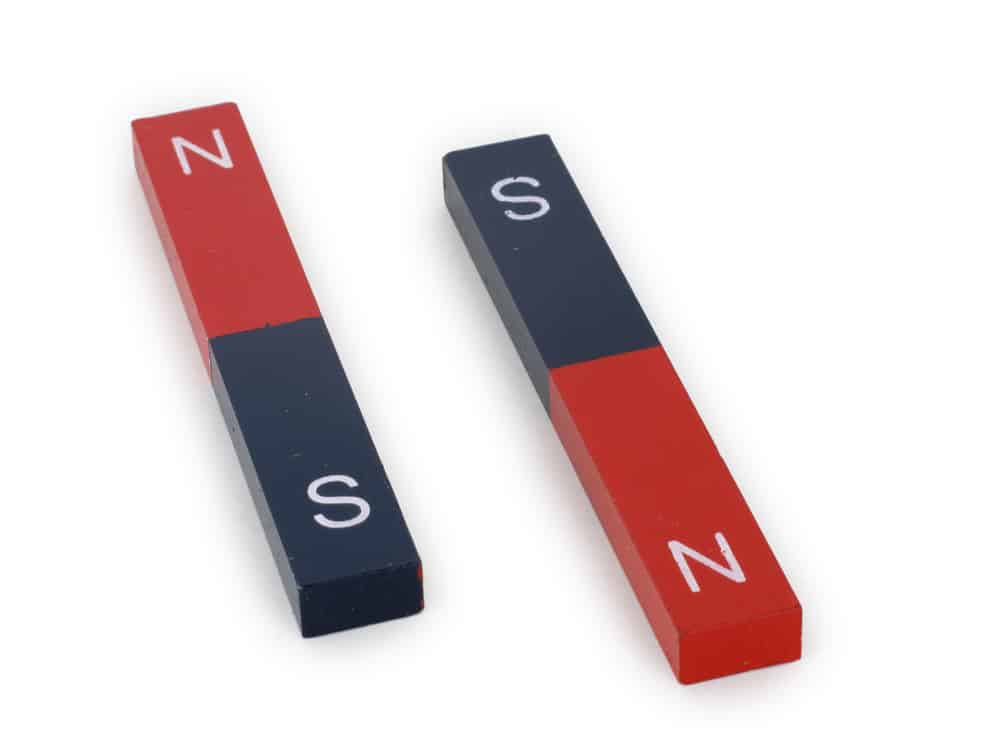
Try this with two bar magnets:
- Mark the north and south poles clearly
- Bring two north poles together → Feel the repulsive force pushing them apart
- Bring north and south poles together → Feel the attractive force pulling them together
- Try with a piece of paper between them → The force still acts through the paper!
Property 5: A magnet causes ferromagnetic material brought near or touching it to become magnetised
This process is called induced magnetism. When you bring a magnet close to a piece of iron or steel, that material temporarily becomes a magnet itself. This explains why a magnet can attract a chain of paper clips - each clip becomes magnetised and attracts the next one.
There are two types of induced magnetism:
- Temporary magnets: Materials like soft iron that lose their magnetism quickly when the magnet is removed
- Permanent magnets: Materials like steel that retain their magnetism for a long time after the inducing magnet is removed
Important
Understanding Induced Magnetism: The induced magnet always has its poles arranged so that the pole nearest to the inducing magnet is opposite to the inducing magnet's pole. This ensures attraction between them, following the rule that unlike poles attract.
Key definitions
Summary
Essential Terms to Remember:
Magnet: An object that attracts ferromagnetic materials and has two poles.
Magnetic field: The region around a magnet where its magnetic effects can be detected.
Magnetic pole: The regions of strongest magnetism at the ends of a bar magnet.
Ferromagnetic: Materials that are strongly attracted to magnets (iron, steel, nickel, cobalt).
Induced magnetism: The process by which a ferromagnetic material becomes temporarily or permanently magnetised when near a magnet.
Practical applications
Understanding these basic properties helps explain how many everyday devices work:
Note
Compass Navigation: Compasses use Property 3 to find direction. The magnetised needle aligns with Earth's magnetic field, with the north-seeking pole pointing towards magnetic north.
Note
Magnetic Door Catches: These use Property 1 to hold doors closed. The magnet attracts the ferromagnetic strike plate, keeping the door securely shut until manually opened.
- Magnetic separators in recycling plants use Property 1 to separate iron from other materials
- Electromagnets in motors and generators rely on these fundamental properties
Remember!
Summary
Key Points to Remember:
- Magnets only attract ferromagnetic materials - iron, steel, nickel, and cobalt
- Magnetic strength is greatest at the poles (ends of the magnet)
- Freely suspended magnets align north-south, making them natural compasses
- Like poles repel, unlike poles attract - this is the fundamental rule of magnetic interaction
- Magnets can induce magnetism in ferromagnetic materials, creating temporary or permanent magnets