Pressure Due to a Liquid (Leaving Cert Physics): Revision Notes
📚Revision Notes
Pressure Due to a Liquid
When you dive to the bottom of a swimming pool, you can feel the water pressing against your eardrums. This sensation demonstrates an important physics principle: liquids exert pressure, and this pressure increases with depth. Understanding how liquids create pressure is crucial for explaining many everyday phenomena, from how submarines work to why dams are built with thick bases.
Note
The pressure you feel when diving underwater is a perfect example of liquid pressure in action. The deeper you go, the more water is above you, creating greater pressure on your body.
What is liquid pressure?
Liquid pressure is the force per unit area that a liquid exerts on any surface in contact with it. This pressure arises because liquids have weight, and the weight of liquid above any point creates a downward force. When this weight is distributed over an area, it creates pressure.
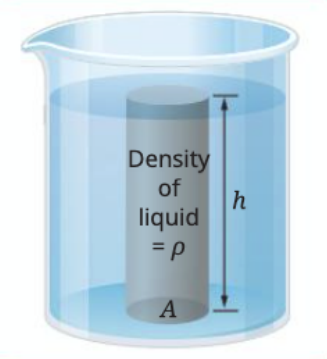
The diagram above shows how the weight of liquid in a container creates pressure at the base. The liquid column above any point contributes to the total pressure at that point.
The pressure formula for liquids
Important
The pressure created by a column of liquid can be calculated using the fundamental formula:
Where:
- = pressure (measured in Pascal, Pa)
- = density of the liquid (kg/m³)
- = acceleration due to gravity (9.8 m/s²)
- = height or depth of the liquid column (m)
This formula tells us that liquid pressure depends on three factors: how dense the liquid is, how deep you go, and the strength of gravity. Notice that the pressure does not depend on the shape of the container or the total amount of liquid - only the vertical height of liquid above the point matters.
Key properties of liquid pressure
Pressure increases with depth
One of the most important characteristics of liquid pressure is that it increases linearly with depth. This means that if you double the depth, you double the pressure. The relationship is direct and predictable.
Pressure acts in all directions
At any given depth in a liquid, the pressure is the same in all directions. This means the liquid pushes sideways and upwards with the same force as it pushes downwards. This property explains why submarines need to be designed to withstand pressure from all directions, not just from above.
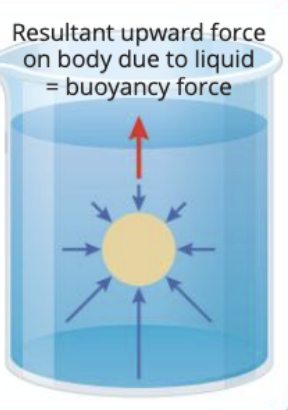
The diagram above illustrates how pressure forces act on a submerged object from all directions, with the net result being an upward buoyancy force.
Note
The equal pressure in all directions is why water spurts out horizontally from holes in the side of a container with the same force as it would flow downward from a hole in the bottom at the same depth.
Pressure differences in liquids
When we need to find the pressure difference between two points at different depths in the same liquid, we can use:
Where is the vertical distance between the two points. This formula is particularly useful when solving problems involving objects submerged at different depths.
Worked example: calculating liquid pressure
Example
Worked Example: Finding Pressure at the Base of a Water Container
Suppose a bucket contains 8 kg of water with a base area of 0.4 m². To find the pressure at the base due to the water:
Step 1: Find the height of water
- Volume of water = mass ÷ density = 8 kg ÷ 1000 kg/m³ = 0.008 m³
- Height = Volume ÷ Area = 0.008 m³ ÷ 0.4 m² = 0.02 m
Step 2: Calculate pressure using
This example shows how the weight of water creates measurable pressure at the container's base.
Connection to buoyancy
The variation of pressure with depth in liquids leads directly to the concept of buoyancy or upthrust. When an object is submerged in a liquid, the pressure at the bottom of the object is greater than the pressure at the top. This pressure difference creates a net upward force called the buoyancy force.
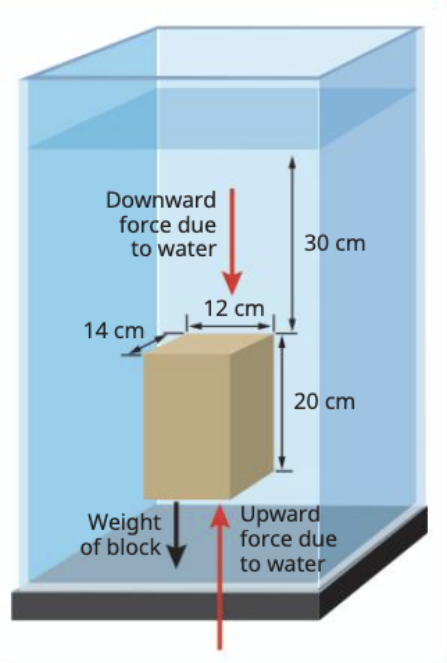
The diagram shows how pressure differences on the top and bottom surfaces of a submerged block create the upward buoyancy force that can cause objects to float.
Real-world applications
Understanding liquid pressure helps explain many important phenomena:
- Dam design: Dams are built thicker at the bottom because water pressure increases with depth
- Submarine construction: Submarines must withstand enormous pressures at great depths
- Water towers: These work by using the pressure created by elevated water to deliver water to homes
- Ship floating: The pressure differences in water create buoyancy forces that keep ships afloat
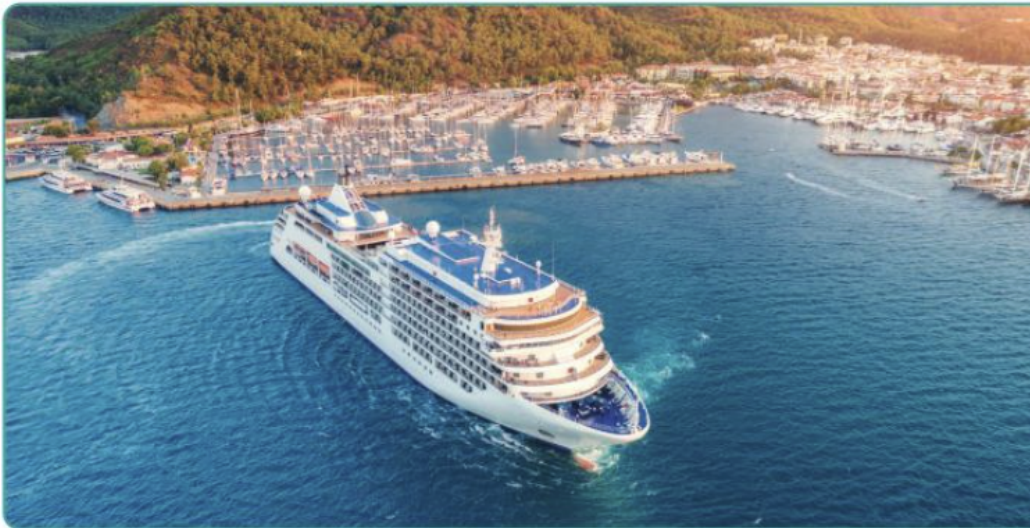
Large ships like cruise liners demonstrate how buoyancy forces, created by pressure differences in water, can support massive objects.
Note
The impressive engineering of modern ships relies entirely on the principles of liquid pressure and buoyancy. A cruise ship can weigh thousands of tonnes yet float because the buoyancy force created by water pressure differences exactly balances its weight.
Exam tips
Important
When solving liquid pressure problems:
- Always identify what type of pressure you're calculating (due to liquid column, pressure difference, or total pressure including atmosphere)
- Make sure your units are consistent (density in kg/m³, height in metres, pressure in Pascals)
- Remember that gives you the pressure due to the liquid column only
- For problems involving floating or sinking, consider both the weight of the object and the buoyancy force
Summary
Key Points to Remember:
- Liquid pressure formula: where is pressure, is density, is gravity, and is depth
- Pressure increases with depth: The deeper you go in a liquid, the greater the pressure becomes
- Pressure acts equally in all directions: At any depth, liquid pressure pushes with equal force in all directions
- Pressure differences create buoyancy: The variation in pressure with depth creates upward forces on submerged objects
- Applications are everywhere: From submarine design to why ships float, liquid pressure principles explain many real-world phenomena