Pressure in Gases and Atmospheric Pressure (Leaving Cert Physics): Revision Notes
📚Revision Notes
Pressure in Gases and Atmospheric Pressure
Understanding gas pressure
Just like liquids, gases can also create pressure on surfaces around them. When we think about gas pressure, it's helpful to understand that the same fundamental principle applies as with liquids - the formula works for gases too, as long as the density of the gas stays constant.
Note
The key similarity between liquids and gases is that both follow the same pressure principles, making it easier to understand gas behaviour if you already understand liquid pressure.
Gas pressure has several important characteristics that make it unique:
- Pressure increases with depth: As you go deeper into a gas, the pressure becomes greater due to the weight of gas above
- Acts perpendicular to surfaces: Gas pressure always pushes at right angles to any surface it contacts
- Equal in all directions: At any given point in a gas, the pressure is the same regardless of which direction you measure it
However, there's an important difference between gases and liquids. The density of gases is typically much smaller than liquids, which means that unless you're dealing with very large vertical distances, the pressure differences between two points in a gas are usually so small they can be ignored. In practical terms, this means that in a container filled with gas, you can assume the pressure is essentially the same throughout.
What is atmospheric pressure?
Our planet Earth is surrounded by a layer of air called the atmosphere. This blanket of air has weight, and this weight creates what we call atmospheric pressure. Think of it as the force created by all the air above us pressing down on everything at Earth's surface.
The standard value for atmospheric pressure at sea level is 1 × 10⁵ Pa (Pascals). This is quite a significant force - imagine the weight of the entire column of air above you pressing down!
Important
The atmospheric pressure value of 1 × 10⁵ Pa at sea level is a fundamental constant that appears frequently in physics calculations. Remember this value - it's essential for solving atmospheric pressure problems!
Scientists measure atmospheric pressure using an instrument called a barometer. This device allows weather forecasters and scientists to track changes in air pressure, which helps predict weather patterns.
How atmospheric pressure varies
Atmospheric pressure isn't constant everywhere - it changes based on several factors:
Altitude effects: As you move further away from Earth's surface, atmospheric pressure decreases. This makes sense because there's less air above you to create pressure. Mountain climbers often notice this effect as breathing becomes more difficult at high altitudes due to lower air pressure.
Weather system influences: Different weather patterns cause atmospheric pressure to rise and fall. High-pressure systems typically bring clear, stable weather, while low-pressure systems often bring clouds and storms.
Daily and seasonal variations: Even at the same location, atmospheric pressure can vary throughout the day and across different seasons.
Note
Understanding pressure variations is crucial for meteorology and aviation. Pilots must constantly monitor atmospheric pressure changes to maintain safe flight conditions and accurate altitude readings.
Practical applications and calculations
Understanding gas and atmospheric pressure helps us solve real-world problems. For example, we can calculate the force that atmospheric pressure exerts on objects using the relationship:
Where Force = Pressure × Area
This is particularly useful when determining the forces acting on surfaces exposed to atmospheric pressure, such as windows, doors, or scientific equipment.
Example
Worked Example: Force on a Window
Step 1: Identify the given information
- Window area = 2.0 m²
- Atmospheric pressure = 1 × 10⁵ Pa
Step 2: Apply the formula
Step 3: Substitute the values
Step 4: Calculate the result
This enormous force (200,000 N) shows why atmospheric pressure is so significant!
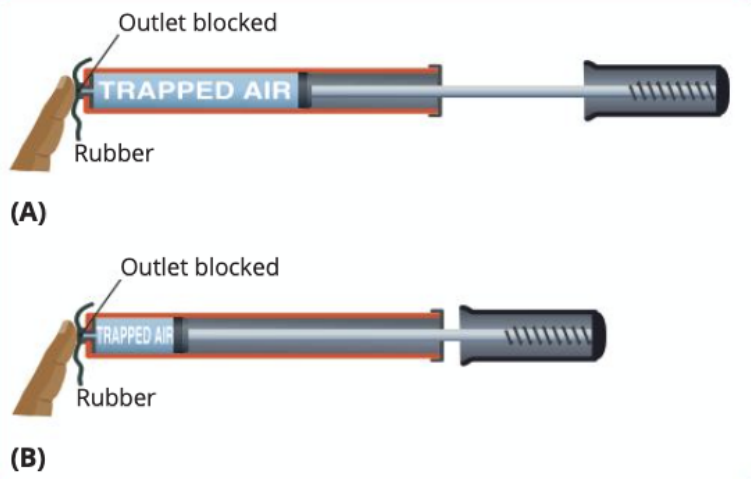
The diagram above shows how trapped air behaves when compressed in a closed system. This demonstrates important principles about gas behaviour under changing conditions, illustrating how gas pressure responds to volume changes.
Measuring and working with pressure
When solving pressure problems involving gases and the atmosphere, remember these key steps:
- Identify what type of pressure you're dealing with: Is it gas pressure in a container or atmospheric pressure acting on a surface?
- Check your units: Make sure all measurements are in consistent units (usually Pascals for pressure, square metres for area)
- Apply the correct formula: Use for gas columns or for force calculations
- Consider the context: Remember that gas pressure is usually uniform in small containers, but atmospheric pressure varies with altitude and weather
Note
Always double-check your units when working with pressure calculations. Mixing different unit systems (like using cm² instead of m² for area) is one of the most common sources of errors in pressure problems.
Summary
Key Points to Remember:
- Gas pressure acts equally in all directions and perpendicular to all surfaces
- The pressure formula applies to gases when density remains constant
- Standard atmospheric pressure at sea level is 1 × 10⁵ Pa
- Atmospheric pressure decreases with altitude and varies with weather systems
- Use to calculate the force exerted by atmospheric pressure on surfaces