Light and Vision (Leaving Cert Physics): Revision Notes
📚Revision Notes
Light and Vision
Understanding the nature of light
Light is one of the most fundamental concepts in physics, and understanding its properties is essential for grasping how we see the world around us.
Light as a form of energy
Light represents a specific type of energy that can travel through space and interact with matter. Just like other forms of energy you've studied, light energy follows the principle of conservation - it cannot be created or destroyed, only converted from one form to another.
You encounter examples of light energy conversion every day:
- Electrical to light energy: LED bulbs and laptop screens convert electrical energy into visible light
- Chemical to light energy: A burning fire releases light energy through chemical reactions
- Light to electrical energy: Solar panels use photocells to convert light energy back into electrical energy
Note
This ability to convert between energy forms makes light incredibly useful in modern technology and helps explain many natural phenomena. Understanding energy conversion is fundamental to grasping how light interacts with the world around us.
The speed of light
Light travels at an enormous speed of metres per second in a vacuum. To put this in perspective, light could circle the entire Earth more than seven times in just one second!
Note
Historical Perspective on Measuring Light Speed
Measuring this incredible speed proved challenging for early scientists. The Italian scientist Galileo Galilei attempted to measure light's speed around 1638 AD but was unsuccessful due to the limitations of his equipment. Later, in 1676, the Danish astronomer Ole Rømer became the first person to demonstrate that light has a finite speed by observing the moons of Jupiter. His calculations showed that light was not infinitely fast but travelled at approximately m s⁻¹, which was remarkably close to the actual value.
Light usually travels in straight lines
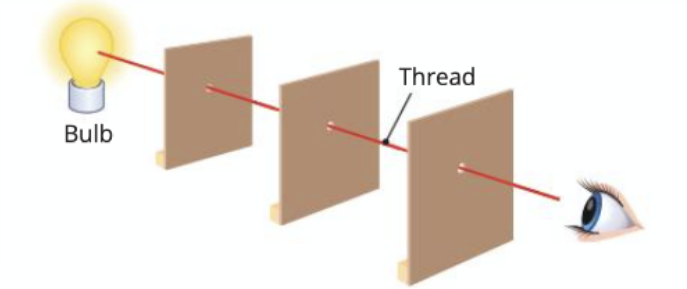
One of light's most important properties is that it typically travels in perfectly straight lines. You can observe this clearly when dust particles or smoke reveal the path of light beams, such as when sunlight streams through a window or when car headlights shine through mist.
Important
Demonstrating Straight-Line Travel
This straight-line travel can be demonstrated using simple equipment. When you align several objects with holes and shine a light through them, the light only passes through when all the holes are perfectly lined up, proving that light doesn't bend around corners on its own.
This property is crucial for understanding how mirrors, lenses, and other optical devices work.
Light rays and light beams
To help us understand and predict how light behaves, physicists use the concept of light rays and different types of light beams.
What is a light ray?
A light ray is simply a straight line that shows the direction in which light is travelling. Think of it as drawing the path that light takes as it moves from one place to another. You'll use light rays frequently when drawing diagrams to solve optics problems.
Types of light beams
Light can form different patterns depending on its source, and understanding these patterns helps explain various optical phenomena:
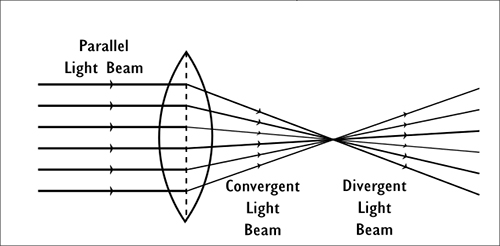
- Diverging beam: Light spreads outwards from a single point, like the light from a torch or the rays from a candle flame. The light rays get further apart as they travel away from the source.
- Converging beam: Light rays come together and meet at a single point. You might see this when light is focused through a magnifying glass or lens.
- Parallel beam: Light rays travel in the same direction without spreading out or coming together. Laser pointers produce nearly parallel beams, and sunlight is approximately parallel due to the Sun's enormous distance from Earth.
Note
Understanding these different beam types is essential for analysing how light behaves in various optical situations. When drawing ray diagrams, always consider which type of beam you're working with to accurately predict light's behaviour.
Vision and light
Understanding how we see requires exploring the relationship between light and our visual system.
Light is necessary for vision
If you were in a completely dark room with all lights switched off and no windows, you wouldn't be able to see anything - not even this textbook! This simple fact reveals a crucial principle: vision is impossible without light.
For any object to be visible, light from that object must enter your eyes. This leads us to classify objects into two important categories:
Luminous and non-luminous objects
Luminous objects produce their own light. Examples include:
- The Sun and other stars
- Burning flames and candles
- LED bulbs and light fixtures
- Lightning and electrical discharges
Non-luminous objects don't produce their own light. Instead, they can only be seen when light from another source bounces off them and enters our eyes. Most everyday objects fall into this category:
- The Moon and planets
- Books, furniture, and clothing
- People and animals
- Rocks, buildings, and trees
Important
Understanding Visibility
It's important to understand that light itself cannot be seen - you only see the objects or sources that the light comes from or bounces off.
This concept explains why we can see the Moon (it reflects sunlight) but cannot see the dark side of the Moon, and why objects become invisible in complete darkness.
How the brain uses light to perceive objects
Your visual system is remarkably sophisticated in how it processes light to create your perception of the world around you.
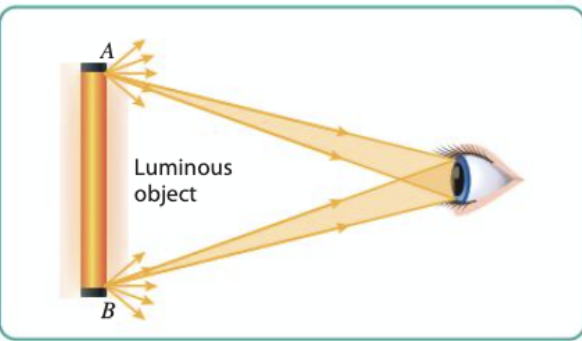
When you look at an object, light rays travel from different points on that object to your eye. Your brain interprets these light rays as having travelled in perfectly straight lines from the object. By analysing the angles between these light rays, your brain can determine:
- Where the object is located in space
- How large the object appears to be
- The object's shape and orientation
Note
The Brain's Visual Processing
This process happens automatically and almost instantaneously, allowing you to navigate and interact with your environment effectively. The brain assumes that all light has travelled in straight lines, which works perfectly well for most everyday situations.
This assumption is so fundamental that optical illusions often work by tricking your brain's interpretation of light ray directions.
Summary
Key Points to Remember:
- Light is a form of energy that travels at m s⁻¹ and can be converted to and from other energy forms
- Light usually travels in straight lines, which can be represented using light ray diagrams
- Light beams can diverge (spread out), converge (come together), or remain parallel
- Vision requires light - you cannot see anything in complete darkness
- Luminous objects produce their own light while non-luminous objects only reflect light from other sources
- Your brain interprets light rays to determine the position, size, and shape of objects in your visual field