What Is Refraction of Light? (Leaving Cert Physics): Revision Notes
📚Revision Notes
What Is Refraction of Light?
Understanding refraction
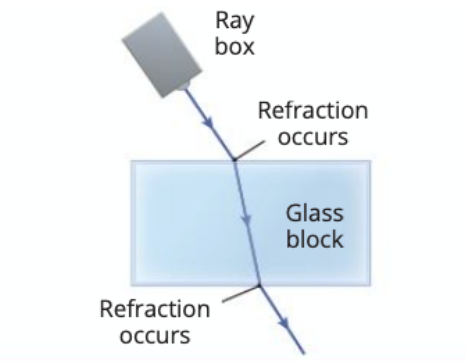
Refraction is one of the most important behaviours of light that you'll encounter in physics. Simply put, refraction is the bending of a ray of light when it travels from one medium to another. This fascinating phenomenon occurs all around us and explains many optical effects we observe in daily life.
When light travels through different materials - such as from air into glass, or from air into water - it changes direction. This change in direction is what we call refraction.
Note
The key to understanding refraction is recognising that it only occurs when light passes between different materials or media. Light travelling through a single uniform medium will continue in a straight line.
Key terms you need to know
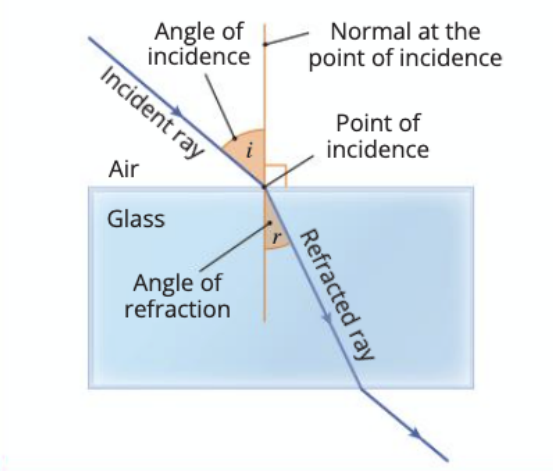
Understanding refraction requires familiarity with several important terms:
| Term | Definition |
|---|---|
| Incident ray | The ray of light falling on the boundary between two media |
| Refracted ray | The ray of light that has passed into the second medium and changed direction |
| Normal | An imaginary line drawn perpendicular to the surface at the point where light hits it |
| Angle of incidence (i) | The angle between the incident ray and the normal |
| Angle of refraction (r) | The angle between the refracted ray and the normal |
| Transparent medium | A substance through which light can travel and through which you can see clearly |
What happens during refraction?
The process of refraction depends on the optical density of the materials involved. This is a key concept to understand:
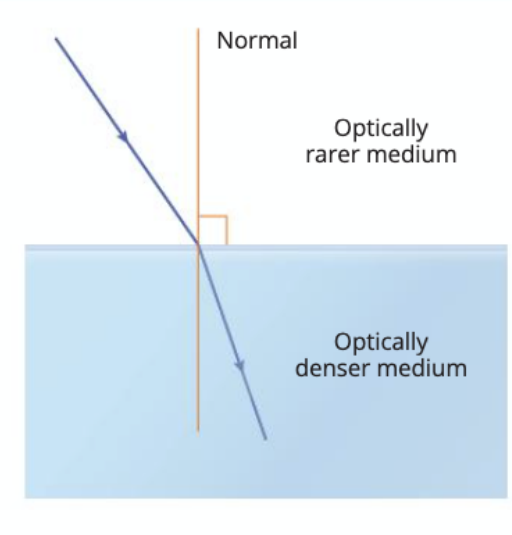
Light entering a denser medium
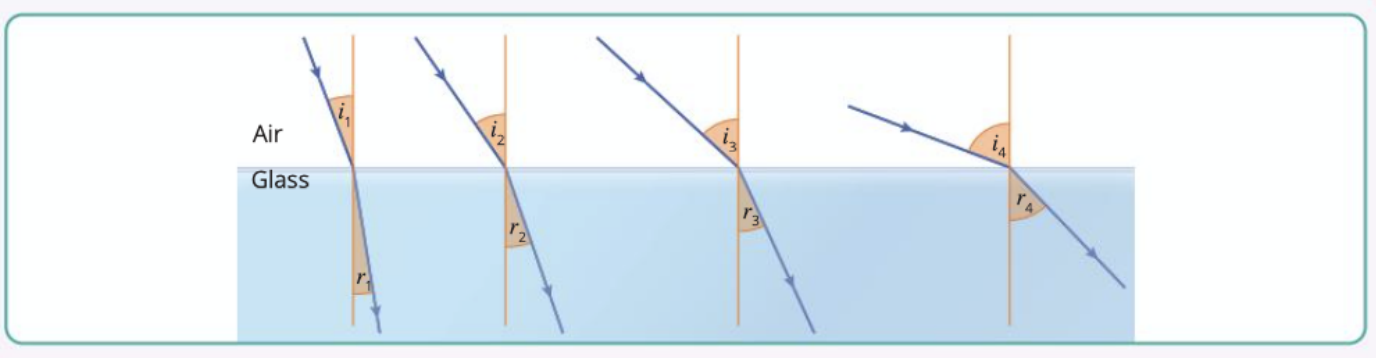
When light travels from an optically rarer medium (like air) into an optically denser medium (like glass or water), the light ray bends towards the normal. This means the angle of refraction is smaller than the angle of incidence.
Important
Key Rule 1: When light enters a denser medium, it bends towards the normal. Remember: "Dense = towards"
Light entering a rarer medium
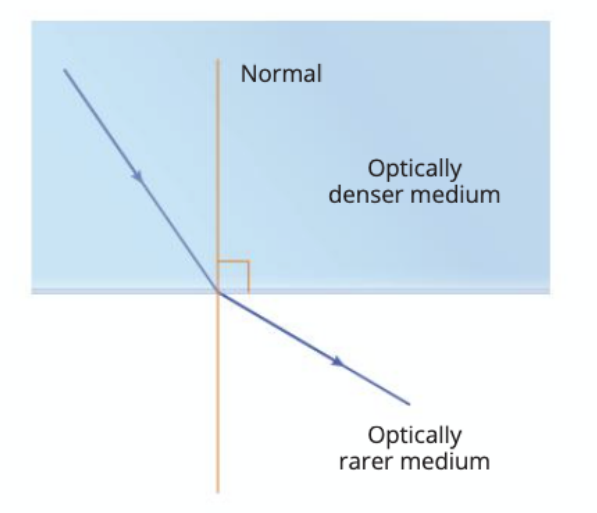
When light travels from an optically denser medium into an optically rarer medium, the light ray bends away from the normal. Here, the angle of refraction is larger than the angle of incidence.
Important
Key Rule 2: When light enters a rarer medium, it bends away from the normal. Remember: "Rare = away"
Special case: No refraction
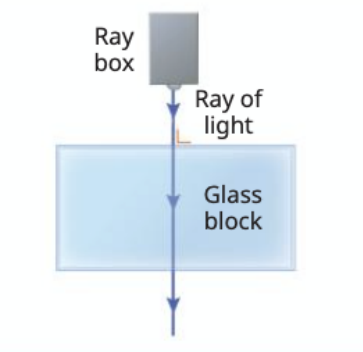
There's one important exception to remember: when light strikes a surface at a right angle (perpendicular to the surface), no refraction occurs. The light passes straight through without bending.
Note
This special case occurs because the light ray is already aligned with the normal, so there's no angle to change, regardless of the optical densities of the media.
The relationship between angles
As you increase the angle of incidence, the angle of refraction also increases, but they don't increase at the same rate. This relationship is not proportional, which is an important point for your exams.
Examples of refraction in everyday life
Refraction creates many interesting effects that you can observe around you:
Example
Everyday Examples of Refraction:
-
Swimming pools: The water appears less deep than it actually is because light from the bottom of the pool bends when it exits the water
-
Objects underwater: Fish, coins, or other objects in water appear closer to the surface than they really are
-
Thick glass blocks: Writing or objects viewed through thick glass appear closer to the top surface than they actually are
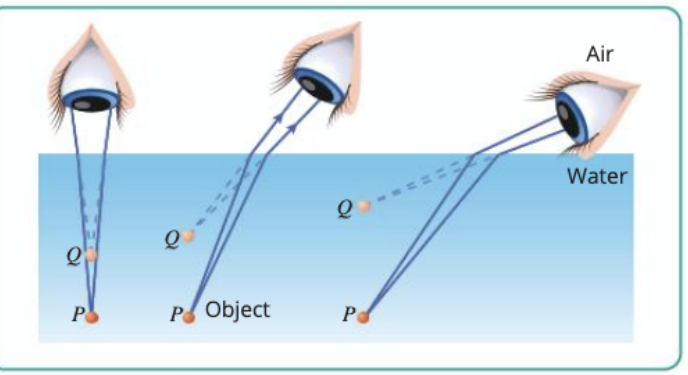
These effects occur because refraction creates virtual images - the objects appear to be in different positions than where they actually are located.
Why does refraction happen?
Refraction occurs because light travels at different speeds in different media. When light enters a new medium, it either speeds up or slows down, causing the change in direction. The denser the medium, the slower light travels through it.
Note
Think of refraction like a car wheel rolling from pavement onto sand - one side of the wheel slows down before the other, causing the wheel to turn. Similarly, when light enters a different medium, it changes speed and direction.
Summary
Key Points to Remember:
- Refraction is the bending of light when it passes from one medium to another
- Light bends towards the normal when entering a denser medium (like air to glass)
- Light bends away from the normal when entering a rarer medium (like glass to air)
- No refraction occurs when light hits a surface at a right angle
- Refraction explains why objects underwater appear closer than they really are