Radioactive Emissions (Leaving Cert Physics): Revision Notes
📚Revision Notes
Radioactive Emissions
Detecting nuclear radiation
Understanding how to detect radioactive emissions is crucial for both scientific research and safety monitoring. There are several methods available, each with specific advantages for different situations.
The Geiger-Müller tube
The Geiger-Müller (GM) tube is one of the most common devices for detecting the presence of radioactivity through the ionisation it produces. This versatile instrument can also measure the activity of radioactive samples.
The GM tube operates using a simple but effective principle:
- Detection mechanism: Radiation passes through a thin mica window into argon gas at low pressure
- Ionisation process: The radiation ionises argon atoms, creating positive argon ions and negatively charged electrons
- Electrical response: When a high voltage is applied between the wire anode and cylindrical cathode, electrons move rapidly towards the anode
- Signal amplification: These electrons collide with other argon atoms, producing an avalanche of electrons that creates a measurable pulse of current
- Counting system: Each radiation event produces a distinct pulse that can be counted using electronic equipment like a ratemeter
Note
This detection method makes the GM tube excellent for measuring radiation levels and determining the activity of radioactive sources. The GM tube's ability to detect individual radiation events makes it particularly valuable for both qualitative detection and quantitative measurement.
The solid-state detector
The solid-state detector represents a more modern approach to radiation detection, using semiconductor technology rather than gas-filled tubes.
Key features of solid-state detectors include:
- Construction: Built around a reverse-biased p-n junction connected to counting equipment such as a ratemeter
- Detection process: When nuclear radiation strikes the depletion layer, it creates electron-hole pairs
- Signal generation: These charge carriers move under the influence of applied voltage, forming a pulse of current
- Amplification: The signal is amplified before being sent to a pulse counter for measurement
Note
Solid-state detectors offer advantages in terms of reliability and precision for many radiation detection applications, making them increasingly popular in modern radiation monitoring systems.
Artificial radioactivity
Scientists can create radioactive isotopes artificially through nuclear bombardment processes. This involves bombarding stable isotopes with neutrons, which are then captured by atomic nuclei. The process typically occurs in nuclear reactors and produces isotopes that are widely used in medicine and industry.
Many artificially produced isotopes have practical applications in medical diagnosis, treatment, and industrial processes, making this an important aspect of nuclear technology.
Safety implications of radioactive emissions
Understanding ionising radiation
Ionising radiation refers to any form of radiation capable of knocking outer electrons from atoms. This process creates ions and can cause significant biological damage when absorbed by human tissue.
The extent of radiation damage depends on several critical factors:
- Type of radiation (alpha, beta, gamma, X-rays, or neutrons)
- Activity of the radioactive source producing the radiation
- Duration of exposure to the radiation
- Type of body tissue being irradiated (some tissues are more sensitive than others)
Health effects of radiation exposure
Ionising radiation can cause both immediate and long-term health problems:
Short-term effects from high radiation doses:
- Radiation sickness symptoms appearing within hours
- Vomiting, diarrhoea, and fever
- Severe cases can be fatal
- These effects occur when radiation damages sufficient molecules in cells to kill them
Long-term effects from lower doses:
- Increased cancer risk, particularly leukaemia
- Genetic damage that may affect reproductive cells
- These effects may not appear for years after exposure
- Even low doses can cause DNA damage leading to genetic changes and various cancers
Precautions when using ionising radiations
Important
Critical Safety Protocols
Proper safety protocols are essential when working with radioactive materials. Never compromise on these safety measures:
- Monitor exposure: Check the dose rate before using any radiation source and measure exposure during procedures
- Minimise time: Reduce the time spent working with radioactive sources
- Protective equipment: Wear appropriate clothing including gloves, glasses, and protective coats
- Source security: Ensure radioactive sources are properly shielded when not in use
- Distance: Maintain maximum possible distance from radiation sources
- Eating restrictions: Never eat, drink, or smoke near unshielded radioactive sources
- Handling tools: Use tongs or other tools for handling sources
- Storage: Keep sources securely locked away and shielded with lead when not in use, away from people
Background radiation
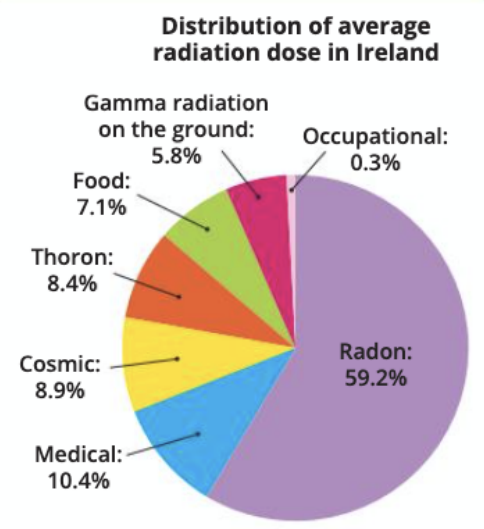
We are constantly exposed to low levels of ionising radiation called background radiation. This radiation comes from both natural and human-made sources and represents the baseline level of radiation present everywhere on Earth.
Natural sources (accounting for about 87% of background radiation)
Outer space: High-energy cosmic radiation continuously reaches Earth from outer space. The atmosphere provides some protection, but the amount of cosmic radiation exposure increases with altitude. Air travellers and airline crew receive higher doses due to prolonged time at high altitudes.
Rocks in the Earth's crust: Naturally occurring radioactive elements like uranium and thorium exist in rocks and soil. These elements and their decay products contribute to background radiation levels. The concentration varies significantly by geographical location.
Note
Radon gas: This radioactive gas represents the largest single source of background radiation exposure, accounting for 59.2% of the average dose in Ireland. Radon comes from uranium decay in rocks and soil, particularly granite. It can accumulate in buildings, especially those with poor ventilation or floors not sealed from ground contact. In Ireland, granite regions pose particular risks for elevated radon levels.
Food and drink: Natural radioactive substances present in food and water contribute to internal radiation exposure. The amounts are generally very small but represent a constant, low-level source.
Human-made sources
Human activities contribute additional radiation to the background level:
Medical sources: Diagnostic procedures and treatments expose people to ionising radiation. Common examples include dental X-rays, chest X-rays, mammography for breast cancer detection, CT scans, and angiocardiopathy for heart conditions. Medical radiation accounts for 10.4% of average exposure in Ireland, though the health benefits often far outweigh the risks.
Nuclear weapons testing: Past atmospheric nuclear weapons testing has contributed to background radiation, though this has decreased significantly since atmospheric testing was largely discontinued.
Nuclear accidents: Accidents at nuclear facilities can release radioactive materials into the environment, contributing to background radiation levels.
Nuclear power plants: Normal operation of nuclear power facilities contributes minimally to background radiation.
Demonstrating background radiation
Scientists can prove that background radiation exists through careful experimental measurement.
Example
Worked Example: Experimental Demonstration of Background Radiation
To show that background radiation is real and measurable:
Step 1: Equipment setup Use a GM tube connected to a ratemeter as shown in experimental diagrams
Step 2: Initial preparation Switch on the ratemeter and allow the GM tube to warm up for several minutes
Step 3: Baseline measurement Set the high-voltage supply to its lowest value and allow the tube to reach operating voltage
Step 4: Operating conditions Set the tube to its proper operating voltage and adjust the integrating time to 25 seconds on the ratemeter
Step 5: Data collection Measure and record the background count rate
Step 6: Pattern observation Note how the count rate varies with time, demonstrating the random nature of background radiation
Result: This experiment clearly shows that radiation is detectable even without any artificial radioactive sources present, confirming the existence of natural background radiation.
Summary
Key Points to Remember:
- Detection methods: GM tubes and solid-state detectors work by measuring ionisation caused by radiation
- Safety first: Always follow proper precautions including minimising exposure time, maximising distance, and using protective equipment
- Background radiation: We're constantly exposed to natural radiation from cosmic rays, radon gas (the biggest source), rocks, and food
- Health effects: Radiation can cause immediate radiation sickness at high doses or long-term cancer risks at lower doses
- Human sources: Medical procedures and past nuclear testing add to natural background radiation levels