Vectors and Scalars (Leaving Cert Physics): Revision Notes
📚Revision Notes
Resolving a Vector Into Perpendicular Components
What is vector resolution?
Vector resolution is the process of breaking down a single vector into two or more component vectors that, when combined, produce the original vector. This is essentially the reverse of finding a resultant vector using the parallelogram law.
Note
When we resolve a vector into perpendicular components, we express the original vector in terms of two other vectors that are at right angles (90°) to each other. This is incredibly useful in physics because it allows us to analyse motion and forces in separate, independent directions.
Understanding perpendicular components
Imagine you're pulling a suitcase at an angle. Your pulling force can be thought of as having two effects:
- A horizontal component that moves the suitcase forwards
- A vertical component that tries to lift the suitcase upward
These two components are perpendicular to each other, meaning they act at right angles. When combined using vector addition, they recreate your original pulling force.
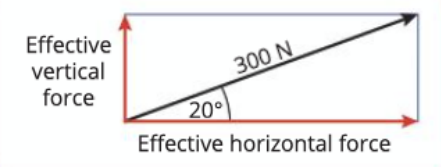
The beauty of perpendicular components is that you can choose any pair of perpendicular directions to resolve your vector into. However, horizontal and vertical directions are most commonly used because they align with our everyday experience of motion.
Mathematical approach using trigonometry
To calculate the magnitude of perpendicular components, we use trigonometric functions. Consider a vector of magnitude r making an angle θ with the horizontal:
Horizontal component:
Vertical component:
Note
These formulas come from basic trigonometry in a right-angled triangle, where:
- The hypotenuse is the original vector (magnitude r)
- The adjacent side is the horizontal component
- The opposite side is the vertical component
Remember SOH CAH TOA - Cosine is Adjacent over Hypotenuse, Sine is Opposite over Hypotenuse.
Step-by-step method for resolving vectors
When resolving any vector into perpendicular components, follow these steps:
- Draw the vector with its correct magnitude and direction
- Choose your perpendicular directions (usually horizontal and vertical)
- Complete the rectangle with the vector as the diagonal
- Identify the angle the vector makes with one of your chosen directions
- Apply trigonometry to calculate component magnitudes
- Assign correct directions to each component (positive/negative, up/down, left/right)
Worked examples
Example
Worked Example 1: Force on an inclined plane
A stone weighing 50 N rests on a roof inclined at 20° to the horizontal. Let's find the components of the stone's weight parallel and perpendicular to the roof.
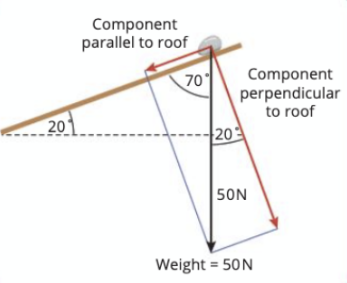
Solution:
- Component perpendicular to roof = N
- Component parallel to roof = N
The perpendicular component presses the stone against the roof, while the parallel component tries to make it slide down.
Example
Worked Example 2: Pendulum system
A pendulum bob weighing 200 N hangs at 50° to the vertical. Find the components parallel and perpendicular to the pendulum string.
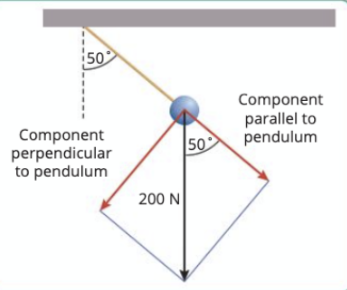
Solution:
- Component parallel to pendulum = N
- Component perpendicular to pendulum = N
The parallel component acts along the string (creating tension), while the perpendicular component causes the pendulum to swing.
Key formulas and relationships
For any vector with magnitude r at angle θ to the horizontal:
| Component | Formula | Description |
|---|---|---|
| Horizontal | Adjacent to angle θ | |
| Vertical | Opposite to angle θ |
Important
Important notes:
- Always identify which angle you're using and measure it from the correct reference line
- Components can be positive or negative depending on direction
- The original vector magnitude:
- The angle of the resultant:
Applications in physics
Vector resolution is essential for analysing:
- Forces on inclined planes - separating weight into components parallel and perpendicular to the surface
- Projectile motion - breaking initial velocity into horizontal and vertical components
- Equilibrium problems - analysing forces in different directions independently
- Pendulum motion - understanding forces along and across the string
Exam tips
Note
Exam Success Tips:
- Always draw a clear diagram showing the vector and its components
- Label all angles and forces clearly
- Remember that sine and cosine values depend on which angle you choose to measure from
- Check your answers make sense - components should be smaller than the original vector
- Use the mnemonic SOH CAH TOA to remember trigonometric ratios
Summary
Key Points to Remember:
-
Vector resolution means breaking a single vector into two perpendicular components that combine to give the original vector
-
Key formulas: Horizontal component = , Vertical component =
-
Choose your angle carefully - measure from the horizontal or vertical as appropriate for the problem
-
Components are independent - you can analyse motion or forces in perpendicular directions separately
-
Applications are everywhere - from inclined planes to projectile motion, vector resolution simplifies complex physics problems