Physical Quantities (Leaving Cert Physics): Revision Notes
📚Revision Notes
Physical Quantities
What are physical quantities?
In physics, we measure many different things around us. A physical quantity is any property that we can measure and express with a number and a unit. Every measurement you make consists of two parts: how much (the number) and what type (the unit).
Note
When you measure anything in physics, you're always dealing with two essential components: a numerical value and a unit. Without both parts, your measurement is incomplete and meaningless.
For example, when you measure the length of a table as 2 metres, the number "2" tells you how much, and "metres" tells you what type of measurement it is.
All physical quantities in physics can be placed into two main groups: scalar quantities and vector quantities. Understanding the difference between these is essential for solving physics problems correctly.
Scalar quantities
A scalar quantity has magnitude (size) only. It doesn't have any direction associated with it in space. When you state a scalar quantity, you only need to give a number and a unit.
Think of scalars as simple measurements that tell you "how much" of something there is, but not "which way" it's pointing or moving.
Common examples of scalar quantities
There are many important scalar quantities you'll encounter in physics:
- Length, area, volume - These tell you about size and space
- Mass - How much matter is in an object
- Time - Duration or when something happens
- Energy, work, power - Different ways of describing energy transfers
- Temperature - How hot or cold something is
- Electric charge, resistance - Properties of electrical systems
- Density, pressure - How matter is distributed or compressed
Key characteristics of scalars
When you combine scalar quantities, you use simple arithmetic. For example, if you have 1000 kg of material and add 500 kg more, the result is 1500 kg. You just add the numbers together because there's no direction to worry about.
Important
Critical Point: Scalar quantities follow ordinary arithmetic rules. You can add, subtract, multiply, and divide them just like regular numbers because direction is not a factor.
Vector quantities
A vector quantity has both magnitude (size) and direction in space. To fully describe a vector quantity, you must state both how much and which way.
This is like giving someone directions - it's not enough to say "walk 5 metres," you also need to say "walk 5 metres north" to give complete information.
Common examples of vector quantities
Here are some important vector quantities:
- Displacement - How far and in which direction you've moved from your starting point
- Velocity - How fast and in which direction you're moving
- Acceleration - How your velocity is changing in magnitude and/or direction
- Momentum - Mass times velocity, so it has the same direction as velocity
- Force - A push or pull in a specific direction
- Electric and magnetic field strength - Fields that have direction
- Gravitational field strength - Points towards the centre of mass
The importance of direction
Direction matters enormously in physics. A force of 10 N pushing east has a completely different effect from 10 N pushing west, even though the magnitudes are identical.
Important
Remember: For vector quantities, direction is just as important as magnitude. Two vectors with the same magnitude but different directions are completely different vectors!
Representing vector quantities
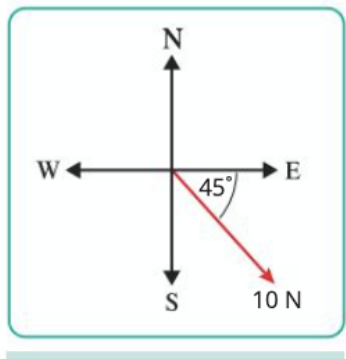
Vector quantities are represented on diagrams using arrows. The arrow provides both pieces of essential information:
- Length of arrow = magnitude of the vector
- Direction of arrow = direction of the vector
Example
Vector Representation Example:
The compass diagram shows a force vector of 10 N pointing southeast at 45° from east. Here's how to interpret it:
- Magnitude: The arrow's length represents 10 N
- Direction: The arrow points southeast (45° from east)
- Complete description: "10 N force acting southeast at 45°"
This gives you all the information needed to fully understand this vector quantity.
Finding the resultant of vectors
When multiple vectors act together, we often need to find their resultant - the single vector that would have the same overall effect as all the individual vectors combined.
When vectors point in the same direction
When two or more vectors point in exactly the same direction, finding the resultant is straightforward:
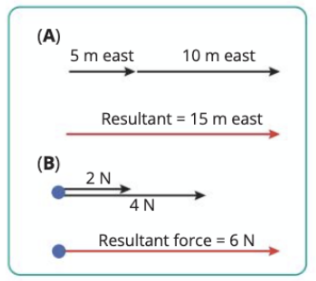
Resultant magnitude = sum of individual magnitudes
Resultant direction = same as the original vectors
Example
Same Direction Addition:
If you have two forces both pushing eastward:
- Force 1: 5 N east
- Force 2: 3 N east
Calculation: Resultant magnitude = 5 N + 3 N = 8 N Resultant direction = east
Final answer: 8 N eastward
For example, if you have a 5 m displacement east followed by another displacement in the same direction, you simply add the magnitudes. The resultant displacement points east with a magnitude equal to the sum.
Similarly, if two forces of 2 N and 4 N both push an object eastward, the resultant force is 6 N eastward.
When vectors point in opposite directions
When vectors point in completely opposite directions, the situation becomes more interesting:
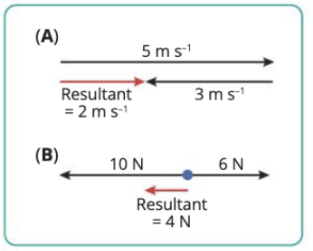
Resultant magnitude = difference between the magnitudes
Resultant direction = direction of the larger vector
Example
Opposite Direction Subtraction:
Consider two forces acting on an object:
- Force 1: 10 N east
- Force 2: 6 N west
Calculation: Since the forces are opposite, we subtract: Resultant magnitude = 10 N - 6 N = 4 N Resultant direction = east (direction of larger force)
Final answer: 4 N eastward
If a 10 N force pushes east while a 6 N force pushes west, the resultant is 4 N eastward. The eastward force "wins" because it's larger, but its effect is reduced by the opposing force.
When the magnitudes are exactly equal but opposite, the resultant is zero - the vectors cancel each other out completely.
Important notes about vector addition
Note
Vector Addition Rules:
- The magnitude of the resultant is found by considering both the sizes and directions of the original vectors
- The direction of the resultant depends on which vector(s) dominate
- Unlike scalars, you cannot simply add vector magnitudes without considering direction
- When vectors don't point in the same or opposite directions, more advanced techniques are needed (covered in later topics)
Practical applications
Understanding scalar and vector quantities helps you:
- Solve physics problems correctly - knowing whether to consider direction or not
- Interpret real-world situations - like understanding why wind direction matters for flight times
- Make accurate measurements - ensuring you record all necessary information
- Predict outcomes - such as the final position after multiple movements
Summary
Key Points to Remember:
- Physical quantities are measurable properties expressed with numbers and units
- Scalar quantities have magnitude only (no direction needed)
- Vector quantities require both magnitude and direction to be fully described
- Vectors are represented by arrows where length shows magnitude and pointing direction shows the vector's direction
- When combining vectors in the same direction, add the magnitudes; when opposite, subtract them
- Direction is crucial for vectors - the same magnitude in different directions creates completely different effects