Vectors in Two Dimensions (Leaving Cert Physics): Revision Notes
📚Revision Notes
Vectors in Two Dimensions
Introduction to vectors in two dimensions
When we work with vectors in physics, we often need to deal with situations where forces, velocities, or displacements act in different directions simultaneously. Vectors in two dimensions allow us to represent and calculate the combined effects of these quantities when they don't act along the same straight line.
A vector is a quantity that has both magnitude (size) and direction. In two dimensions, vectors can point in any direction within a plane, such as north-east, south-west, or at specific angles from a reference direction.
Note
Unlike scalar quantities (such as mass or temperature) that only have magnitude, vectors must be described with both how large they are and which direction they point. This dual nature makes vector calculations more complex but also more powerful for describing real-world phenomena.
The parallelogram law for finding resultants
The parallelogram law is one of the fundamental methods for finding the resultant of two vectors. When two vectors act from the same point, you can find their combined effect using this method.
Here's how the parallelogram law works:
- Draw both vectors starting from the same point, maintaining their correct magnitudes and directions
- Complete a parallelogram using these vectors as two adjacent sides
- The diagonal of the parallelogram represents the resultant vector
- The resultant has the same effect as both original vectors acting together
Important
The parallelogram law applies to any type of vector quantity, including displacements, velocities, and forces. It's particularly useful when you need to find the combined effect of two vectors that act at an angle to each other.
The triangle law for finding resultants
The triangle law is essentially the same as the parallelogram law, but it only requires drawing a triangle instead of a complete parallelogram. This method is often more convenient for calculations.
To use the triangle law:
- Draw the first vector from your starting point
- From the head (end) of the first vector, draw the second vector
- The vector from the tail of the first to the head of the second is the resultant
Note
Both the parallelogram law and triangle law give exactly the same result. The triangle law is sometimes called the "head-to-tail" method because you connect vectors by placing the head of one at the tail of the next.
Mathematical calculations for resultants
Finding magnitude using Pythagoras' theorem
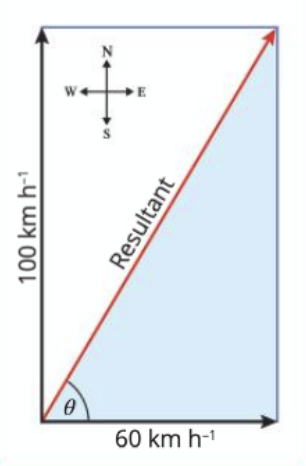
When two vectors are perpendicular (at 90° to each other), you can calculate the magnitude of the resultant using Pythagoras' theorem:
Where and are the magnitudes of the two component vectors.
Finding direction using trigonometry
To find the direction of the resultant vector, use basic trigonometry:
Where is the angle the resultant makes with the horizontal (or your chosen reference direction).
Important
Common Mistake to Avoid: Remember that trigonometric functions on your calculator may give angles in degrees or radians depending on the mode setting. Always check your calculator mode and ensure your final answer uses the appropriate units for the context of your problem.
Worked examples in physics
Displacement problems
Example
Worked Example: Horse Displacement Problem
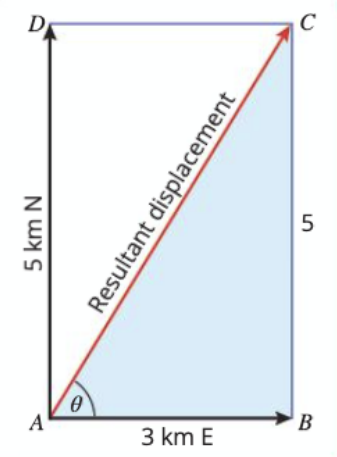
Consider a walking horse that moves 3.0 km east followed by 5.0 km north. Find the overall displacement.
Solution using the triangle law:
- The eastward displacement and northward displacement form two sides of a right triangle
- The resultant displacement forms the hypotenuse
Step 1: Calculate magnitude
Step 2: Calculate direction north of east
Answer: The horse's overall displacement is 5.8 km at 59.0° north of east.
Force problems
When multiple forces act on an object, you need to find their resultant to determine the overall effect. Forces are measured in newtons (N), and they follow the same vector addition rules as displacements.
Example
Worked Example: Combined Forces
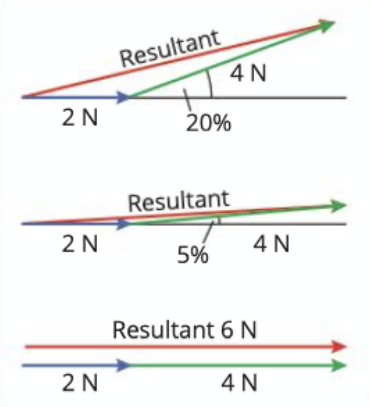
If a 2 N force acts horizontally and a 4 N force acts vertically on the same object, find the resultant force.
Step 1: Calculate magnitude
Step 2: Calculate direction above horizontal
Answer: The resultant force is 4.5 N at 63° above horizontal.
Finding resultants experimentally
In laboratory work, you can verify vector addition principles using practical experiments. The key principles for experimental work are:
Note
Experimental Principles:
- Force is a vector quantity measured in newtons (N)
- The resultant of two forces is a single force that produces the same effect as both forces acting together
- You can demonstrate this using force metres and objects in equilibrium
When three forces keep an object at rest, the resultant of any two forces must be equal in magnitude but opposite in direction to the third force. This principle helps you verify your calculations experimentally.
Laboratory setup
A typical experiment involves:
- Applying known forces in different directions to an object
- Measuring the third force needed to keep the object stationary
- Comparing this measured force with your calculated resultant
- Verifying that they match within experimental error
Key calculation steps
Summary
Systematic Steps for Vector Problems:
- Draw a clear diagram showing all vectors with their magnitudes and directions
- Choose your method - parallelogram law or triangle law (both give the same answer)
- Apply mathematics - use Pythagoras' theorem for perpendicular vectors, or more complex trigonometry for other angles
- Calculate magnitude using appropriate formulas
- Find direction using trigonometric ratios
- State your answer clearly with both magnitude and direction
Common applications
Vector addition in two dimensions is essential for understanding:
- Navigation problems - combining wind velocity with aircraft velocity
- Force analysis - finding the overall effect of multiple forces on objects
- Motion problems - analysing displacement when objects move in multiple directions
- Engineering applications - designing structures that must withstand forces from different directions
Important
Remember that the resultant vector completely replaces the component vectors - it has exactly the same physical effect as all the original vectors acting together.
Remember!
Summary
Key Points to Remember:
- Vectors in two dimensions have both magnitude and direction, and can point in any direction within a plane
- The parallelogram law and triangle law both give the same resultant - use whichever is more convenient for your problem
- Use Pythagoras' theorem () when vectors are perpendicular to find the resultant magnitude
- Apply trigonometry () to find the direction of resultants
- The resultant replaces all component vectors - it has exactly the same physical effect as the original vectors acting together