Work (Leaving Cert Physics): Revision Notes
📚Revision Notes
Work
In physics, work has a very specific meaning that's different from our everyday understanding of the word. When you push a heavy box across the floor, you're doing work on the box. But if you push against a brick wall all day and it doesn't move, you've done no work in the physics sense!
What is work?
Work is done when a force causes an object to move through a distance in the direction of that force. The key point is that there must be movement - if there's no displacement, no work is done regardless of how much force you apply.
Think of it this way: when you push a car along a level road, you're applying a force and the car moves in the direction of your push. This means you're doing work on the car.
Note
The crucial distinction in physics is that work requires both force AND movement in the direction of that force. This is why pushing against an immovable wall, no matter how hard, results in zero work being done.
The mathematical definition
When a force F moves an object through a displacement s in the direction of the force, the work done W is calculated using:
Where:
- = work done (measured in joules)
- = force applied (measured in newtons)
- = displacement in the direction of the force (measured in metres)
It's crucial to remember that work is a scalar quantity - it has magnitude but no direction. This means we don't need to worry about vector calculations when finding work.
Important
Work is only calculated for displacement in the SAME direction as the applied force. If force and displacement are perpendicular to each other, no work is done by that force.
The unit of work: the joule
The SI unit of work is the joule, symbol J. One joule is defined as the work done when a force of 1 newton acts through a distance of 1 metre in the direction of the force.
Since , we can also write:
The joule is named after James Prescott Joule (1818-1889), an English physicist who made important discoveries about energy and established that different forms of energy can be converted into each other.
Understanding work through examples
Let's look at some practical examples to make the concept clearer:
Example
Worked Example 1: Pushing a cart
A horse exerts a constant horizontal force of 400 N on a cart and pulls it 20 m in the direction of the force.
Solution:
Example
Worked Example 2: Lifting an object
To find the work done in raising an object of mass 5 kg through a vertical distance of 10 m at steady speed:
Step 1: Find the force required = weight of object =
Step 2: Calculate work done:
Extension: If this lifting is repeated 50 times, the total work =
Example
Worked Example 3: Climbing stairs
A man carries a 50 kg bag of cement up a flight of stairs at steady speed. The vertical height he climbs is 20 m.
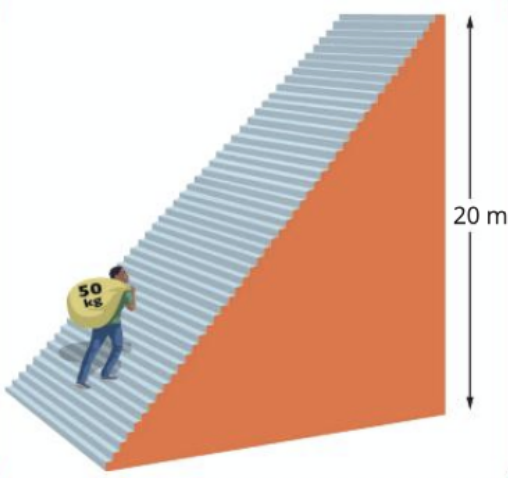
Solution:
- The force needed = weight of bag =
- Displacement in direction of force = vertical height = 20 m
- Work done =
Key insight: The actual distance travelled up the stairs is longer than 20 m, but what matters for work calculation is the displacement in the direction of the force (vertically upward).
Important points to remember
Understanding work in physics requires grasping several key concepts that often differ from our everyday experience:
Note
Key Physics Concepts:
- Work is only done when there is movement in the direction of the applied force
- If you apply a force perpendicular to the direction of movement, no work is done by that force
- Work can be positive (when force and displacement are in the same direction) or negative (when they're in opposite directions)
- The work done depends only on the force applied and the displacement in the direction of that force - not on how fast the movement occurs
- Work is a scalar quantity, so we add work values arithmetically, not as vectors
Summary
Key Points to Remember:
- Work is done when a force causes displacement in the direction of that force
- The formula for work is , where is force and is displacement
- The SI unit of work is the joule (J), where
- Work is a scalar quantity - it has magnitude but no direction
- No displacement means no work is done, regardless of the force applied