The Phenomenon of Business Cycles (Grade 10 NSC Matric Economics): Revision Notes
📚Revision Notes
The Phenomenon of Business Cycles
What are business cycles?
A business cycle refers to the natural pattern of ups and downs that occur in a country's economic activity over several months or years. Think of it like a wave - sometimes the economy grows rapidly (the peak), and other times it slows down, stops growing, or even shrinks (the trough). Every country experiences these patterns of economic expansion followed by periods of slower or negative growth.
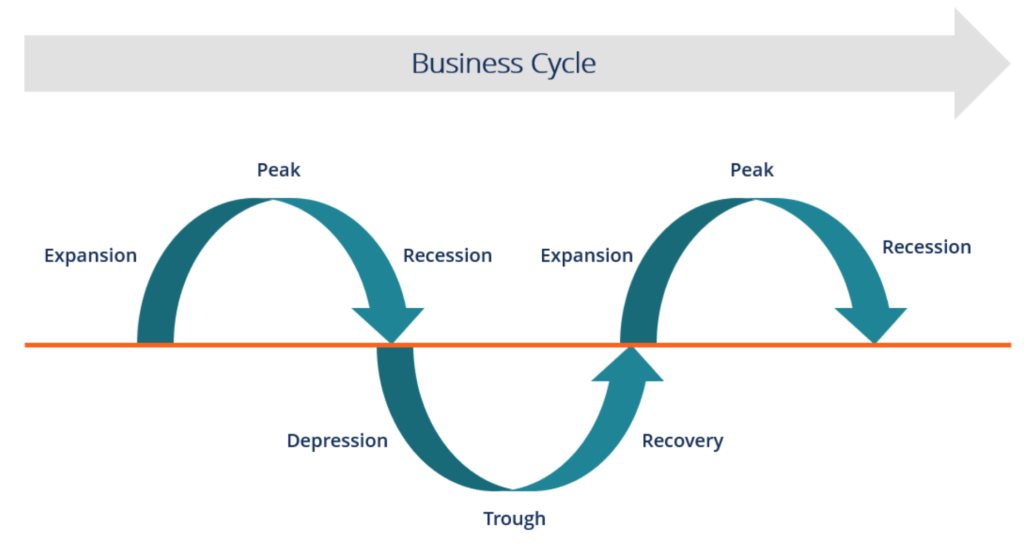
The interconnected nature of global trade means that these economic fluctuations don't just happen in isolation. When major economies experience upswings or downturns (recessions), the effects often spread to other countries through trade relationships.
Note
Key concepts to remember:
- Economic growth - when a country's production increases over time
- Real GDP - the main measure economists use to track economic activity and growth
Economic indicators
Economic indicators are like signposts that help economists understand where the economy is heading. They act as early warning systems or confirmation tools for changes in business cycles. These indicators are organised into different categories based on when they change and how they move.
Classification by timing
Understanding when different indicators change helps economists make better predictions and assessments about the economy.
Leading indicators
Leading indicators change direction before the economy itself changes, making them valuable for predicting future economic trends. Economists use leading indicators to forecast what might happen in the coming months.
Example
Example: JSE Share Prices as Leading Indicator
The Johannesburg Securities Exchange (JSE) share prices act as a leading indicator. Share prices typically increase before an economic upswing begins and fall before a downturn starts. This happens because investors buy and sell shares based on their expectations of future economic performance.
Lagging indicators
Lagging indicators change after the economy has already shifted direction. While they can't predict future trends, they're useful for confirming that an economic change has actually occurred.
Example
Example: Unemployment Rate as Lagging Indicator
The unemployment rate is a classic lagging indicator. When the economy starts recovering, it takes time for businesses to hire new workers, so unemployment rates remain high even after growth begins. Similarly, when the economy starts declining, unemployment rises only after businesses have had time to assess their situation and make job cuts.
Coincident indicators
Coincident indicators change at the same time as the overall economy changes. They provide real-time information about the current state of economic activity.
Example
Example: Company Payrolls as Coincident Indicator
Company payrolls (the total wages and salaries paid by businesses) serve as coincident indicators. When the economy strengthens, companies immediately pay more in wages and salaries as business improves. When the economy weakens, payrolls decrease alongside the economic decline.
Classification by direction
Indicators can also be categorised by how they move relative to the economy's direction.
Procyclic indicators
Procyclic indicators move in the same direction as the economy. When the economy expands, procyclic indicators increase. When the economy contracts, these indicators decrease.
Example
Example: GDP as Procyclic Indicator
GDP is a procyclic indicator because it rises during economic expansion and falls during economic contraction.
Countercyclic indicators
Countercyclic indicators move in the opposite direction to the economy. When the economy expands, countercyclic indicators decrease. When the economy contracts, these indicators increase.
Example
Example: Unemployment Rate as Countercyclic Indicator
The unemployment rate is countercyclic because it falls when the economy expands (more jobs available) and rises when the economy contracts (fewer jobs available).
South African business cycles
The South African Reserve Bank plays a crucial role in monitoring and recording the country's business cycles. Understanding South Africa's economic history helps us recognise patterns and learn from past experiences.
Historical patterns in South Africa's economy
South Africa's economic history shows distinct periods that illustrate how business cycles work in practice:
1945-1975: The growth period This era represented a time of significant economic expansion and prosperity. The country's abundant mineral wealth, particularly gold and diamonds, drove much of this growth. Mining exports provided substantial foreign currency earnings, which supported broader economic development.
Important
Impact of Political Factors on Business Cycles
The following periods demonstrate how both internal policies and external factors can dramatically influence a country's business cycles.
1975-1994: The decline period During this time, South Africa experienced economic difficulties marked by declining growth, rising unemployment, and reduced international demand for the country's products. A major factor was the international community's response to apartheid policies. Many countries imposed economic sanctions and boycotts, which severely limited South Africa's ability to trade internationally and access foreign investment.
1994-2007: The recovery period Following the end of apartheid and the establishment of democratic government, South Africa began experiencing economic growth once again. International sanctions were lifted, leading to increased demand for South African goods and services. However, this period was characterised by growth that didn't translate into significant job creation, meaning unemployment remained a persistent challenge despite overall economic improvement.
Note
These historical periods demonstrate how both internal policies and external factors can influence a country's business cycles. They also show that economic growth doesn't automatically solve all economic problems, such as unemployment.
Summary
Key Points to Remember:
- Business cycles are natural patterns of economic ups and downs that all countries experience
- Leading indicators (like JSE share prices) help predict future economic changes
- Lagging indicators (like unemployment rates) confirm that economic changes have occurred
- Procyclic indicators move with the economy, while countercyclic indicators move against it
- South Africa's economic history shows how political factors and international relationships can significantly impact business cycles