How and Where Earthquakes Occur (Grade 10 NSC Matric Geography): Revision Notes
📚Revision Notes
How and Where Earthquakes Occur
What are earthquakes?
Earthquakes are powerful and violent movements that occur within the Earth's crust. These movements are directly linked to the movement of tectonic plates beneath our feet. When these massive rock structures shift and move, they can cause tremendous damage and destruction on the surface above. In fact, earthquakes are responsible for more deaths than any other type of natural disaster worldwide.
Note
The relationship between earthquakes and plate tectonics is crucial to understand. Most earthquakes happen because of the immense forces created when tectonic plates interact with each other at their boundaries.
Key earthquake terminology
Understanding earthquakes requires learning several important terms that describe different aspects of how they work:
Earthquake - This refers to the violent shaking of the Earth's crust that happens when movement occurs along a fault or fracture in the rock layers underground.
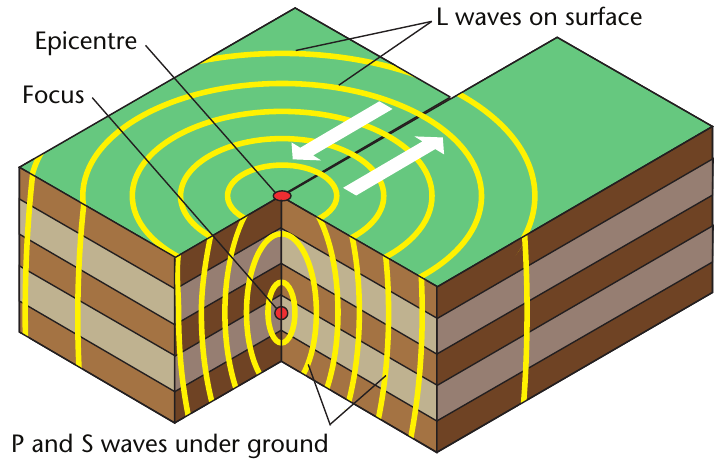
Focus - This is the actual point underground where the earthquake movement begins. Think of it as the origin point of the earthquake, located beneath the Earth's surface. It can be just a few kilometres below the surface or much deeper in the crust.
Epicentre - This is the point on the Earth's surface that sits directly above the focus. When we hear about earthquake locations in the news, they're usually referring to the epicentre.
Seismic waves - These are the vibrations that travel through the Earth's crust during an earthquake, similar to ripples spreading outward when you throw a stone into a pond.
Tsunami - This is a massive wave of water that forms when an earthquake occurs beneath the ocean floor.
Types of seismic waves
When an earthquake occurs, it creates different types of waves that travel through and across the Earth:
P waves (Primary waves) and S waves (Secondary waves) travel through the underground rock layers. These waves move through the Earth's interior and are the first to be detected by seismographs.
L waves (Love waves) travel along the Earth's surface. These surface waves often cause the most damage to buildings and infrastructure because they create the violent shaking we feel during earthquakes.
Note
The way these waves behave is similar to dropping a stone in water - the waves spread outward in all directions from the point of impact. However, earthquake waves are much more complex because they travel through solid rock in three dimensions.
Where earthquakes occur most frequently
The location of earthquakes around the world follows very specific patterns that are closely related to plate tectonics:
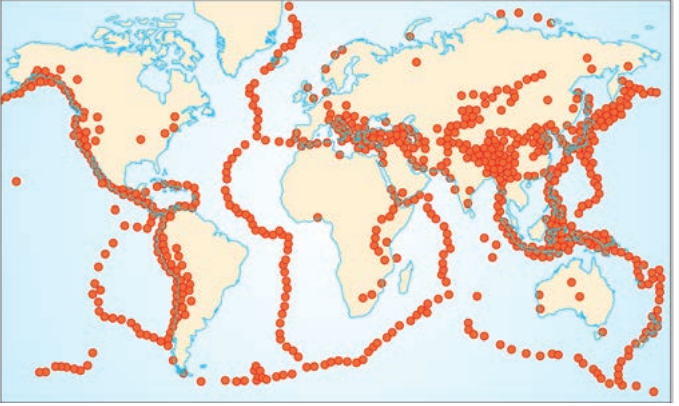
Under the oceans - Most earthquakes actually happen beneath the ocean floor rather than on land. Many of these underwater earthquakes are small and cause no damage, but some can be extremely powerful.
At plate boundaries - The most active earthquake zones are found where tectonic plates meet. Divergent plate boundaries, where plates are moving apart, are particularly active earthquake zones.
Continental areas - When earthquakes do occur on land, most of the damage and loss of life is caused by collapsing buildings rather than the ground shaking itself.
Important
It's surprising to many people that most earthquakes actually occur under the oceans rather than on land. This is because oceanic crust is constantly being created and destroyed at plate boundaries, generating frequent seismic activity.
How earthquakes develop
The process of earthquake formation involves the buildup and sudden release of enormous stress within the Earth's crust:
Movements within the Earth's crust cause stress to gradually build up at points where the rock is naturally weaker. When this stress becomes too great for the rock to bear, it fractures along existing zones of weakness, such as fault lines. The energy that has been stored in the stressed rock is suddenly released, creating an earthquake.
Example
Process Example: How an Earthquake Forms
Step 1: Tectonic plates move and create stress in the rock along fault lines
Step 2: Stress builds up over time as the rock resists the forces
Step 3: When stress exceeds the rock's strength, it fractures suddenly
Step 4: Stored energy is released as seismic waves that travel through the crust
When the Earth's crust moves during this process, it sets up vibrations that travel through the crust as seismic waves. The strength and impact of these waves depend largely on how close the focus is to the surface - earthquakes with shallow focuses tend to cause more severe shaking and damage than those with deep focuses.
Tsunamis and their devastating effects
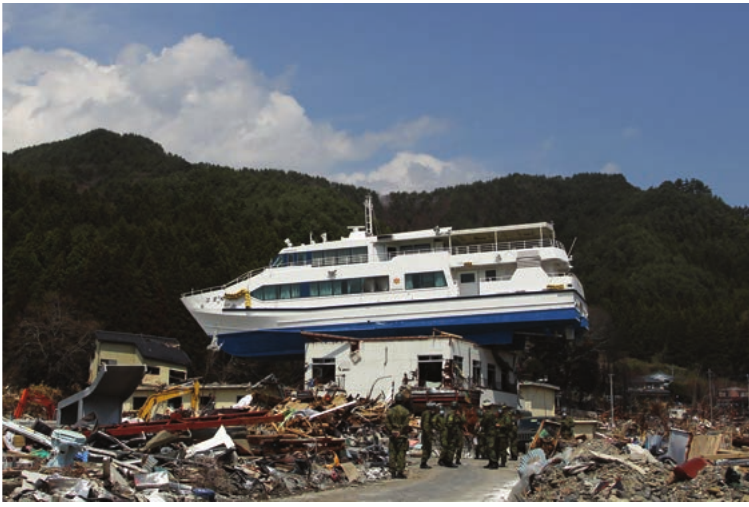
When earthquakes occur under the ocean, they can displace massive amounts of water, creating tsunamis. These are not normal waves but rather walls of water that can travel across entire ocean basins at incredible speeds.
The movement of oceanic crust during an underwater earthquake pushes vast volumes of water upward and outward, forming a tsunami that can wash over coastal areas with devastating force. The flooding and destruction caused by tsunamis can be immense, causing significant damage and loss of life far from the original earthquake location.
Important
A powerful example of this destruction occurred in 2004 when a tsunami struck Indonesia and killed approximately 280,000 people across multiple countries around the Indian Ocean. This demonstrates how earthquakes can cause casualties thousands of kilometres away from their origin point.
Global earthquake distribution patterns
Earthquakes are not randomly distributed around the world. Instead, they follow clear patterns that reveal important information about our planet's geological structure:
The Pacific Ring of Fire is one of the most significant earthquake zones on Earth. This area around the Pacific Ocean is highly active for both earthquakes and volcanic activity, which is why it has earned this dramatic name. The concentration of tectonic activity in this region makes it one of the most geologically dangerous areas on the planet.
Note
Looking at global earthquake distribution maps reveals that seismic activity is concentrated along specific linear patterns. These patterns trace major geological features including mid-ocean ridges, transform faults, and the boundaries between tectonic plates.
Damage and intensity patterns
The amount of damage caused by an earthquake depends on several factors:
-
Distance from epicentre - Areas closest to the epicentre typically experience the most severe damage because this is where the shaking of the crust is most violent.
-
Depth of focus - Shallow earthquakes often cause more surface damage than deeper ones because the seismic waves don't have as far to travel before reaching the surface.
-
Local geology - The type of rock and soil in an area affects how seismic waves travel and how much the ground shakes.
-
Building construction - In developed countries with strict building codes, earthquake-resistant construction can dramatically reduce casualties, while areas with poor construction standards may suffer catastrophic building collapses.
Summary
Key Points to Remember:
-
Earthquakes are violent crustal movements caused by stress building up along fault lines until the rock fractures and releases stored energy as seismic waves
-
Most earthquakes occur under oceans and at divergent plate boundaries where tectonic plates are actively moving
-
Focus is underground, epicentre is on the surface - remember that the focus is the origin point beneath the Earth's surface, while the epicentre is directly above it
-
Three types of seismic waves exist - P and S waves travel through the Earth's interior, while L waves travel along the surface and often cause the most damage
-
Tsunamis form from underwater earthquakes and can cause devastating flooding and destruction across vast coastal areas, sometimes affecting multiple countries