Faulting (Grade 10 NSC Matric Geography): Revision Notes
📚Revision Notes
Faulting
Faulting is a fundamental geological process that shapes our planet's surface. A fault is essentially a crack or fracture in rocks where movement has occurred along the break. This process can happen on small scales within individual rock formations or on massive scales that affect entire continents.
What causes faulting?
Faulting occurs when rocks are subjected to different types of stress forces. These forces can stretch rocks apart (tension), squeeze them together (compression), or slide them past each other sideways. When the stress becomes too great for the rock to handle, it breaks along what we call a fault plane - the surface where the fracture occurs.
Note
The concept of stress in geology is similar to stress in everyday materials. Just as a rubber band will snap if you stretch it too far, rocks will fracture when the forces acting on them exceed their strength limits.
Types of faults
Different stress forces create different types of faults. Understanding these helps us recognise how landscapes form and change over time.
Normal faults
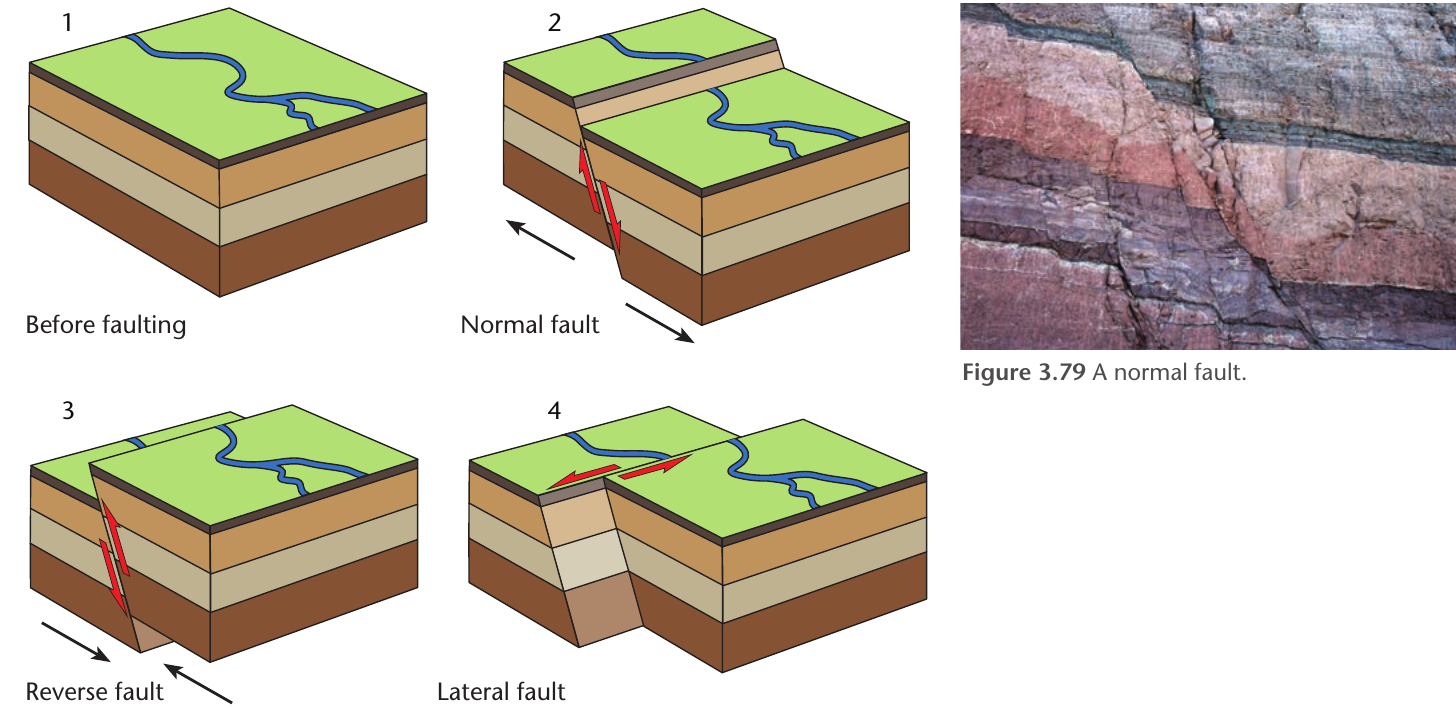
Normal faults form when tension forces pull rocks apart. In this type of fault, one block of rock drops down relative to the other block. Think of it as gravity doing its "normal" job - pulling the rock downward. These faults commonly occur in areas where the Earth's crust is being stretched.
Reverse faults
Reverse faults are the opposite of normal faults. They form when compression forces squeeze rocks together, causing one block to be pushed upward over another. These typically occur in areas where crustal plates are colliding.
Lateral faults
Also known as strike-slip faults, lateral faults involve horizontal movement where rock blocks slide past each other sideways. The movement is parallel to the Earth's surface rather than up or down.
Important
Remember the three main fault types by their movement:
- Normal faults: One block drops DOWN (tension)
- Reverse faults: One block pushes UP (compression)
- Lateral faults: Blocks slide SIDEWAYS (horizontal movement)
Faults and plate boundaries
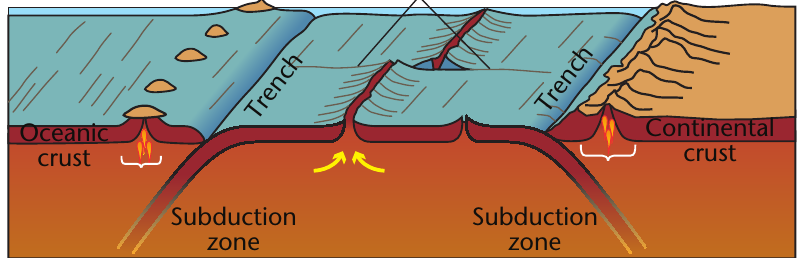
Large-scale faulting is closely connected to plate tectonics. When tectonic plates move, the enormous forces involved create extensive fault systems along plate boundaries.
Transform faults
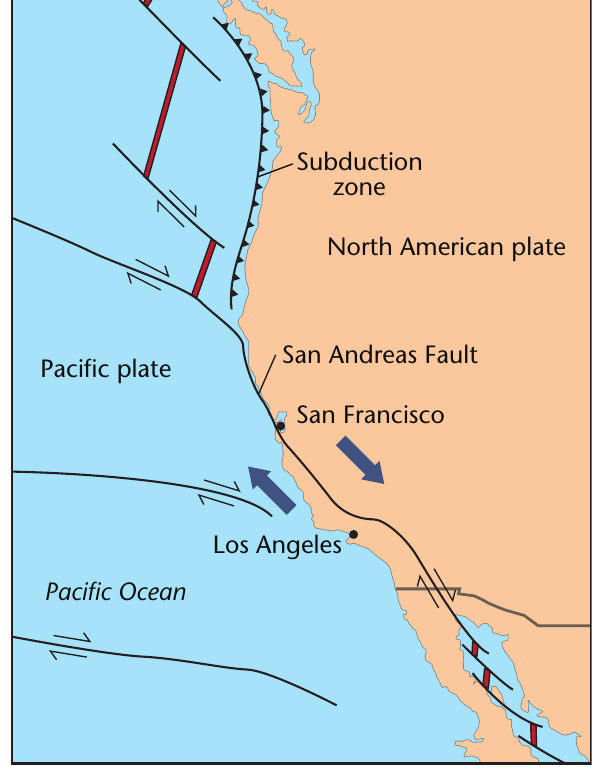
Transform faults are special types of faults that occur at right angles to plate boundaries. These massive fault systems can extend for hundreds of kilometres through the Earth's crust, sometimes reaching all the way down to the mantle. The famous San Andreas Fault in California is a perfect example of a transform fault.
Example
Real-World Example: The San Andreas Fault System
The San Andreas Fault system demonstrates how transform faults work in real life. Here, the Pacific Plate moves northwestward relative to the North American Plate, creating a fault line that runs through much of California. This movement causes frequent earthquakes and has shaped California's geography over millions of years.
Landforms created by faulting
Faulting doesn't just break rocks - it creates distinctive landforms that we can observe across the world. Two major landform types result from faulting processes: rift valleys and block mountains.
Rift valleys
Rift valleys form when tension forces in the Earth's crust cause blocks of land to drop downward between parallel faults. This process, called rifting, occurs when convection currents in the mantle create upward pressure that stretches and cracks the continental crust above.
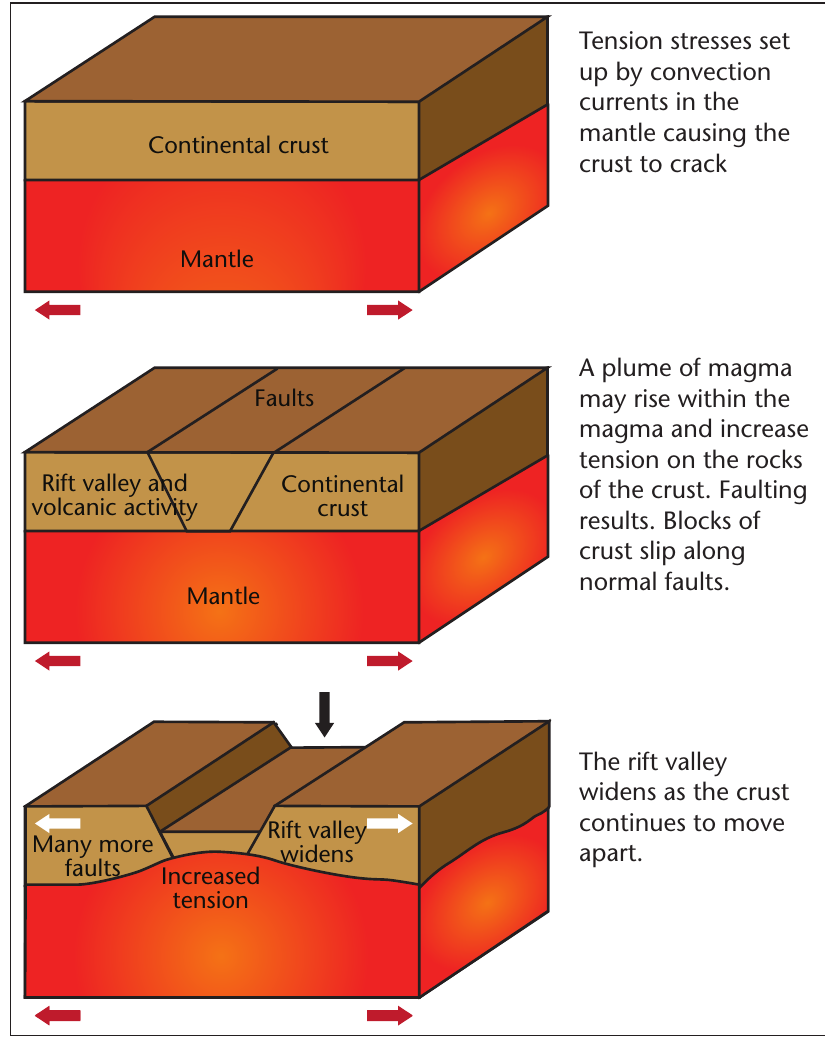
The formation of rift valleys happens in stages:
- Tension stresses develop due to mantle convection currents
- The continental crust begins to crack and fault
- Blocks of crust start to slip down along normal faults
- As tension continues, the rift valley widens and more faults develop
Note
Rift valleys are essentially the "opposite" of mountain ranges - instead of land being pushed up, it's pulled apart and drops down between parallel fault lines.
The Great Rift Valley system in Africa
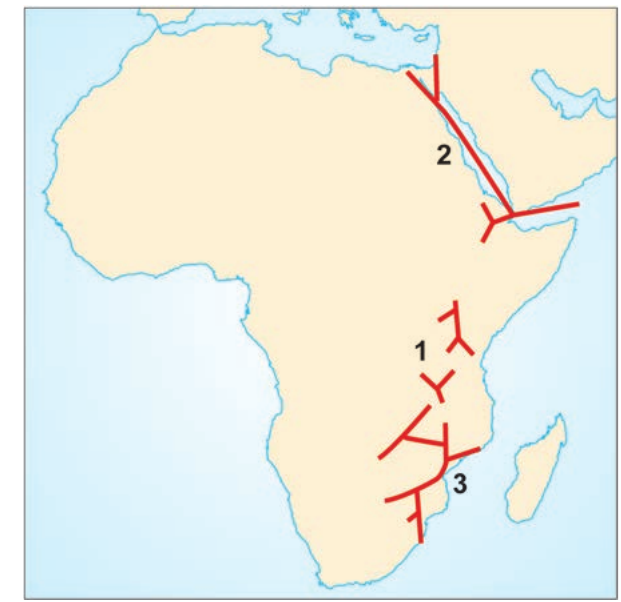
Africa provides an excellent example of rift valley formation at different stages of development. The East African Rift Valley system stretches approximately 6000 kilometres and varies in width from 20 to 60 kilometres.
Example
Case Study: Africa's Great Rift Valley
This massive geological feature shows three main rift zones:
- The northern section includes the Red Sea area
- The main East African Rift runs through eastern Africa
- A southern section extends through southeastern Africa
Interestingly, the Red Sea represents what happens when rifting continues - it has become the beginning of a new ocean as the sea floor continues to spread apart.
Block mountains
Block mountains form alongside rift valleys through the same faulting processes. While tension in one area causes land to drop down and create rift valleys, compression in adjacent areas pushes blocks of crust upward to form mountains.
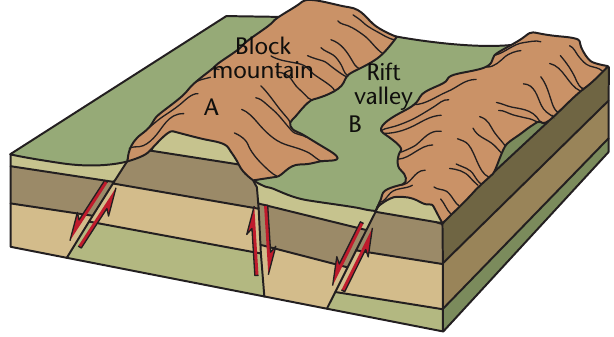
This creates a landscape pattern where elevated block mountains (labeled A and B in the diagram) stand on either side of a sunken rift valley in the centre. The alternating pattern of high and low areas results from the complex stress patterns that develop during continental rifting.
Why faulting matters
Understanding faulting helps explain many geographical features we see today. It explains why certain areas are prone to earthquakes, how mountain ranges form, and why some regions have such dramatic changes in elevation over relatively short distances.
Faulting also has practical importance for humans. Areas with active faults experience earthquakes, which affects where and how people build settlements. Additionally, fault systems often control groundwater flow and can concentrate valuable mineral deposits.
Important
Active fault zones pose significant risks to human settlements. Understanding fault locations and behaviour is crucial for earthquake preparedness, urban planning, and infrastructure development.
Summary
Key Points to Remember:
- Faults are cracks in rocks where movement has occurred along a fracture surface called a fault plane
- Three main fault types exist: normal faults (one block drops down), reverse faults (one block pushes up), and lateral faults (blocks slide sideways)
- Transform faults occur at plate boundaries and can extend hundreds of kilometres, like the San Andreas Fault in California
- Rift valleys form when tension forces cause blocks of land to drop down between parallel faults, as seen in the East African Rift Valley
- Block mountains form alongside rift valleys when compression forces push adjacent blocks of crust upward, creating alternating high and low landscape patterns