The Mechanics of Plate Movements (Grade 10 NSC Matric Geography): Revision Notes
📚Revision Notes
The Mechanics of Plate Movements
Understanding how tectonic plates actually move is crucial for grasping many geological processes. Scientists have discovered that the driving force behind plate movement comes from deep within the Earth itself, through a process involving convection currents in the mantle.
What drives plate movement?
The key to understanding plate mechanics lies in recognising that convection currents are the main driving force. These are circular movements of hot material in the Earth's mantle, caused by heating and cooling processes occurring deep below the surface.
Note
Convection currents can be understood like water boiling in a pot - hot material rises to the top while cooler material sinks to the bottom, creating a circular movement pattern. The same process happens in Earth's mantle, but with molten rock instead of water.
How convection currents work
The process begins with heat from the Earth's core warming the material in the mantle above it. When this material heats up, it becomes less dense and rises towards the surface. As it reaches areas closer to the crust, it cools down, becomes denser, and sinks back down towards the core. This creates a continuous circular movement pattern within the mantle.
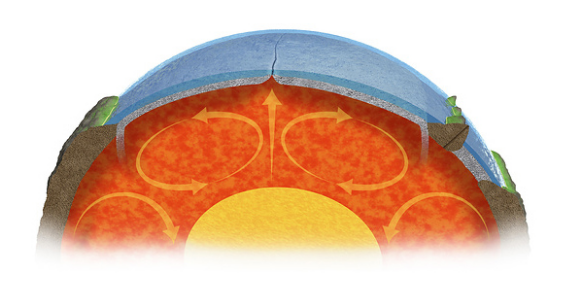
These convection currents act like giant conveyor belts beneath the tectonic plates. The moving mantle material drags the solid crustal plates above it, causing them to move in the same direction as the underlying current flow.
Creation of new oceanic crust at ridges
Where tectonic plates move away from each other (at divergent boundaries), something remarkable happens. The gap created between the separating plates needs to be filled, and this is where new oceanic crust is born.
Ridges are underwater mountain ranges where new ocean crust forms from magma rising from the mantle. As the plates move apart, magma wells up from below to fill the space, cooling and solidifying to create brand new oceanic crust.
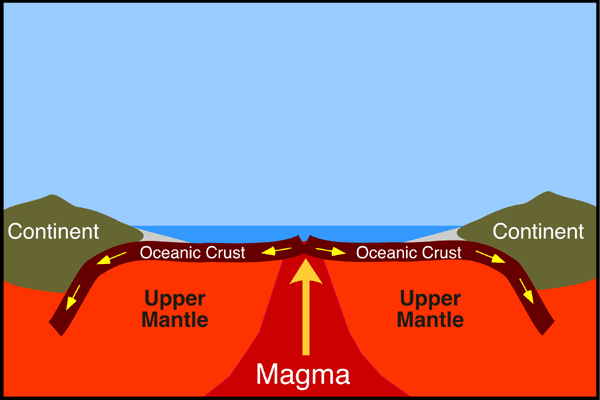
This process is called seafloor spreading, and it means the ocean floor is constantly being renewed. The newly formed crust then moves away from the ridge as more magma rises to take its place, creating a continuous conveyor belt of new oceanic material.
Destruction of oceanic crust at subduction zones
Since new oceanic crust is constantly being created at ridges, something must happen to the old crust to prevent the Earth from getting bigger. This is where subduction zones come into play.
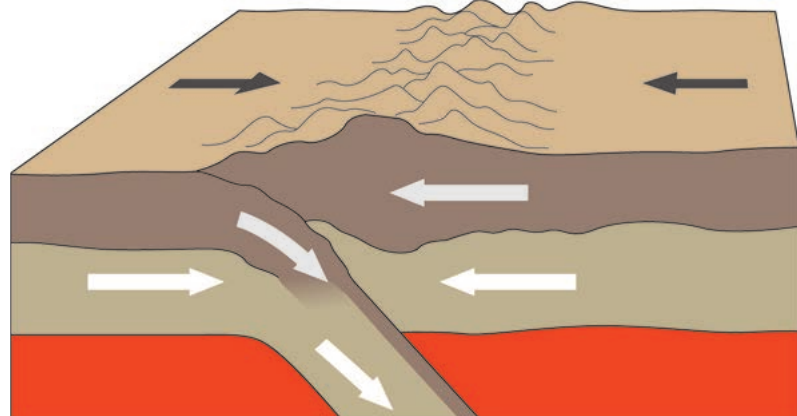
At convergent plate boundaries, denser oceanic plates slide beneath lighter continental plates in a process called subduction. The oceanic plate descends into the mantle, where the intense heat causes it to melt and become part of the mantle again.
Important
Key Features Created by Subduction:
- Trenches: Deep cracks in the ocean floor where the oceanic plate bends and descends
- Volcanic activity: As the oceanic plate melts, it can trigger volcanic eruptions on the continental plate above
- Earthquakes: The grinding and cracking of plates creates seismic activity
The complete mechanical cycle
The mechanics of plate movement work as a complete system:
Example
Worked Example: The Complete Plate Movement Cycle
Step 1: Heat source - The Earth's core provides the heat energy needed to drive the system
Step 2: Convection begins - Hot mantle material rises while cooler material sinks, creating circular currents
Step 3: Plate dragging - These convection currents drag the tectonic plates above them
Step 4: Crust creation - At ridges, plates move apart and new oceanic crust forms from rising magma
Step 5: Crust destruction - At subduction zones, old oceanic crust melts back into the mantle
Step 6: Cycle continues - The process repeats continuously, keeping plates in constant motion
Why this system works
This mechanical system is self-sustaining because:
- The Earth's core continues to provide heat energy
- The creation and destruction of oceanic crust maintains Earth's overall size
- The density differences between hot and cold material keep convection currents flowing
- The system can operate continuously over millions of years
The movement may seem slow to us (only a few centimetres per year), but over geological time, these mechanics have shaped our planet's surface and continue to drive processes like mountain building, earthquakes, and volcanic activity.
Summary
Key Points to Remember:
- Convection currents in the mantle are the driving force behind plate movement - hot material rises, cool material sinks
- New oceanic crust is created at ridges where plates move apart and magma rises from the mantle
- Old oceanic crust is destroyed at subduction zones where dense oceanic plates slide under continental plates
- The system works as a continuous cycle - creation at ridges balances destruction at trenches
- This mechanical process explains why plates move constantly, even though the movement is very slow by human standards