Classification of Rocks and the Rock Cycle (Grade 10 NSC Matric Geography): Revision Notes
📚Revision Notes
Classification of Rocks and the Rock Cycle
Introduction to Earth's rocks
Earth's crust forms a thin layer made up entirely of rocks. While we often see bare rock exposed as cliffs in mountains or large boulders in fields, most rocks lie hidden beneath soil, buildings, and plants. Just a few metres below the surface, you'll find solid rock everywhere.
Geologists classify all rocks into three main categories based on how they form: igneous, sedimentary, and metamorphic. Each type of rock forms through different processes, but they're all connected through an amazing system called the rock cycle.
Note
Understanding rock classification is fundamental to geology because it helps us interpret Earth's history and predict where we might find valuable resources like coal, oil, or building materials.
Igneous rocks
What are igneous rocks?
Igneous rocks were Earth's first rocks, forming over four billion years ago as our planet began cooling down. The word "igneous" means fire, which gives us a clue about how these rocks form. They develop when extremely hot liquid rock cools down and becomes solid.
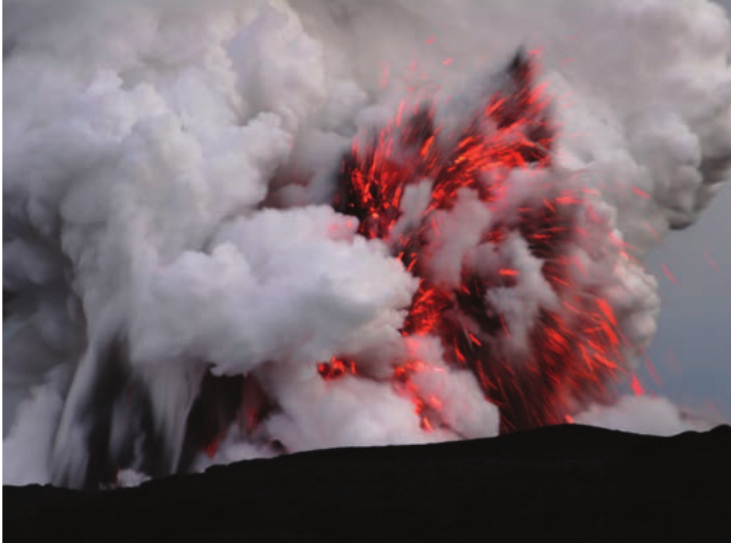
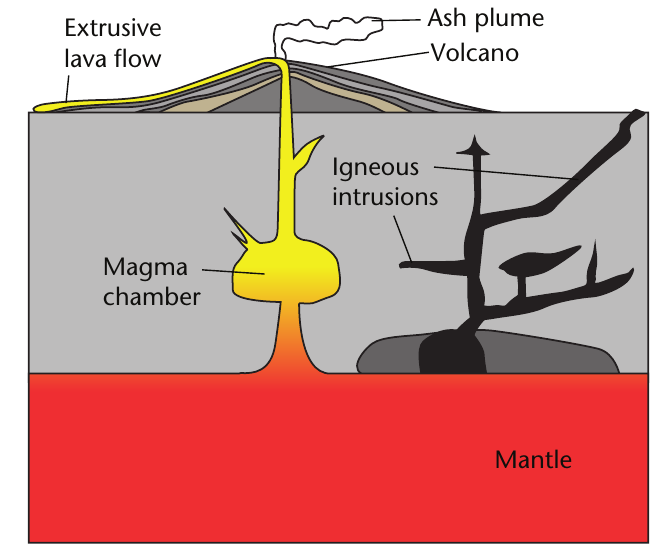
This liquid rock has different names depending on where you find it. When it's underground, we call it magma. When it reaches Earth's surface through volcanic eruptions, we call it lava.
Important
Key Distinction:
- Magma = liquid rock inside Earth
- Lava = liquid rock on Earth's surface
This distinction is crucial because it determines how the resulting igneous rocks will form and what characteristics they'll have.
Types of igneous rocks
Geologists classify igneous rocks based on where they cool and solidify. This location affects their appearance and characteristics.
Extrusive igneous rocks form when lava cools on Earth's surface after volcanic eruptions. Because they cool quickly in the open air, they develop small crystals that are often difficult to see without a magnifying glass. These rocks usually appear dark in colour. Basalt is a common example of extrusive igneous rock.
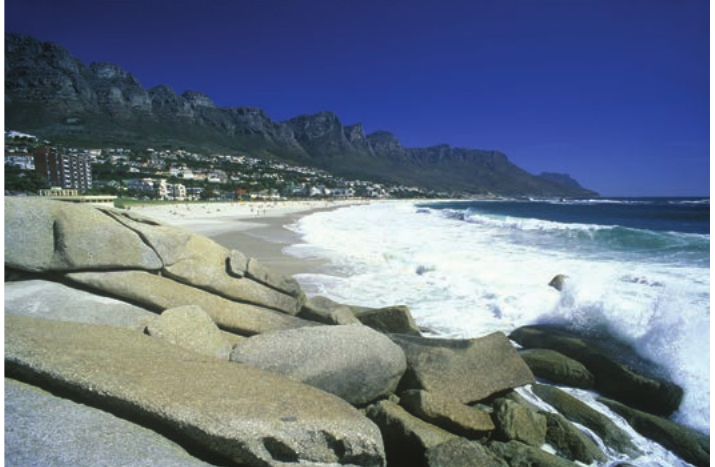
Intrusive igneous rocks form when magma cools slowly inside Earth's crust, deep underground. The slow cooling process allows large crystals to grow, which you can easily see with the naked eye. These rocks tend to be lighter in colour than extrusive rocks. Granite is a typical example of intrusive igneous rock.
Example
Memory Aid for Rock Formation
Think of it this way:
- EXtrusive = EXternal (outside Earth, quick cooling, small crystals)
- INtrusive = INternal (inside Earth, slow cooling, large crystals)
The longer the cooling time, the larger the crystals can grow!
Comparison of igneous rock types
| Type of igneous rock | Where formed | Composition | Occurrence in South Africa |
|---|---|---|---|
| Extrusive igneous rocks (e.g., basalt) | On Earth's surface from volcanic and fissure eruptions | Small, fine crystals, usually dark | High peaks of the uKhahlamba-Drakensberg mountains |
| Intrusive igneous rocks (e.g., granite) | Inside Earth's crust; some igneous intrusions occur deep in Earth's crust | Large crystals that can be seen; often lighter in colour, grey | Usually exposed by erosion or digging; Cape mountains |
South African examples
South Africa showcases both types of igneous rocks beautifully. The dramatic peaks of the uKhahlamba-Drakensberg mountains contain extrusive basalt rocks formed from ancient volcanic activity. Meanwhile, the Cape mountains display intrusive granite rocks that formed deep underground and became exposed through millions of years of erosion.
Sedimentary rocks
What are sedimentary rocks?
Most rocks you see on Earth's surface are sedimentary rocks. These fascinating rocks form from tiny pieces of material called sediments that accumulate in layers, usually on ocean floors.
Sediments include pieces of rocks, stones, remains of plants and animals, sand, and mud that have been worn away from the land. Rivers carry these materials to the oceans, where they settle in layers over millions of years. Examples of sedimentary rocks include sandstone, limestone, and coal.

Clastic sedimentary rocks
The most common sedimentary rocks form through a process that begins with weathering and erosion. Weathering breaks down large rock surfaces into smaller pieces like boulders, stones, pebbles, and sand grains. Erosion then carries this weathered material away through water, wind, or ice.
Note
The terms "weathering" and "erosion" are often confused, but they're different processes:
- Weathering = breaking down rocks in place
- Erosion = moving the broken pieces away
This process creates what we call clastic sedimentary rocks - rocks formed from pieces of broken-up rock material. Here's how they form:
Example
Step-by-Step Formation of Clastic Sedimentary Rocks
- Weathering and erosion break rock surfaces into small pieces
- Transportation: Rivers wash these pieces downstream, making them smaller as they bounce against other rocks
- Deposition: The pieces eventually become sand grains and fine mud
- Accumulation: Over long periods, sand and mud build up on ocean floors near river mouths
- Compaction: The weight of upper sediment layers slowly compresses lower layers
- Cementation: Chemicals from water act like cement, binding particles together
- Formation: Eventually, loose sediments transform into solid sedimentary rocks like sandstone
Sediments can also be pushed above sea level by moving continents, forming mountain ranges made of sedimentary rocks.
Organic sedimentary rocks
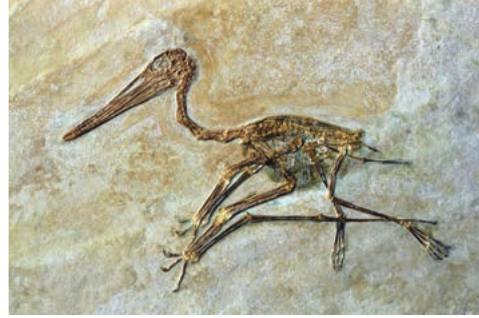
Some sedimentary rocks form from the remains of plants and animals, which we call organic matter. Fossils - recognisable remains of ancient plants and animals - often appear in these organic sedimentary rocks.
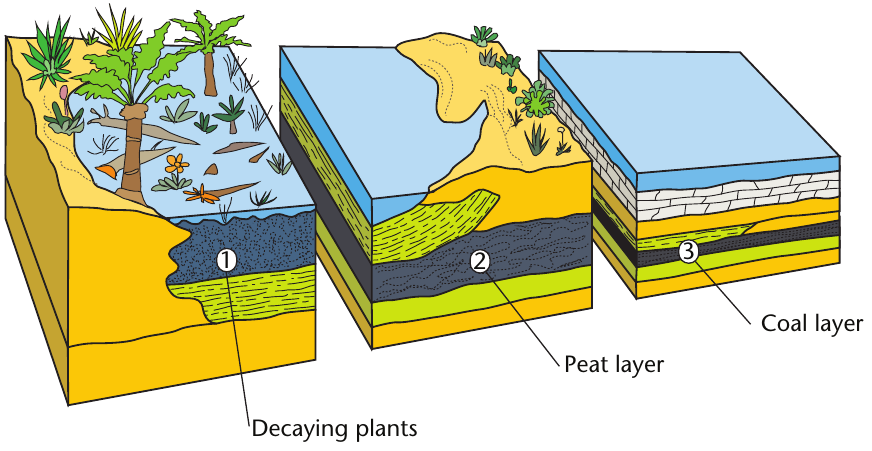
Coal provides an excellent example of organic sedimentary rock formation:
Example
Coal Formation Process
- Stage 1: Coal begins forming in swampy areas where plants decay without oxygen
- Stage 2: Other sediments like sand, clay, and silt settle on top of the decaying plants
- Stage 3: The weight of these sediments compresses the organic matter into a rich, dark substance called peat
- Stage 4: Further compression gradually squeezes out water and transforms peat into solid coal
Chemical and biochemical sedimentary rocks
Some sedimentary rocks form through chemical processes. Chemicals dissolved in water can be deposited to form rocks like rock salt when the water evaporates.
Biochemical sedimentary rocks form from the remains of sea creatures, particularly their shells. Ancient sea creature shells contain calcium carbonate, which dissolves in seawater. As sediment layers thicken, the weight squashes out water, leaving calcium carbonate as a natural glue that cements broken and dissolved shells together.
Limestone exemplifies biochemical sedimentary rock formation and often contains fossils of ancient sea creatures.
Metamorphic rocks
What are metamorphic rocks?
Metamorphic rocks begin as either igneous or sedimentary rocks that have been transformed by heat, pressure, or both. The word "metamorphic" means "changed form," which perfectly describes what happens to these rocks.
Important
Remember: Metamorphic rocks are not new rocks - they are existing rocks that have been changed. The original rock is called the "parent rock" or "protolith."
Contact metamorphism
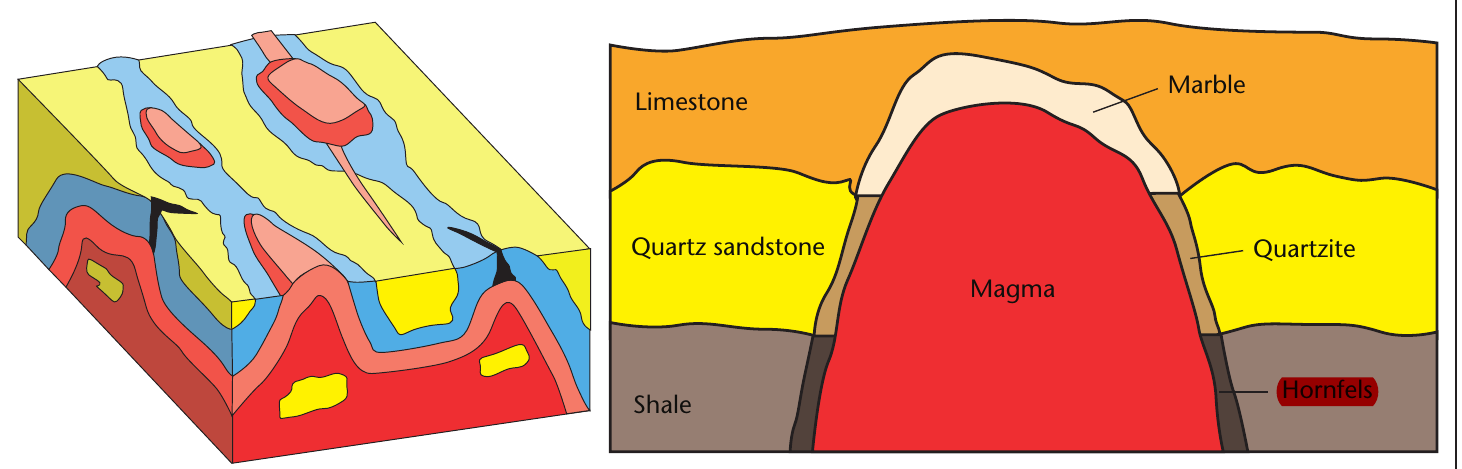
Contact metamorphism occurs when existing rocks come into close contact with hot magma or lava. The intense heat causes the minerals in the original rock to recombine and form completely different minerals, creating a new type of rock.
This process can happen deep underground when magma intrudes into surrounding rocks, or at Earth's surface when lava flows over existing rocks. The heat literally "bakes" nearby rocks, transforming them into metamorphic varieties.
Example
Contact Metamorphism Examples
- Limestone → Marble (heat transforms calcium carbonate crystals)
- Sandstone → Quartzite (quartz grains fuse together)
- Shale → Hornfels (clay minerals recrystallize)
Pressure metamorphism
Pressure metamorphism occurs when rocks experience tremendous pressure from the weight of overlying rock layers or from tectonic forces that squeeze and crush them. This pressure can flatten, stretch, or fold the crystals in rocks, creating entirely new rock structures.
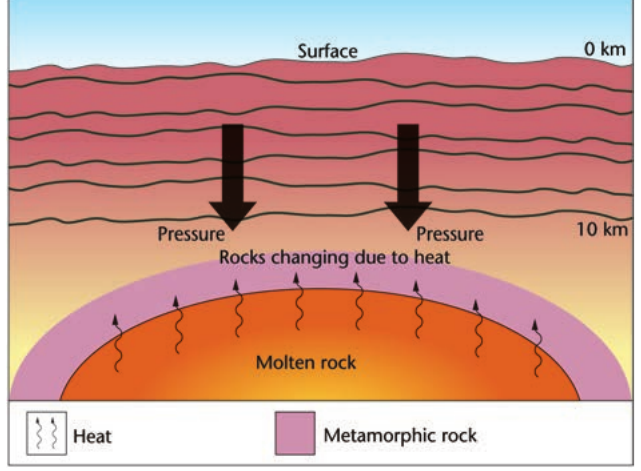
The combination of heat from deep underground magma and pressure from overlying rocks creates metamorphic rocks in zones where these forces meet. Examples include quartzite forming from sandstone and schist developing from shale.
The rock cycle
Understanding the rock cycle
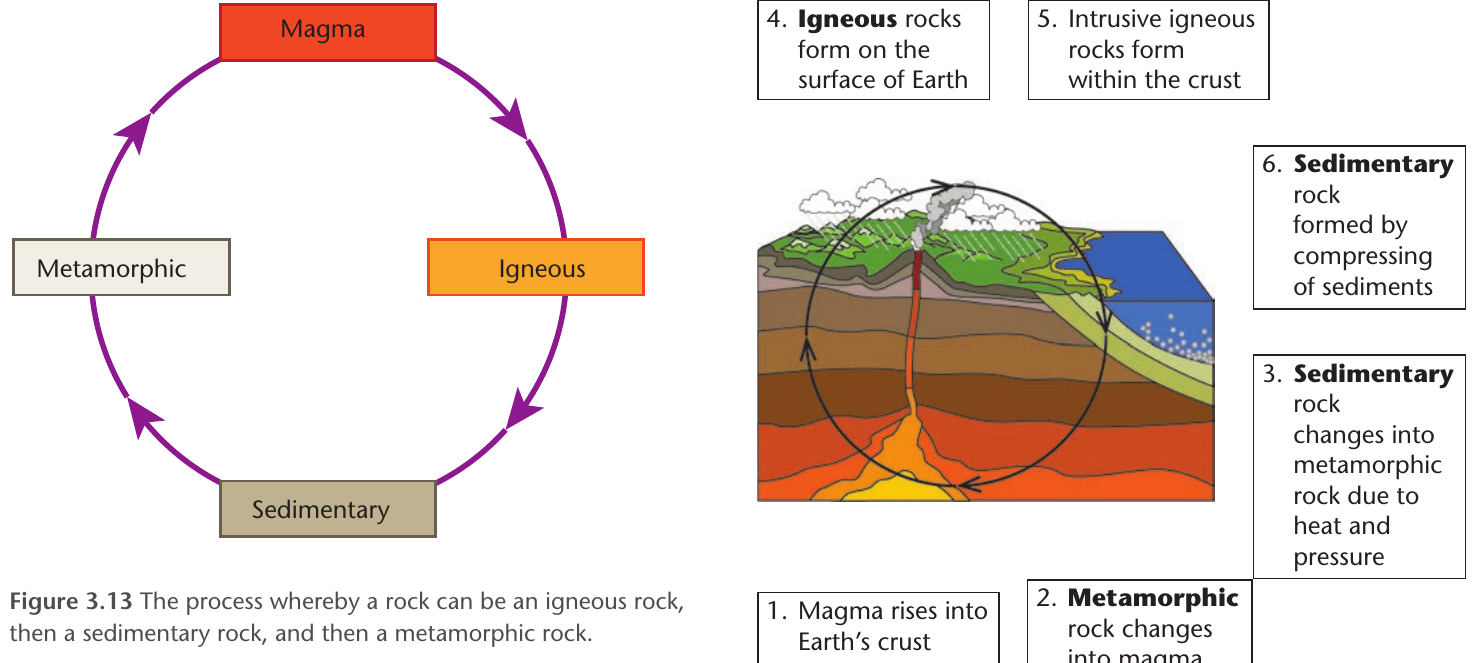
The rock cycle represents one of Earth's most important processes - the continuous transformation of rocks from one type to another over geological time. This cycle shows that rocks aren't permanent; they constantly change through various natural processes.
Important
The Rock Cycle Concept: No rock type is permanent! Given enough time and the right conditions, any rock can transform into any other type of rock. This is what makes geology so dynamic and fascinating.
How rocks transform
The rock cycle demonstrates several key transformations:
Example
Rock Cycle Transformation Pathways
- Magma cooling → creates igneous rocks (both extrusive on the surface and intrusive underground)
- Weathering and erosion → break down existing rocks into sediments
- Compression of sediments → forms sedimentary rocks
- Heat and pressure → transform any existing rock into metamorphic rocks
- Extreme heat → can melt metamorphic rocks back into magma, starting the cycle again
Real Example: A piece of granite (igneous) might weather into sediments, compress into sandstone (sedimentary), then transform under heat and pressure into quartzite (metamorphic). Eventually, even quartzite might melt back into magma and begin the process again.
The rock cycle shows us that Earth's crust remains dynamic and constantly changing, with rocks moving through different forms as geological conditions change over time.
Summary
Key Points to Remember:
-
Three main rock types exist: igneous (from cooling magma/lava), sedimentary (from compressed sediments), and metamorphic (changed by heat/pressure)
-
Location matters for igneous rocks: extrusive rocks cool quickly on the surface with small crystals, while intrusive rocks cool slowly underground with large crystals
-
Sedimentary rocks form in layers from weathered material, organic matter, or chemical deposits, often containing fossils that tell Earth's history
-
Metamorphic rocks are "changed rocks" that transform through contact with hot magma or pressure from overlying rock layers
-
The rock cycle connects everything - rocks continuously transform from one type to another through weathering, heat, pressure, and cooling processes over geological time