The Ozone Layer (Grade 10 NSC Matric Geography): Revision Notes
📚Revision Notes
The Ozone Layer
What is the ozone layer?
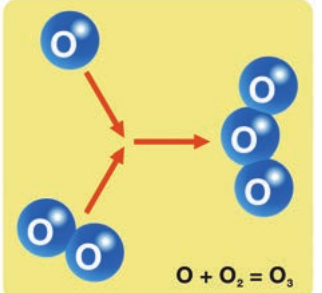
The ozone layer is a vital protective shield in Earth's atmosphere. Ozone is a special gas where each molecule contains three oxygen atoms bonded together, which scientists write as . This makes it different from the regular oxygen we breathe, which has only two oxygen atoms ().
Note
The word "deplete" means to reduce or lessen something, where more is lost than is replaced. Understanding this term is crucial when studying ozone layer problems.
Where is the ozone layer located?
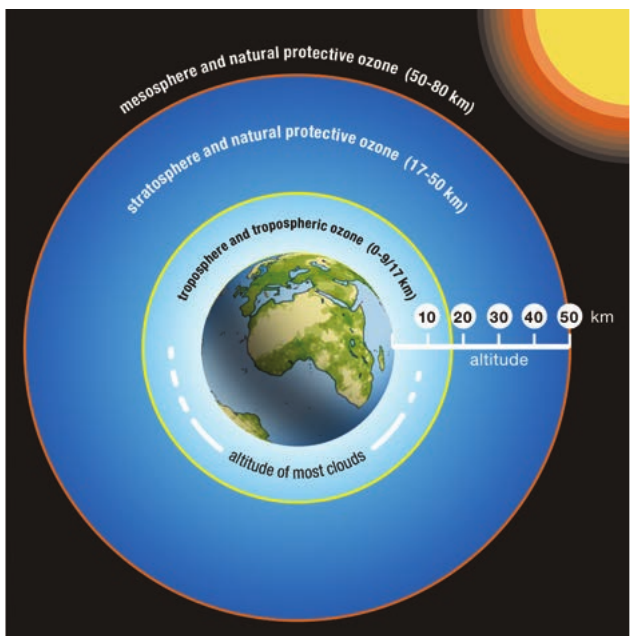
The ozone layer sits in the stratosphere, which is the second major layer of Earth's atmosphere. Most ozone exists between altitudes of 15 kilometres and 55 kilometres above Earth's surface.
Note
Ozone Distribution in the Atmosphere:
- 90% of all atmospheric ozone is found in the stratosphere
- Only 10% occurs in the lower atmosphere (troposphere)
How ozone is formed
Ozone forms through a simple but important chemical process in the upper atmosphere. When high-energy ultraviolet radiation from the sun hits a regular oxygen molecule (), it can split it into two separate oxygen atoms. One of these single oxygen atoms can then combine with another oxygen molecule to create ozone ().
Important
Ozone Formation Equation:
This chemical reaction is essential for maintaining Earth's protective ozone layer.
Functions of the ozone layer
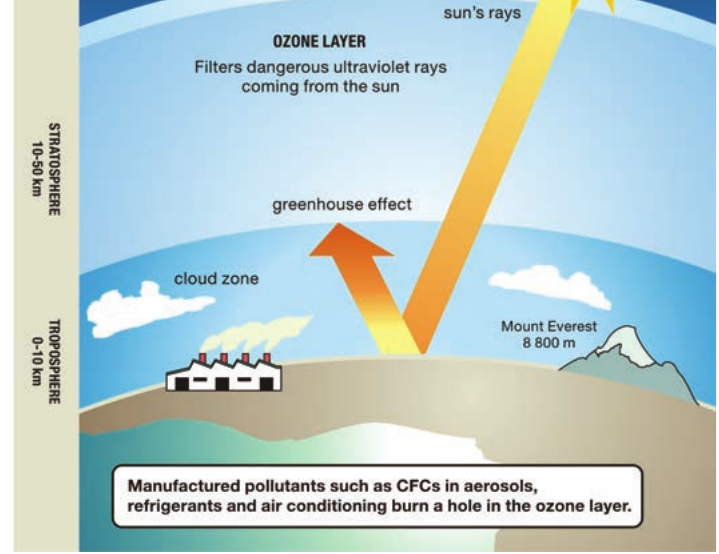
The ozone layer serves as Earth's natural sunscreen, performing a critical protective function. When ozone molecules absorb harmful ultraviolet (UV) radiation from the sun, they break apart into an oxygen molecule and a single oxygen atom. This process converts dangerous UV radiation into heat energy, which is why temperatures increase in the stratosphere.
Note
This protective function is essential for life on Earth because excessive UV radiation can damage living tissues and cause serious health problems. The ozone layer acts like a filter, screening out the most harmful wavelengths of solar radiation.
Measuring ozone levels
Scientists monitor ozone concentrations using a technique called remote sensing, which involves satellites and other instruments that can measure ozone from a distance. Ozone concentration is measured in Dobson Units, named after a British scientist.
Important
Critical Ozone Measurements:
- Average atmospheric ozone concentration: approximately 300 Dobson Units
- Ozone hole threshold: when measurements drop below 220 Dobson Units
When any area falls below this threshold, scientists consider it to have an "ozone hole."
Ozone depletion
Unfortunately, the ozone layer has been getting thinner over recent decades, a process known as ozone depletion. This thinning has serious consequences for life on Earth because it allows more harmful UV radiation to reach the planet's surface.
Note
Ozone depletion is not uniform across the globe - some areas experience more severe thinning than others, with the most dramatic effects observed over Antarctica.
Causes of ozone depletion
The primary cause of ozone depletion is a group of manufactured chemicals called chlorofluorocarbons, or CFCs. These chemicals were first developed in the 1930s and became popular because they seemed safe and stable.
CFCs were widely used in:
- Refrigeration systems
- Air conditioning units
- Aerosol sprays
- Manufacturing polystyrene foam
Important
The apparent stability of CFCs becomes a major problem in the stratosphere. When CFCs finally reach the upper atmosphere, intense UV radiation causes them to break down and release chlorine atoms - and these chlorine atoms are what destroy ozone molecules.
The process of ozone destruction
The destruction of ozone follows a devastating chain reaction process. When UV radiation breaks down a CFC molecule, it releases chlorine atoms. These chlorine atoms are highly reactive and attack ozone molecules, stealing oxygen atoms to form chlorine monoxide and leaving behind ordinary oxygen molecules.
Important
The Devastating Chain Reaction:
The most dangerous aspect of this process is that one chlorine atom can destroy thousands of ozone molecules before it is removed from the atmosphere. This creates a continuous cycle of destruction that significantly depletes the ozone layer.
Evidence of this depletion can be seen in satellite measurements comparing ozone levels between 1983 and 1993, which show dramatic thinning, particularly over Antarctica.
Effects of ozone depletion
A reduction in ozone has serious consequences for both human health and the environment. Scientists have calculated that just a 1% reduction in ozone concentration results in a 2% increase in harmful UV radiation reaching Earth's surface.
Important
Critical Relationship:
This mathematical relationship shows how even small changes in ozone can have significant impacts on Earth's surface.
Effects on humans
| Effect | Description |
|---|---|
| Skin cancer | Increased UV exposure raises the risk of developing skin cancers |
| Eye cataracts | UV radiation can damage eye tissues, leading to cataracts |
| Weakened immune systems | Higher UV levels can suppress immune function in both people and animals |
| Increased malaria incidence | Changes in environmental conditions may affect disease patterns |
Effects on the environment
| Effect | Description |
|---|---|
| Altered weather patterns | Changes in atmospheric heating can affect global weather systems |
| Higher surface temperatures | More UV radiation reaching Earth contributes to warming |
| Disrupted plant life cycles | Plants may be damaged by increased UV, affecting food chains |
| Microscopic organism death | Tiny organisms that form the base of food chains may die out |
Ways to protect the ozone layer
Fortunately, there are many practical steps that individuals and society can take to help protect the ozone layer:
- Choose ozone-friendly products: Look for items labelled as "ozone friendly" when shopping
- Proper CFC disposal: Technicians should recover and recycle old CFCs from refrigerators and air conditioners rather than releasing them
- Regular maintenance: Check air conditioning units regularly for leaks to prevent CFC escape
- Reduce air travel: High-altitude flights can reduce atmospheric oxygen levels
- Eliminate harmful chemicals: Stop producing CFCs and other ozone-depleting substances
- Plant trees: Trees release oxygen through photosynthesis, helping replenish atmospheric oxygen
Note
Every action counts when it comes to ozone protection. Individual choices, when multiplied across millions of people, can make a significant difference in reducing ozone-depleting substances in our atmosphere.

International action: The Montreal Protocol
The Montreal Protocol is a landmark international environmental treaty designed to protect the ozone layer. This agreement works by gradually phasing out the production of substances believed to cause ozone depletion.
Since 1989, the protocol has established timetables for eliminating different ozone-depleting chemicals. For example, it has set targets to phase out hydrochlorofluorocarbon (HCFC) chemicals, with a final phase-out scheduled for 2030.
Note
UNIDO's Role:
The United Nations Industrial Development Organisation (UNIDO) plays a key role in helping developing countries transition to ozone-friendly alternatives. UNIDO focuses on cost-effective ways to reduce ozone-depleting substances in areas such as refrigeration, plastic foams, solvents, and aerosols.
Summary
Key Points to Remember:
- Ozone (O₃) is a protective gas made of three oxygen atoms that shields Earth from harmful UV radiation in the stratosphere
- CFCs are the main culprit - these manufactured chemicals break down in the upper atmosphere and release chlorine atoms that destroy ozone molecules
- One chlorine atom can destroy thousands of ozone molecules through a chain reaction process, making CFC pollution extremely damaging
- Ozone depletion affects everyone - it increases UV radiation reaching Earth, causing health problems like skin cancer and environmental damage
- International cooperation works - the Montreal Protocol demonstrates how global action can successfully address environmental threats by phasing out harmful substances