India (Mughal) from 1526 to 1858 (Grade 10 NSC Matric History): Revision Notes
📚Revision Notes
India (Mughal) from 1526 to 1858
The Mughal Empire was one of the most powerful and influential empires in Indian history. This Muslim dynasty, originating from the Uzbekistan region in Central Asia, transformed the Indian subcontinent from 1526 until British colonial rule was established in 1858. Understanding this period is crucial for grasping how India developed politically, socially, and economically during these transformative centuries.

The establishment of Mughal rule
In 1526, Babur, a descendant of both Genghis Khan and Tamerlane, successfully invaded India and founded what would become the largest empire in Indian history by 1600. Babur was not just a conqueror but a remarkable leader who brought multiple talents to his new empire. He demonstrated exceptional military strategy, possessed literary gifts as both a writer and poet, created beautiful palace gardens, and governed according to strict personal principles.
/newsnation-english/media/post_attachments/images/2017/06/05/542580333-MughalemperorBabur.jpg)
The Mughals brought significant changes that would reshape Indian society for centuries. They successfully unified numerous small kingdoms under a single centralised government, creating unprecedented political stability. This unification enabled anyone to approach the emperor directly with complaints or concerns, establishing a more accessible form of governance than had existed before. Perhaps most importantly, the Mughals introduced religious tolerance, allowing different faiths to coexist peacefully within their empire.
Note
The concept of religious tolerance under Mughal rule was revolutionary for its time. Unlike many other empires that imposed their religion on conquered peoples, the Mughals allowed Hindus, Muslims, Christians, and other religious groups to practice their faiths freely, contributing to the empire's stability and cultural richness.
Government structure and administration
The Mughal government operated as an effective centralised system that brought remarkable political stability to the Indian subcontinent. This stability became the foundation for significant economic growth throughout the empire. The Mughals also contributed to Indian culture by developing Urdu, a new language that blended Persian, Arabic, and Hindi elements, which became widely used across the region.
The strength of Mughal administration lay in its organised tax collection system and its recognition of local customs whilst maintaining overall imperial control. This balance allowed the empire to govern effectively across diverse populations and geographical regions.
Note
The development of Urdu as a common language was crucial for administrative efficiency and cultural unity. This linguistic innovation allowed people from different regions and backgrounds to communicate more effectively, facilitating trade, governance, and cultural exchange across the vast empire.
Social organisation and the caste system
Mughal society was structured on a feudal basis, meaning it operated through a hierarchy of land ownership and loyalty. At the top of this system sat the emperor, followed by powerful nobles who held impressive titles such as Maharaja or Raja (meaning 'king'). These nobles possessed vast estates, maintained their own private armies, governed local peasant populations, and collected taxes within their territories.
The majority Hindu population continued to live according to the traditional caste system, which divided society into four main social groups that determined a person's occupation and marriage prospects from birth. These groups were:
- Teachers, scholars, and priests - the learned class responsible for education and religious guidance
- Rulers and warriors - those who governed and protected society through military service
- Skilled traders, merchants, and minor officials - the commercial class that facilitated trade and administration
- Unskilled workers, peasants, service providers, and artisans - the labour force that sustained the economy
Important
Outside this system existed the 'untouchables' - people who lived in extreme poverty and performed jobs considered unpleasant or polluting. These individuals were strictly prohibited from interacting with members of the caste system, creating a stark division in society. This social exclusion represents one of the most challenging aspects of traditional Indian society during the Mughal period.
The position of women in Mughal India
During the Mughal period, women's status had declined significantly compared to ancient Indian times when they enjoyed equality with men. Mughal women faced several restrictions: they were required to cover their faces in public, child marriage was permitted, and the practice of sati (burning widows alive) occurred, though this horrific custom was eventually stopped.
Despite these limitations, women retained certain rights and opportunities. They could own property and operate businesses independently. Noble women, in particular, received superior education compared to the general female population, learning skills such as painting, poetry composition, and music performance. This created a divide between the experiences of wealthy and poor women within Mughal society.
Important
The practice of sati was one of the most disturbing aspects of this period. While not universally practiced and eventually banned, it represents the extreme restrictions placed on women's freedoms and the dangerous intersection of social pressure and religious misinterpretation.
Economic strength through trade networks
The Mughal Empire's centralised government created ideal conditions for economic prosperity through political stability and effective administration. The empire developed two key economic strengths: an efficient tax collection system and extensive trade networks that connected India to markets across the known world.
Internal trade flourished through well-established networks including important coastal ports for Indian Ocean commerce, river-based trade routes along the Ganges River, and overland routes connecting India to Afghanistan, the Middle East, and Central Asia. These networks enabled India to maintain profitable trade relationships with Europe, the Middle East, and Southeast Asia.
India's export economy was built on high-quality textiles such as muslin, calicos, and shawls, alongside valuable agricultural products including pepper, cinnamon, opium, and indigo (a purple dye highly prized in international markets). In exchange, India imported gold and silver, which strengthened the empire's wealth and supported further economic development.
Note
The Mughal trade networks were remarkably sophisticated for their time, connecting three continents and facilitating not just the exchange of goods, but also ideas, technologies, and cultural practices. These trade routes made India one of the wealthiest regions in the world during the 16th and 17th centuries.
Scientific and cultural achievements
The Mughal Empire demonstrated remarkable advancement in multiple fields. In astronomy, they constructed a major observatory near Delhi and invented sophisticated instruments, including a seamless celestial globe created using secret wax casting methods that represented cutting-edge technology of the time.
Military technology under the Mughals was superior to European standards. By the 16th century, Indian manufacturers were producing advanced firearms including large bronze guns, rapid-firing weapons, and war rockets with ranges exceeding one kilometre - innovations that gave Mughal armies significant advantages in warfare.
Architecture and art flourished through Persian influence, as Persian artists shared their cultural knowledge throughout the empire. Persian scribes created beautiful illustrated manuscripts depicting court celebrations, battles, and hunting scenes using cheetahs. The most famous architectural achievements include Emperor Humayun's tomb and the iconic Taj Mahal.

Example
The Construction of the Taj Mahal: A Monument to Love
Shah Jahan began construction of the Taj Mahal in 1632 as a memorial to his beloved wife who died after giving birth to their 14th child. This remarkable project demonstrates the empire's wealth and architectural capabilities:
- Duration: 16-year construction project
- Purpose: Memorial to Shah Jahan's wife
- Significance: Created what is still recognised today as one of the world's most beautiful symbols of love
- Legacy: Represents the pinnacle of Mughal architectural achievement
British colonisation and the end of Mughal rule
By the late 17th century, the Mughal Empire faced increasing pressure from European trading companies. The English East India Company (EEIC) established India as their primary trading destination, setting up commercial posts in various Indian provinces to export cotton textiles to European markets.
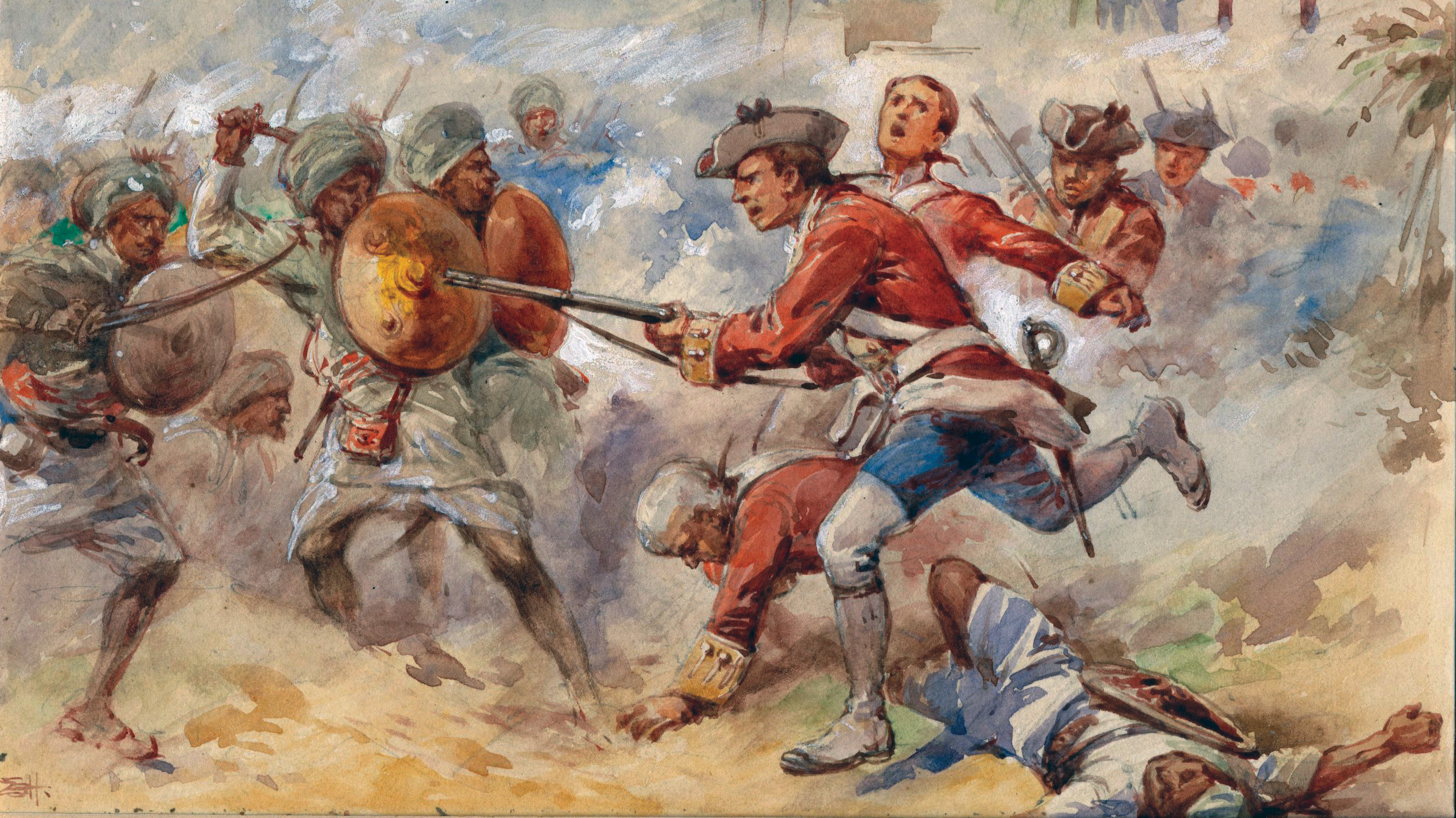
The decisive moment came in 1757 when Britain, led by Commander Robert Clive, defeated Mughal forces and seized control of the wealthy Bengal province. This military victory marked the beginning of systematic British colonisation of India.
Over the following century, British control expanded rapidly and relentlessly. By 1857, Britain had annexed an astounding 60% of the entire Indian subcontinent, effectively ending over three centuries of Mughal rule and replacing it with direct British colonial administration.
Important
The Battle of Plassey in 1757 represents a turning point in world history. This single military defeat not only ended Mughal dominance but also initiated a period of colonial exploitation that would fundamentally reshape India's economy, society, and political structure for the next 200 years.
Summary
Key Points to Remember:
- Babur founded the Mughal Empire in 1526, creating the largest empire in Indian history through military conquest and effective governance
- The feudal social structure included powerful nobles under the emperor, while the majority Hindu population lived according to the traditional four-tier caste system
- Economic prosperity resulted from political stability, efficient tax collection, and extensive trade networks connecting India to global markets
- Cultural achievements included advanced astronomy, superior military technology, and architectural masterpieces like the Taj Mahal
- British colonisation began in 1757 with the conquest of Bengal and culminated in controlling 60% of India by 1857, ending Mughal rule