Organic Compounds: Carbohydrates and Lipids (Grade 10 NSC Matric Life Sciences): Revision Notes
📚Revision Notes
Organic Compounds: Carbohydrates and Lipids
Introduction to organic compounds
Organic compounds are special molecules that contain carbon atoms, usually with at least one carbon-carbon or carbon-hydrogen bond. These compounds are essential for life because most molecules in living cells are carbon-based. The main types of organic compounds we'll study include carbohydrates, lipids, proteins, and nucleic acids.
These large molecules are built from smaller units called monomers. When several monomers join together, they form polymers. Each type of organic compound has a specific structure that determines its function in living organisms.
Note
Understanding the relationship between monomers and polymers is fundamental to biochemistry. Think of monomers as building blocks (like LEGO pieces) and polymers as the complex structures built from these blocks.
When studying organic compounds, we focus on four key aspects:
- Molecular make-up: the main elements that form each compound
- Structural composition: how monomers join together to create polymers
- Biological role: the importance of these molecules to animals and plants
- Chemical tests: how to detect the presence of each compound
Carbohydrates
Molecular make-up
Carbohydrates are made up of three elements: carbon (C), hydrogen (H), and oxygen (O). The name "carbohydrate" literally means "carbon with water" because these molecules contain carbon atoms combined with water molecules.
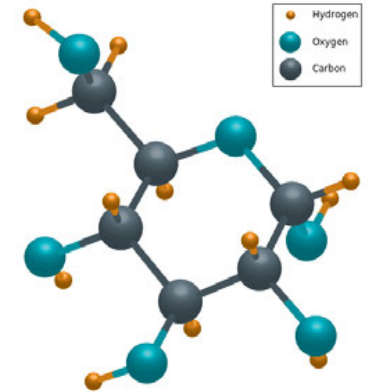
This diagram shows the 3D structure of a glucose molecule, which is the most common building block of carbohydrates.
Structural composition
Carbohydrates are built from simple sugar monomers called monosaccharides. The most important monosaccharide is glucose, though others include fructose and galactose.
Monosaccharides are single sugar units that can be joined together by special bonds called glycosidic bonds. When two monosaccharides join together, they form disaccharides. Common disaccharides include:
- Sucrose (table sugar) = glucose + fructose
- Lactose (milk sugar) = glucose + galactose
- Maltose (malt sugar) = glucose + glucose
When many monosaccharides join together, they form polysaccharides (complex carbohydrates). Important polysaccharides include starch, glycogen, and cellulose.
Note
The suffix "-ose" typically indicates a sugar. Notice how glucose, fructose, galactose, sucrose, lactose, and maltose all end in "-ose" – this is a helpful pattern to remember when identifying carbohydrates.
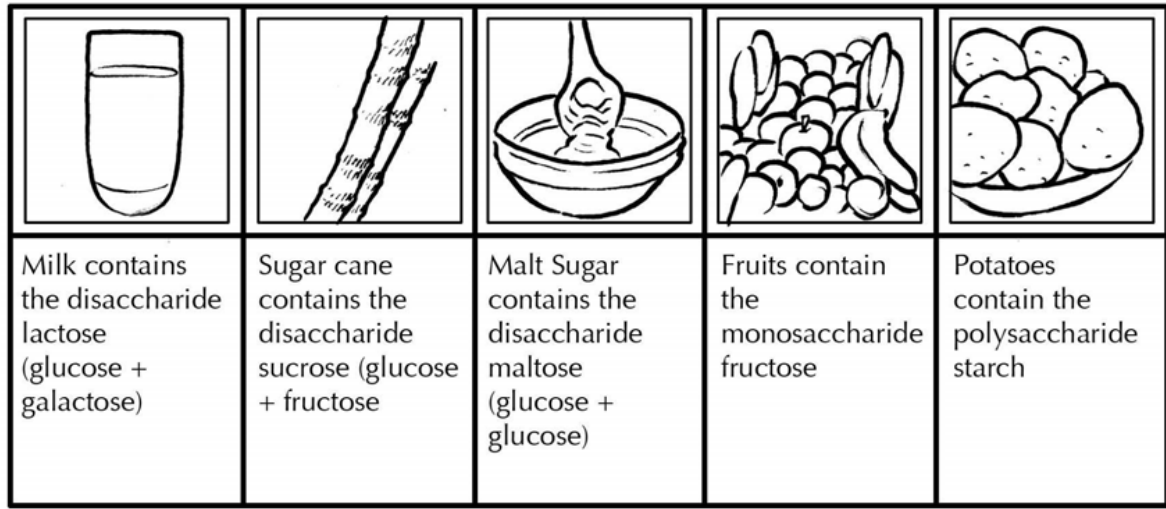
This table shows different types of carbohydrates and their food sources, helping you understand where these molecules are commonly found in our diet.
Role in animals and plants
Carbohydrates serve two main functions in living organisms:
Energy storage and supply: Carbohydrates are the body's preferred energy source. Each gramme of carbohydrate provides approximately 17 kilojoules (kJ) of energy. When cells need energy, they break down carbohydrates to release this stored energy.
Energy storage molecules:
- Starch: This is the main energy storage molecule in plants. Plants store excess glucose as starch in roots, stems, and seeds
- Glycogen: This is the energy storage molecule in animals. It's stored mainly in the liver and muscles
Important
Both starch and glycogen are made from glucose monomers, but their different branching patterns affect how quickly energy can be released. Glycogen is more highly branched than starch, allowing animals to access stored energy more rapidly when needed.
Structural functions: Cellulose forms the cell walls of plants, providing strength and support. All polysaccharides are made from glucose monomers, but their different arrangements give them different properties.
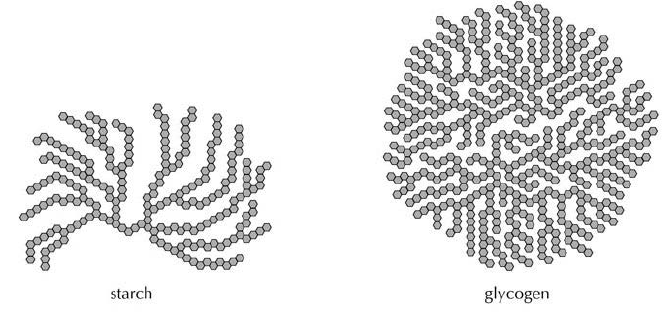
This comparison shows how starch has a more linear, tree-like structure while glycogen is highly branched and compact, making it ideal for quick energy release in animals.
Chemical tests to identify presence of carbohydrates
Test for starch
The iodine test is used to detect starch. When iodine solution is added to a substance containing starch, it turns blue-black. This colour change is the basis for identifying starch in food samples.
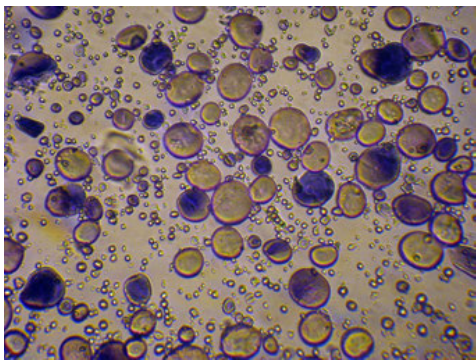
This microscopic image shows starch granules that have been stained, appearing as coloured circular structures of various sizes.
Example
Investigation: Test for the presence of starch
Aim: To test for the presence of starch using iodine solution
Apparatus:
- Piece of potato or bread
- Lettuce leaf
- Petri dish
- Iodine solution
- Dropper
Method:
- Place a piece of potato or bread and the lettuce leaf in the petri dish
- Using the dropper, add a few drops of iodine solution onto the potato or bread
Observations: Record any colour changes you observe
Questions:
- Can this method determine how much starch is present? Explain your answer
- What would you expect to see if you tested the lettuce leaf?
Test for reducing sugars
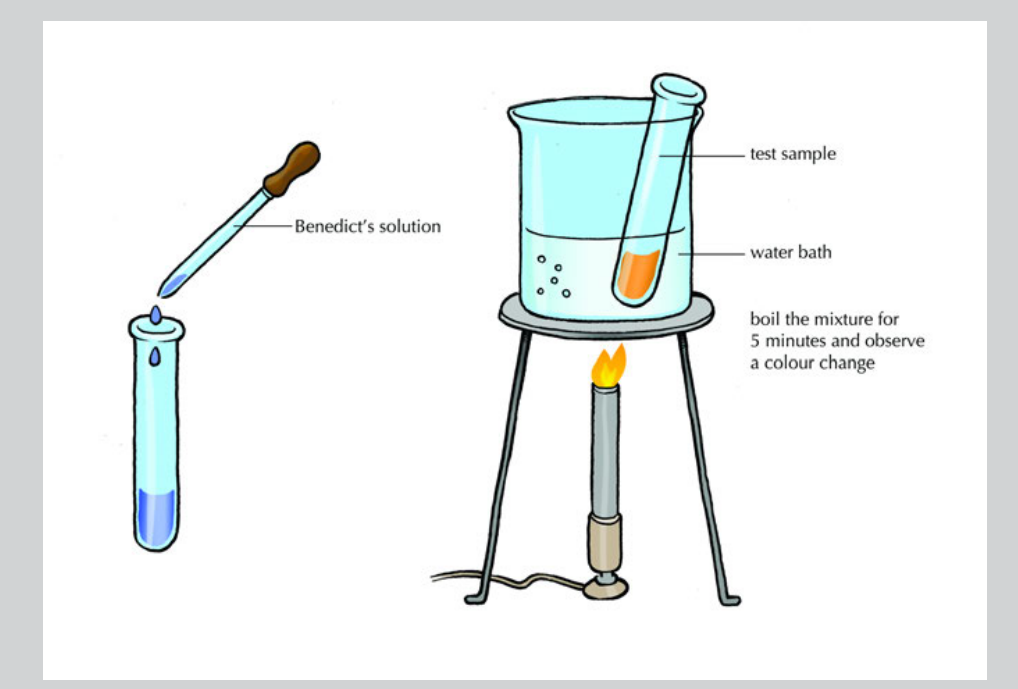
Some monosaccharides, like glucose, are called reducing sugars because they can easily undergo chemical reactions where they lose electrons. Benedict's test is used to detect these reducing sugars.
When Benedict's solution (which is blue) is heated with a reducing sugar, it changes colour from blue to green, yellow, orange, or brick-red, depending on the concentration of sugar present.
Note
The intensity of the colour change in Benedict's test indicates the concentration of reducing sugar present. A faint green indicates low concentration, while brick-red indicates high concentration.
Example
Investigation: Testing for the presence of reducing sugars
Aim: To test for the presence of sugars using Benedict's test
Apparatus:
- 4 heat-resistant test tubes
- 1 beaker
- Bunsen burner or water bath with hot water (+50°C)
- Test tube rack
- Glucose solution
- Albumen solution or egg white
- Starch solution
- Water
- Benedict's solution
- Marking pen
- Thermometer
- 10 ml syringe or measuring cylinder
Safety precautions:
- Follow safety procedures when lighting the Bunsen burner
- Ensure test tube mouths point away from you and others when heating
- Use test tube holders when handling hot tubes and wear safety goggles
Method:
- Prepare a water bath by filling a beaker halfway with water and heating it on a tripod over a Bunsen flame
- Label test tubes 1-4
- Add the following to each test tube:
- Test tube 1: 5 ml of 1% starch solution
- Test tube 2: 5 ml of 10% glucose solution
- Test tube 3: 5 ml of 1% albumen solution
- Test tube 4: 5 ml water
- Add 5 ml Benedict's solution to each tube
- Place test tubes in the hot water bath
- Monitor water temperature and maintain at approximately 50°C
- After about 5 minutes, observe any colour changes
- Remove tubes and compare colours
Results: Use this table format to record your observations from each test tube.
| Tube number | Observations in each tube |
|---|---|
| 1 | |
| 2 | |
| 3 | |
| 4 |
Questions:
- What colour changes did you observe after heating the samples with Benedict's solution?
- Which samples tested positive for reducing sugars?
- What happened to the consistency of the Benedict's solution during heating?
- What can you conclude from this investigation?
- Why was water included in test tube 4?
Lipids
Molecular make-up
Lipids contain carbon (C), hydrogen (H), and oxygen (O), but they have much less oxygen compared to carbohydrates. This gives lipids different properties and functions. Examples of lipids in our diet include cooking oils (like sunflower and olive oil), butter, margarine, and lard. Many nuts and seeds also contain high proportions of lipids.
Structural composition
Triglycerides are the most common type of lipids. These molecules consist of one glycerol molecule attached to three fatty acid chains. The fatty acid chains are made up of many carbon atoms joined together, and the number of carbons in these chains can vary.
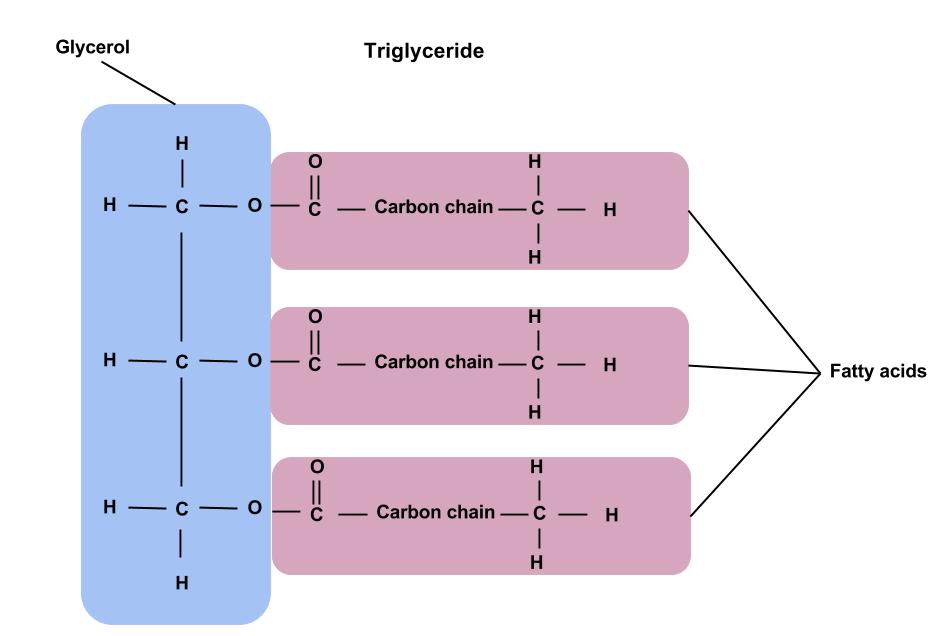
This diagram shows the basic structure of a triglyceride, with the glycerol backbone on the left and three fatty acid chains extending to the right.
Saturated and unsaturated fats
Carbon atoms can form four bonds with other atoms. In fatty acid chains, most carbons are bonded to two other carbons and two hydrogen atoms. However, sometimes two adjacent carbons form a double bond with each other, which affects the fatty acid's properties.
Saturated fatty acids have the maximum number of hydrogen atoms possible - they are "saturated" with hydrogen. These fatty acids have no double bonds between carbon atoms.
Unsaturated fatty acids have one or more double bonds between carbon atoms. These double bonds create "kinks" in the fatty acid chain:
- Monounsaturated fatty acids have one double bond
- Polyunsaturated fatty acids have multiple double bonds
Note
The "kinks" created by double bonds in unsaturated fats are crucial for their physical properties. These kinks prevent the molecules from packing tightly together, which is why unsaturated fats tend to be liquid at room temperature.
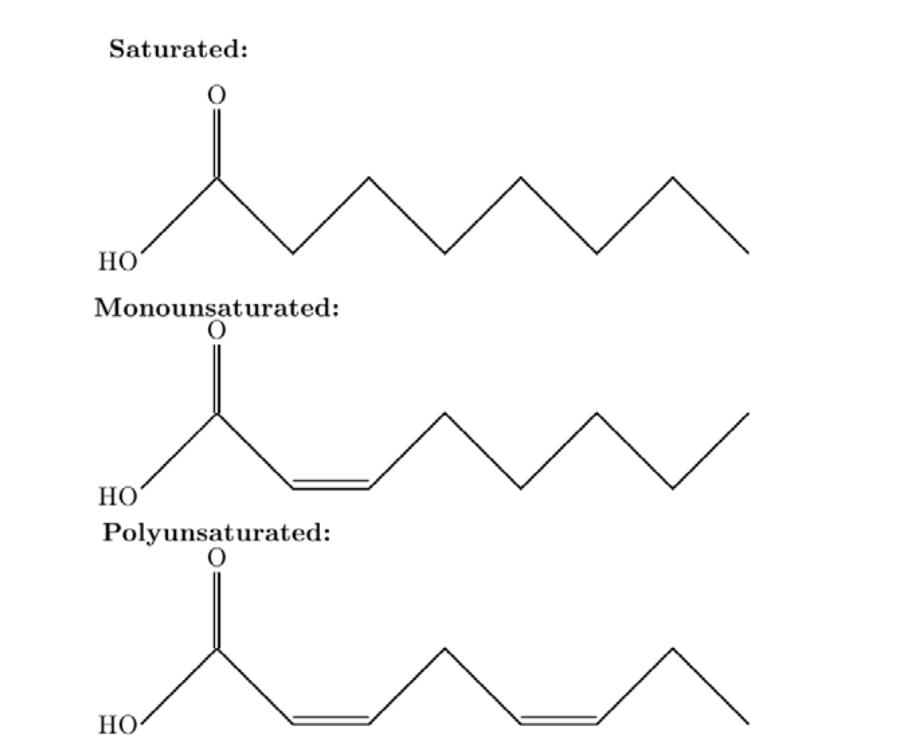
This diagram compares the three types of fatty acids, showing how double bonds create bends in the molecular structure.
The presence of double bonds affects the physical properties of fats:
- Saturated fats tend to be solid at room temperature
- Unsaturated fats tend to be liquid at room temperature
- The "kinks" in unsaturated fats prevent molecules from packing tightly together
Cholesterol
Cholesterol is an important organic molecule known as a sterol. It's a crucial component of cell membranes and is found in foods like cheese, eggs, pork, poultry, fish, and shrimp.
Cholesterol is transported through the body in the blood by proteins called lipoproteins:
Low Density Lipoprotein (LDL): Often called "bad" cholesterol because higher levels are associated with heart disease. LDL has a higher proportion of cholesterol relative to protein.
High Density Lipoprotein (HDL): Often called "good" cholesterol because it transports cholesterol away from cells to the liver for disposal. HDL has a high proportion of protein relative to cholesterol.
Important
High levels of LDL can cause cholesterol to build up in blood vessels, leading to narrowing and hardening of arteries, which can result in heart attacks. Maintaining a healthy balance of HDL and LDL cholesterol is crucial for cardiovascular health.
Role in animals and plants
Lipids serve several important functions in living organisms:
Energy storage: Lipids are an excellent energy reserve, containing 37.8 kilojoules (kJ) of energy per gramme - more than twice the energy provided by carbohydrates. When triglycerides are broken down, they release glycerol and fatty acids that can be used for energy.
Note
Compare the energy content: carbohydrates provide 17 kJ/g while lipids provide 37.8 kJ/g. This makes lipids incredibly efficient for long-term energy storage, which is why animals store excess energy as fat rather than carbohydrates.
Essential nutrients: Some fatty acids are essential nutrients that cannot be produced by the body and must be obtained from food. Non-essential fatty acids can be produced in the body from other compounds.
Protection and insulation: Lipids help insulate body organs against temperature changes and physical shock, helping maintain body temperature.
Vitamin transport: Lipids are important for the digestion and transport of essential fat-soluble vitamins.
Cell membrane structure: Lipids play a crucial role in forming cell membranes, controlling what enters and leaves cells.
Test for lipids
The grease spot test is used to detect lipids. This test works because lipids leave a translucent "grease spot" on brown paper bags, while non-lipid substances do not.
Example
Investigation: Test for the presence of lipids
Aim: To test for the presence of lipids using the grease spot test
Apparatus:
- Brown paper or "fish-and-chips" paper bag
- Food items (e.g., chips, cooked meat)
- 10 ml cooking oil (positive control)
- 10 ml water (negative control)
Method:
- Positive control: Add cooking oil to brown paper bag until it soaks in. The area that absorbs oil should become translucent compared to areas that don't
- Negative control: Wet the paper with water. The paper may become wet and soggy but should not become translucent
- Experimental samples: Rub the brown paper bag with the food item being tested. If it becomes translucent (similar to the positive control), the food item contains lipid
Observations: Record your observations, noting key differences between the controls and experimental samples
Summary
Key Points to Remember:
- Organic compounds contain carbon and are essential building blocks of life
- Carbohydrates (C, H, O) provide energy and structure - test with iodine for starch and Benedict's solution for reducing sugars
- Monosaccharides are simple sugars, disaccharides are two sugars joined, polysaccharides are many sugars joined
- Lipids have less oxygen than carbohydrates and provide concentrated energy storage - test with grease spot test
- Triglycerides consist of glycerol plus three fatty acids
- Saturated fats have no double bonds, unsaturated fats have one or more double bonds that create kinks
- Carbohydrates provide 17 kJ/g while lipids provide 37.8 kJ/g of energy