Developing Questions and Collecting Data (Grade 10 NSC Matric Mathematical Literacy): Revision Notes
📚Revision Notes
Developing Questions and Collecting Data
Introduction and key concepts
Data handling is a systematic process that helps us gather, organise and analyse information to answer research questions. In this topic, you will learn three essential skills:
- Develop research questions - Create clear, focused questions that can be investigated
- Collect, classify and organise data - Gather information using appropriate methods and arrange it systematically
- Summarise, represent and analyse data - Process the information to draw meaningful conclusions
Note
These skills work together in a continuous cycle that forms the foundation of statistical investigation and research. Mastering each component is essential for conducting reliable research.
The data handling cycle
The process of handling data follows a structured, cyclical approach with five interconnected stages:
- Develop research question - Identify what you want to investigate
- Plan research - Decide how you will conduct your investigation
- Collect data - Gather the information you need
- Classify and organise data - Sort and arrange your information systematically
- Summarise, represent and analyse data - Process and interpret your findings
Key concept: Research
Research means studying a subject systematically to uncover new facts or gain new insights.
Important
This process is cyclical because analysing your results often leads to new questions, which starts the cycle again. This continuous nature allows researchers to build knowledge progressively and refine their understanding.
Understanding bias and valid data
When collecting information, we must ensure our data accurately reflects reality. This requires avoiding bias and ensuring our data is valid.
Valid data means the information represents the real world accurately. If data is not valid, any conclusions we draw will be unreliable.
Important
Bias can occur in two main ways:
- Intentionally - When researchers deliberately try to get specific results
- Unintentionally - When poor planning leads to skewed data
To collect valid data, careful planning is essential at every stage of the data collection process.
Developing clear research questions
The importance of research aims
Before starting any investigation, you must clearly state your research aim. A good research question should be:
- Specific - Focus on exactly what you want to find out
- Measurable - Allow you to collect concrete data
- Achievable - Be possible to investigate with available resources
Note
Example of unclear vs clear research aims:
- Unclear: "I want to find out what learners think about the school"
- Clear: "To find out learners' opinions about the condition of the school buildings and whether the facilities are adequate"
The clearer version specifies exactly what aspects of the school will be investigated and can be measured through specific questions.
Methods of collecting data
There are four main methods for collecting data, each suitable for different types of investigations:
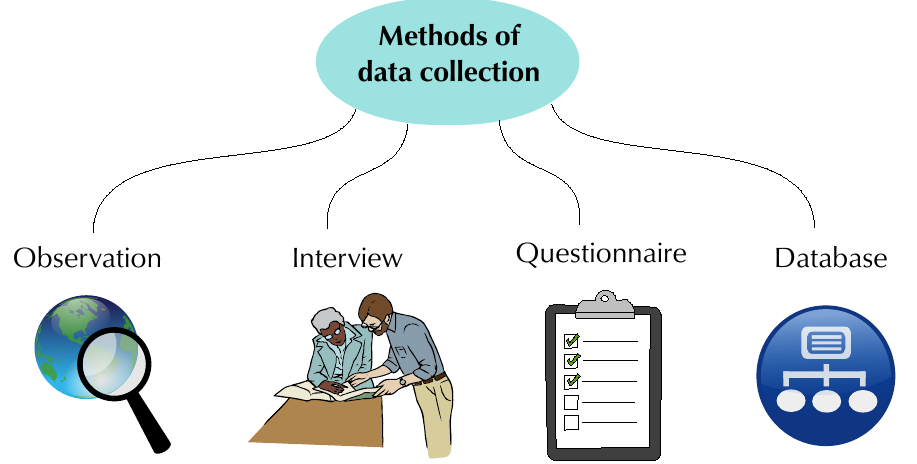
1. Observation
Observation involves watching and recording what happens without interfering with the situation.
Note
When to use observation:
- When you need to record behaviour or events as they naturally occur
- When personal contact is not necessary or desired
- For gathering objective, factual information
Example: Counting the number of vehicles crossing an intersection each hour provides observational data about traffic patterns.
2. Interview
Interviews involve direct conversation between a researcher (interviewer) and a participant (interviewee or respondent).
Note
When to use interviews:
- When you need detailed, personal responses
- To explore opinions, feelings, or experiences
- When you want to ask follow-up questions for clarity
Example: Interviewing bank customers about their satisfaction with service allows for detailed feedback and clarification of responses.
3. Questionnaire
Questionnaires are predetermined sets of questions given to respondents to complete independently.
Note
When to use questionnaires:
- When you need information from many people
- When respondents are spread over a wide area
- When you want standardised responses that can be easily compared
- For sensitive topics where anonymity is important
Example: The South African population census uses questionnaires to collect standardised information from millions of households.
4. Database
Databases contain information that has already been collected and organised systematically.
Note
When to use databases:
- When the information you need already exists in organised form
- To save time and resources
- When you need historical or official data
Example: School registers contain learners' birth dates, which can provide age information without collecting new data.
Example
Worked Example: Choosing data collection methods
Question: Which method would be most appropriate for collecting data in each case? Give reasons for your choices.
- How many learners at your school know about tuberculosis (TB) and what their perceptions are
- Whether bank clients feel they are treated professionally by bank staff
- The symptoms of hospital patients with cancer
- The average age of all learners in Grade 10
Solution:
-
Anonymous questionnaires would be most useful because learners don't need to worry about answering incorrectly. Interviews by a skilled interviewer could also be useful to find out more about what learners know and believe about TB.
-
A questionnaire that clients fill in while visiting a bank would be a convenient way to collect this information from many customers.
-
Observation (in the form of medical examination) would be the best method for gathering objective medical data.
-
This information could most easily be obtained from a database, such as the school's register of learners, which should contain all learners' dates of birth.
Population and sampling
Understanding population and sample
When collecting data, we must decide who to ask for information.
Population: The complete group that we want to collect data from and make conclusions about.
Sample: A smaller selection chosen from the larger population.
Often, it's impossible or impractical to ask every person in the population, so we select a representative sample. The larger and more representative the sample, the more reliable our conclusions will be.
Avoiding sample bias
Sample bias occurs when certain sections of the population are not fairly represented in the sample. This makes the sample unrepresentative of the whole population.
Important
Example of sample bias: If you want to find out what learners at your school think about physical exercise, surveying only the soccer team would create bias. Soccer players are likely to be fitter and more positive about exercise than the general school population.
Random sampling
Random sampling helps avoid bias by giving every member of the population an equal chance of being selected. The interviewer doesn't choose specific people - selection is based on chance.
Note
Example: Asking every tenth learner who arrives at the school gate would be an example of random sampling.
Even with random sampling, some bias can still occur, so it's important to ensure your random sample is truly representative.
Developing effective questionnaires
A well-designed questionnaire is crucial for collecting valid, useful information. The questionnaire should aim for:
- High number of respondents
- Accurate information
- Clear, understandable questions
Guidelines for effective questionnaires
Important
1. Keep it short Don't include information you already know or questions that aren't necessary.
2. Analyse each question carefully Ask yourself:
- Is this question necessary?
- Can the respondent realistically answer this question?
- Will the respondent answer honestly?
- Can the question be answered quickly?
3. Use categories when appropriate Instead of asking for exact numbers (age, weight, salary), group them into ranges. This makes questions easier to answer and encourages more responses.
4. Choose question types carefully
Open-ended questions allow respondents to answer in their own words:
- Advantage: Provides detailed, insightful information
- Disadvantage: Takes longer to answer and may reduce response rates
Closed-ended questions provide options for respondents to choose from:
- Advantage: Quick and easy to answer, convenient for respondents
- Disadvantage: May not capture the full range of opinions
5. Check question wording Ensure all questions are clear and easily understood by your target audience.
6. Arrange questions logically Order questions in a sequence that's easy to follow and understand.
Example
Worked Example: Questionnaire design
Question: Design a questionnaire to collect information about "the heights of learners in your class."
Solution:
Height Survey Questionnaire
Hello! We are conducting a survey to get information about the heights of learners in this school. Please tick the correct box below.
Is your height:
| Height Range | Tick One |
|---|---|
| Shorter than 140 cm? | ☐ |
| 140-149 cm? | ☐ |
| 150-159 cm? | ☐ |
| 160-169 cm? | ☐ |
| 170 cm or taller? | ☐ |
Alternative: Observation Sheet for Measurement Data
| Range of heights (cm) | Number of learners |
|---|---|
| Shorter than 140 cm | |
| 140 cm - 149 cm | |
| 150 cm - 159 cm | |
| 160 cm - 169 cm | |
| Taller than 170 cm |
This approach uses categories instead of asking for exact heights, making it easier for respondents to answer quickly and encouraging higher response rates.
Summary
Key Points to Remember:
- Data handling follows a cyclical process - from developing questions through to analysis, which often leads to new questions
- Valid data accurately represents reality - careful planning is essential to avoid bias
- Choose the right collection method - observation for natural behaviour, interviews for detailed responses, questionnaires for many respondents, databases for existing information
- Sampling must be representative - avoid bias by using random sampling techniques where every member has an equal chance of selection
- Effective questionnaires are short, clear and well-organised - use categories and appropriate question types to encourage responses