Ratio, Rate, and Proportion (Grade 10 NSC Matric Mathematical Literacy): Revision Notes
📚Revision Notes
Ratio, Rate, and Proportion
What is a ratio?
A ratio is a way of comparing two or more numbers that are usually of the same type or measurement. When numbers have different units, you must convert them to the same units before making any calculations.
We write ratios using a colon (:) between the numbers.
For example, if 8 learners travel by bus and 12 learners travel by taxi, we can express this as a ratio of 8 learners travelling by bus to 12 learners travelling by taxi. We write this as 8 : 12.
This ratio can be simplified to 2 : 3 by dividing both numbers by 4.
Important
The order in which you state the ratio matters. A ratio of 1 : 7 is not the same as a ratio of 7 : 1.
Key facts about ratios
Note
Ratios don't have measurement units because the units cancel out. When we write a ratio of 3 litres to 4 litres as 3 : 4, we don't include 'litres'. However, the units must be the same before simplification. For example, a ratio of 300 ml to 1 litre must be written as 300 : 1000 before simplifying to 3 : 10.
Writing ratios in simplest form and equal ratios
You can write a ratio in its simplest form using the same method as simplifying fractions. Find a number that divides into both numbers, starting with the smallest number in the ratio, then check larger factors.
To check if ratios are equivalent, write both in their simplest form. If they simplify to the same ratio, they are equal.
Example
Worked Example: Writing ratios in simplest form
Question: Write these ratios in their simplest forms:
- 5 : 30
- 14 : 18
- 18 : 30
- 7 : 280
Solutions:
-
5 and 30 are both divisible by 5, so the ratio simplifies to 1 : 6
-
14 and 18 are both divisible by 2, so the ratio simplifies to 7 : 9
-
18 and 30 are both divisible by 6, so the ratio simplifies to 3 : 5
-
7 and 280 are both divisible by 7, so the ratio simplifies to 1 : 40
Writing ratios in unit form
A unit ratio occurs when one of the numbers in the ratio equals 1. This makes comparisons easier and is particularly useful in practical situations.
For example, if the ratio of 5 lilies to 15 daisies simplifies to 1 : 3, this is a unit ratio.
When a unit ratio is not in simplest form, you can create one by dividing both numbers by the smaller number. For example, 5 : 9 can be written as 1 : 1.8 by dividing both numbers by 5.
Example
Worked Example: Writing ratios in unit form
Question:

- There are 23 nurses in a hospital and 7567 patients. How many patients does each nurse care for?
- In a Grade 10 class, learners vote for a class badge. 4 learners vote for badge A and 17 vote for badge B. How many learners vote for badge B for each learner voting for badge A?
Solutions:
- 23 : 7567
Divide both numbers by 23:
So each nurse cares for 329 patients on average.
- 4 : 17
Divide both numbers by 4:
So there are 4.25 votes for Badge B for every one vote for Badge A.
What is a rate?
A rate is also a comparison between two numbers or measurements, but unlike ratios, the two numbers in a rate have different units.
Examples of rates include:
- Cost rates (potatoes cost R 16.95 per kg)
- Speed rates (a car travels at 60 km/h)
When calculating rates, we divide by the second value to find the amount per one unit.
Unit rates
A unit rate expresses a rate where one quantity equals 1 unit.
For example, if we want a rate for R 20 for 2 kg of flour:
This rate is a unit rate because it shows the cost per 1 kg.
Example
Worked Example: Calculating rates
Question:
- Elias, a star athlete, runs 100 m in 15 seconds. a) What is his speed in metres per second? b) If he could keep running at this speed, how long would it take to cover 1 km?
- Cheese costs R 56 per kg. Thandi buys 200 g of cheese. How much does she pay?

Solutions:
a)
b) 1 km = 1000 m
There are 1000 g in 1 kg. We can either work out that there are 5 × 200 g in 1000 g and divide the cost by 5, or calculate the cost per 100 g first.
Cost per 100 g =
200 g costs
Finding missing numbers in ratios and rates
We can use ratios and rates to find unknown values by using equivalent ratios and cross-multiplication.
Example
Worked Example: Finding missing numbers in a ratio
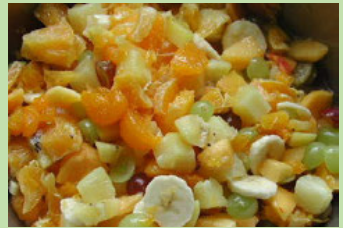
Question: Thenji makes a fruit salad for breakfast at a restaurant. She uses pieces of fruit in the following ratio:
banana : apple : paw-paw 1 : 2 : 3
-
If she uses 20 pieces of apple, how many pieces of banana and paw-paw should she use?
-
If she uses 12 pieces of banana, how many pieces of apple and paw-paw should she use?
Solutions:
-
Start with the banana : apple ratio: So we have 10 banana pieces and 20 apple pieces.
Next, look at the apple : paw-paw ratio: So we have 20 apple pieces and 30 paw-paw pieces.
Complete ratio: 10 : 20 : 30
-
Start with banana : apple ratio: So we have 12 banana pieces and 24 apple pieces.
For apple : paw-paw ratio:
Using cross-multiplication:
Complete ratio: 12 : 24 : 36
Direct proportion and inverse proportion
Equal ratios show a directly proportional relationship. There is another type of relationship called inverse proportion.
Note
Definitions
-
Direct proportion: As one quantity increases, the other increases OR as one quantity decreases, the other decreases.
-
Inverse proportion: As one quantity decreases, the other increases OR as one quantity increases, the other decreases.
Example
Worked Example: Working with inverse proportion
Question: Learners at a school want to hire a hall for a party. They can hire the hall for one evening for R 3000. The learners who attend the party need to split the cost between them.
-
Draw up a table to show the cost per learner if 30, 50, 100, 200 and 300 learners attend the party.
-
The learners decide they can't hold the party if they need to pay more than R 25 each. What number of learners must go to the party for it to be affordable?
Solutions:
| Number of learners | Cost per learner going to the party |
|---|---|
| 30 | 100 |
| 50 | 60 |
| 100 | 30 |
| 200 | 15 |
| 300 | 10 |
- So there must be at least 120 learners going to the party.
This is an example of inverse proportion because as the number of learners increases, the cost per learner decreases.
Summary
Key Points to Remember:
- Ratios compare numbers of the same type using a colon (:) and can be simplified like fractions
- Rates compare numbers with different units to find amounts per unit
- Unit ratios have 1 as one number, making comparisons easier
- Direct proportion means quantities change in the same direction (both increase or both decrease)
- Inverse proportion means quantities change in opposite directions (one increases while the other decreases)