Squares, Square Roots, and Cubes (Grade 10 NSC Matric Mathematical Literacy): Revision Notes
📚Revision Notes
Squares, Square Roots, and Cubes
What are squares?
When we square a number, we multiply that number by itself. This operation is fundamental in mathematics and has many practical applications.
Note
Definition: A square is the result when a number is multiplied by itself.
The mathematical notation for squaring uses a small 2 as a superpower: (read as "n squared").
Visual representation of squares
We can understand squares better by looking at them as grid diagrams. The number of blocks along each side of the square represents the number being squared.
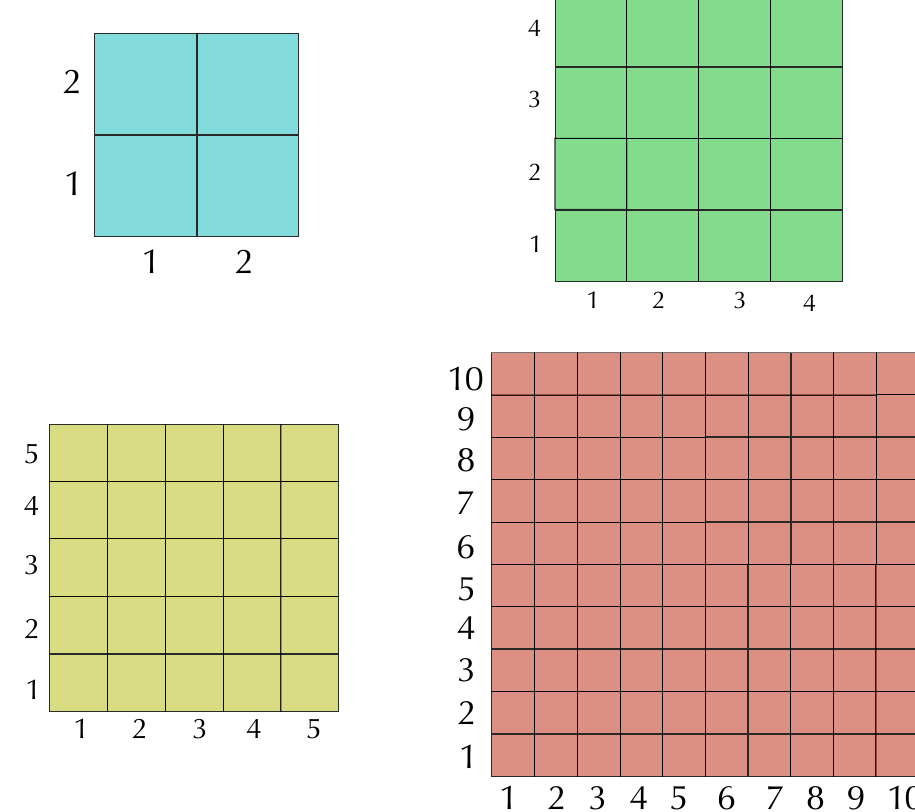
Looking at these grids:
- A grid contains small squares
- A grid contains small squares
- A grid contains small squares
- A grid contains small squares
Connection to area
The area of any square equals the side length multiplied by itself. This is why we say "side squared" when calculating the area of a square.
Important
Formula: Area of square = side × side =
This concept will be essential when working with area calculations in geometry.
What are square roots?
A square root is the opposite operation of squaring. When we find the square root, we ask: "What number, when multiplied by itself, gives us this result?"
Note
Definition: The square root of a number is the value that, when squared, produces the original number.
We write square roots using the symbol . For example: because .
Understanding square roots through squares
Finding the square root of a number is the same as finding the side length of a square with that area. If a square has an area of 16 small squares, then each side must be 4 units long, so .
Important
Key relationship: Squaring and taking square roots are inverse operations - they undo each other.
What are cubes?
A cube is formed when we multiply a number by itself three times. This creates a three-dimensional shape.
Note
Definition: To cube a number means to multiply it by itself twice (three factors total).
The mathematical notation uses a small 3 as a superpower: (read as "n cubed").
Visual representation of cubes
We can visualise cubes as three-dimensional blocks made up of smaller unit cubes.
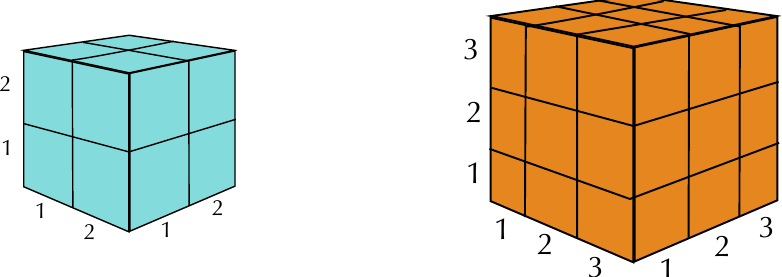
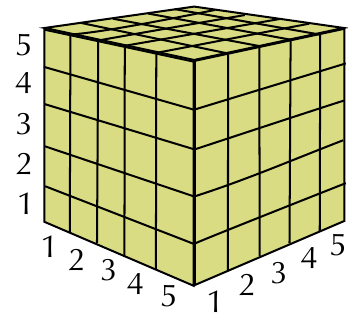
Looking at these cube diagrams:
- A cube contains small cubes
- A cube contains small cubes
- A cube contains small cubes
Key formulas
Important
To square a number: Multiply it by itself
- Example:
To cube a number: Multiply it by itself twice
- Example:
Using your calculator
You can easily calculate square roots using your calculator. Simply enter the number and press the square root key ( button).
For squares and cubes, you can:
- Use the power button (usually or )
- For squares: enter the number, then or use the button
- For cubes: enter the number, then
Note
Most scientific calculators have dedicated buttons for common operations like squares and square roots, making calculations much faster than doing them by hand.
Worked examples
Example
Worked Example: Finding squares
Calculate :
Example
Worked Example: Finding square roots
Calculate :
Ask: "What number multiplied by itself equals 49?"
, so
Example
Worked Example: Finding cubes
Calculate :
Example
Worked Example: Practical application
A square garden has an area of 144 square metres. What is the length of each side?
Solution: Find metres
The garden has sides of 12 metres each.
Example
Worked Example: Volume calculation
A cube-shaped box has sides of 3 cm. What is its volume?
Solution: Volume = cubic centimetres
The box has a volume of 27 cm³.
Summary
Key Points to Remember:
- Squaring means multiplying a number by itself:
- Square roots are the inverse of squaring - they help us find the original number
- Cubing means multiplying a number by itself three times:
- Squares relate to area (2D), while cubes relate to volume (3D)
- Use your calculator's square root button for quick calculations of values