Current (Grade 10 NSC Matric Physical Sciences): Revision Notes
📚Revision Notes
Current
What is current?
Current describes how electric charge moves through a circuit. Think of it like water flowing through a pipe - current measures how much charge flows past any point in the circuit every second.
Note
Understanding Current with an Analogy
To understand current better, imagine a tube filled with marbles in a row. When you push one marble into one end, another marble immediately pops out the other end. This is similar to how charge moves in a wire - all the charges start moving simultaneously when the circuit is connected.

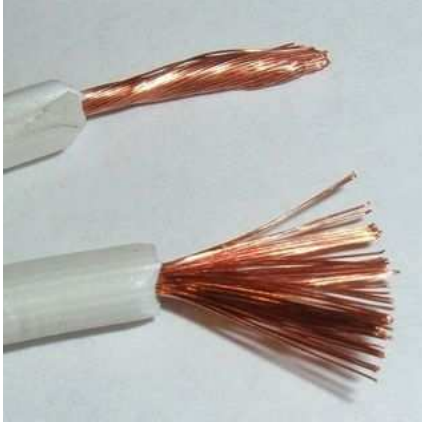
When a battery is connected to a circuit, it pushes charges around the wires. All the charges in the wire start moving at the same time, just like the marbles in the tube. The battery provides the energy needed to keep the charges moving.
Definition of current
Important
Current is the rate at which electric charge moves past a fixed point in a circuit.
- Quantity: Current (I)
- Unit name: Ampere
- Unit symbol: A
Current is measured in amperes (A). One ampere means that one coulomb of charge passes through a point in the circuit every second.
Current formula
The mathematical relationship for current is:
Where:
- I = current (in amperes, A)
- Q = charge (in coulombs, C)
- Δt = time (in seconds, s)
This formula tells us that current equals the amount of charge divided by the time taken.
Direction of current
By convention, we say that current flows from the positive terminal of a battery to the negative terminal. This is called conventional current direction.
When we draw circuit diagrams, we show current direction using arrows that point from positive to negative around the circuit.
Measuring current with an ammeter
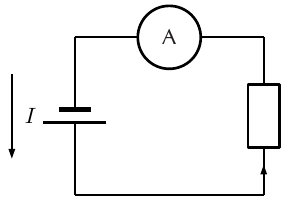
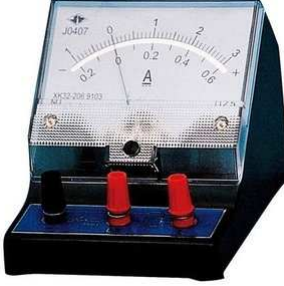
An ammeter is an instrument used to measure electric current in a circuit.
Important
Critical Connection Rule: An ammeter must be connected in series with the component whose current you want to measure. This means the current must flow through the ammeter to reach the component.
Circuit components and symbols
When building circuits, you need to know the symbols for different components:
| Component | Symbol | Function |
|---|---|---|
| Light bulb | ⊗ | Glows when current flows through it |
| Battery | ǁǁ | Provides energy for current to flow |
| Switch | ⟋ | Allows circuit to be opened or closed |
| Resistor | ▬ or ∿∿∿ | Limits the flow of current |
| Voltmeter | ⓥ | Measures potential difference |
| Ammeter | Ⓐ | Measures current |
| Connecting lead | — | Connects circuit elements together |
Measuring instruments comparison
| Instrument | Measured Quantity | Proper Connection |
|---|---|---|
| Voltmeter | Voltage | In Parallel |
| Ammeter | Current | In Series |
Note
Exam tip: Always connect meters to their largest scale first to prevent damage from high readings.
Worked examples
Example
Worked Example 1: Basic Current Calculation
Question: An amount of charge equal to 45 C moves past a point in a circuit in 1 second. What is the current in the circuit?
Solution:
-
Step 1: Identify what we know
- Charge (Q) = 45 C
- Time (Δt) = 1 s
- Need to find: Current (I)
-
Step 2: Apply the formula
- I = 45 A
-
Step 3: State the answer
- The current is 45 A
Example
Worked Example 2: Current with Different Time
Question: An amount of charge equal to 53 C moves past a fixed point in a circuit in 2 seconds. What is the current in the circuit?
Solution:
-
Step 1: Identify what we know
- Charge (Q) = 53 C
- Time (Δt) = 2 s
- Need to find: Current (I)
-
Step 2: Apply the formula
- I = 26.5 A
-
Step 3: State the answer
- The current is 26.5 A
Example
Worked Example 3: Current from Electron Flow
Question: 95 electrons move past a fixed point in a circuit in one tenth of a second. What is the current in the circuit?
Solution:
-
Step 1: Identify what we know
- Number of electrons = 95
- Time (Δt) = 0.1 s
- Charge of one electron = C
-
Step 2: Calculate total charge
-
Step 3: Apply the current formula
-
Step 4: State the answer
- The current is 1.52 × 10⁻¹⁶ A
Summary
Key Points to Remember:
- Current is the rate of charge flow past a point in a circuit
- Current is measured in amperes (A), where 1 A = 1 coulomb per second
- The formula is
- Ammeters must be connected in series to measure current
- Current flows from positive to negative by convention
- Always connect meters to their largest scale first to prevent damage