Reference Frame (Grade 10 NSC Matric Physical Sciences): Revision Notes
📚Revision Notes
Reference Frame
What is a reference frame?
Understanding motion starts with knowing where things are located. When you want to describe your position, saying you are "here" or "there" is meaningless without more information. You need to use known points, called reference points, to help specify exactly where you are.

Note
Think about giving directions to someone. You don't just say "turn left" - you say "turn left at the traffic light" or "turn left after the bank." These landmarks serve as reference points that give meaning to your directions.
A frame of reference is the combination of a reference point and a set of directions that allows us to describe the position of objects precisely. Think of it as setting up a coordinate system that everyone can understand and use.
Definition and components
Important
Frame of reference: A reference point combined with a set of directions.
This is the fundamental concept that underlies all position and motion descriptions in physics.
To create a useful frame of reference, you need two main components:
- Reference point (origin) - A fixed location that serves as your starting point for measurements
- Coordinate system - A set of directions that define positive and negative directions
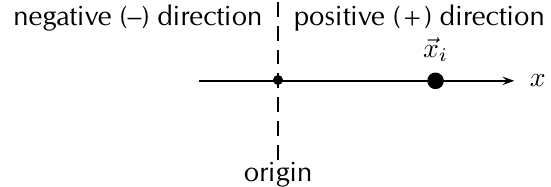
The diagram above shows a simple one-dimensional coordinate system. The vertical dashed line marks the origin (zero point), with positive direction to the right and negative direction to the left.
Setting up coordinate systems
When studying one-dimensional motion, we restrict ourselves to movement along a straight line. This simplifies our coordinate system to just one direction.
Important
One-dimensional motion: An object is constrained to move back and forth along a line.
This constraint makes calculations much simpler while still teaching the fundamental concepts of position and reference frames.
The beauty of physics is that you can choose different reference frames for the same problem, and while the position values might change, the physical results remain the same.
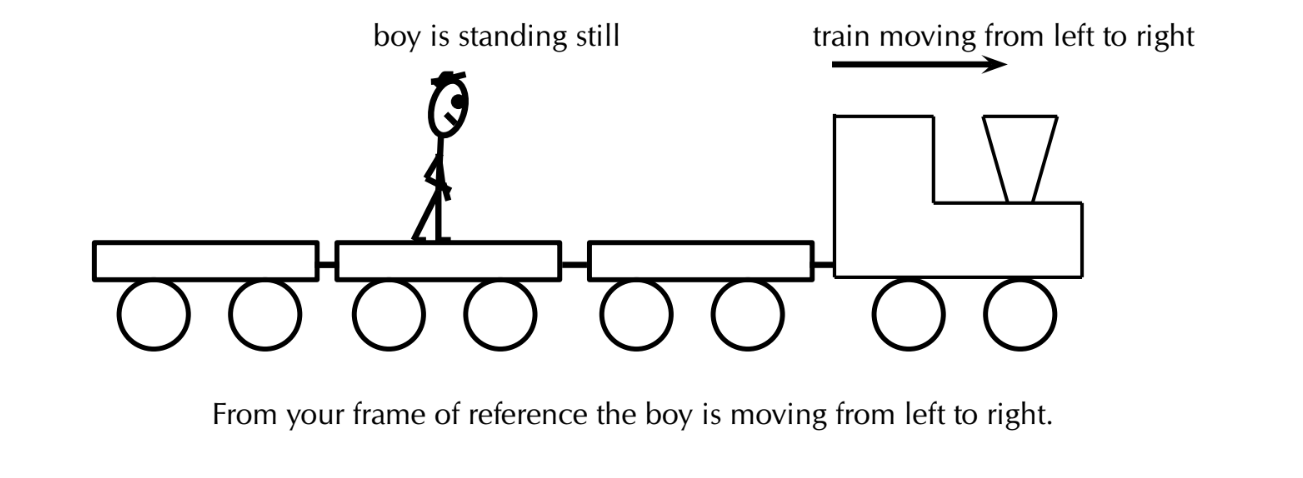
Consider the example of a boy standing on a moving train. From your perspective on the platform, the boy appears to be moving with the train. However, from the boy's perspective (using the train as his reference frame), he is standing still. Both descriptions are correct - it just depends on which reference frame you choose.
Position in different reference frames
Position is a measurement of location within a reference frame. Positions can be positive or negative depending on your choice of origin and coordinate system directions.
Important
Position: A measurement of a location, with reference to an origin.
- Quantity: Position (x)
- Unit name: metre
- Unit symbol: m
Remember that position values are meaningless without specifying the reference frame being used.
Let's look at a practical example to understand how reference frame choice affects position values:
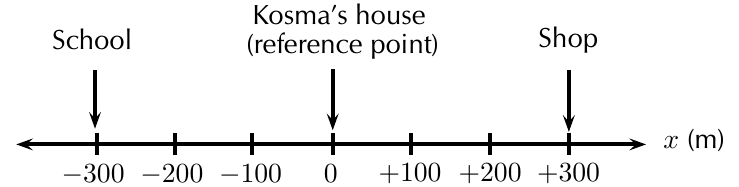
In this coordinate system, Kosma's house is at the origin (0 m). The school is 300 m to the left (negative direction), and the shop is 300 m to the right (positive direction).
But we could choose a different reference frame:
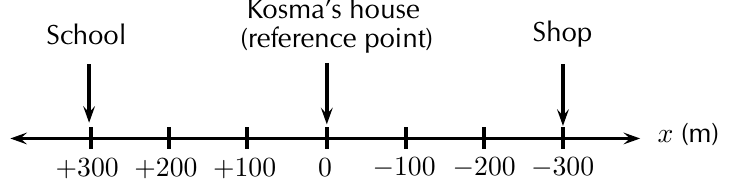
Here, we've chosen the same locations but changed which direction is positive. Now the school is at +300 m and the shop is at -300 m, with Kosma's house still at the origin.
Note
Notice how changing just the positive direction completely changes all the position values, even though the physical locations haven't moved at all. This demonstrates why clearly defining your reference frame is so important.
Worked example: choosing different reference frames
Let's examine how the same physical situation can be described using different reference frames:
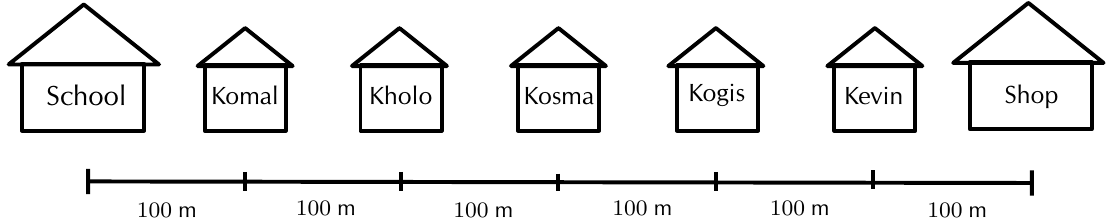
Example
Worked Example: Comparing Different Reference Frames
This shows seven locations spaced 100 m apart. Let's see how position values change when we choose different reference points.
Step 1: Using Kosma's house as the origin
- School position: -300 m
- Shop position: +300 m
- Kevin's house position: +100 m
Step 2: Using the school as the origin
- Kosma's house position: +300 m
- Shop position: +600 m
- Kevin's house position: +400 m
Observation: Notice how all position values change when we change the reference point, but the distances between locations remain the same.
Reference frames and relative motion
Reference frames help us understand that motion is relative. What appears to be moving in one reference frame may appear stationary in another.
Note
Key Points About Relative Motion:
- You must specify both a reference point and positive direction
- Position values depend on your choice of reference frame
- The same object can have different position values in different reference frames
- Physical processes are not affected by your choice of coordinate system
Practical applications
When solving physics problems, follow these steps:
- Choose a convenient reference frame - Often the starting position or a fixed landmark
- Clearly define your positive direction - Usually right, up, or forward
- Be consistent - Use the same reference frame throughout your calculations
- Remember position can be negative - This just means the object is on the opposite side of the origin from the positive direction
Important
Common Mistake to Avoid: Don't change your reference frame in the middle of a problem without clearly stating the change. This leads to confusion and incorrect answers.
Exam tips
- Always state your chosen reference frame clearly in exam answers
- Draw a simple coordinate system diagram to avoid confusion
- Remember that changing reference frames changes position values but not physical relationships
- When comparing motion from different perspectives, consider what each observer would see
Summary
Key Points to Remember:
- A reference frame combines a reference point (origin) with directions to create a coordinate system
- Position values depend on your choice of reference frame - the same object can have different coordinates in different systems
- Motion is relative - what appears moving in one frame may be stationary in another
- Physical results remain the same regardless of which reference frame you choose
- Always define your origin and positive direction clearly when solving problems