Sound (Grade 10 NSC Matric Physical Sciences): Revision Notes
📚Revision Notes
Characteristics of a Sound Wave
Sound waves possess specific properties that determine how we perceive them. Understanding these characteristics helps us explain why different sounds affect our ears in unique ways.
Note
The study of sound wave characteristics bridges physics and biology, helping us understand both how waves behave and how our sensory systems respond to different wave properties.
Basic properties of sound
Sound waves have three main characteristics that determine what we hear:
- Pitch - how high or low a sound seems
- Loudness - how strong or weak a sound seems
- Tone - the quality that distinguishes different sound sources
These properties relate directly to the wave characteristics of sound, allowing us to connect what we hear to measurable wave properties.
Pitch and frequency
Pitch describes how high or low a sound appears to our ears. This perception connects directly to the frequency of the sound wave.
Understanding the relationship
When a sound wave has a higher frequency, our ears perceive this as a higher pitch. Conversely, lower frequency waves create lower pitch sounds. Think of a bird's chirp compared to a lion's roar - the bird produces high-frequency waves that we hear as high pitch, while the lion creates low-frequency waves that sound much deeper.
Important
Key Relationship: Higher frequency = Higher pitch
This fundamental relationship allows us to predict how changes in wave properties will affect what we hear.
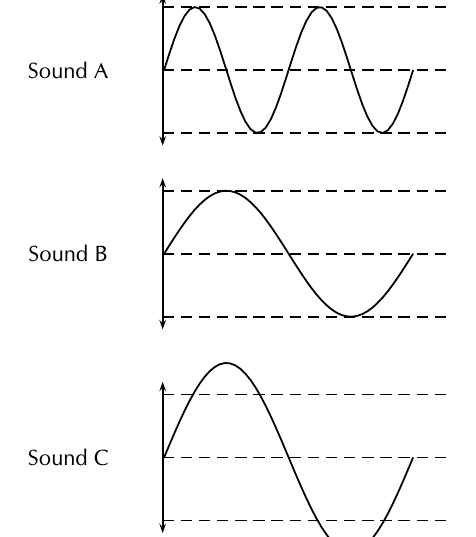
The diagram above shows three different sound waves. Sound A has the highest frequency and would produce the highest pitch. Sound B has a medium frequency, while Sound C has the lowest frequency and would create the lowest pitch.
Human hearing range
The human ear can detect sound frequencies ranging from 20 Hz to 20,000 Hz. This range defines the limits of human hearing:
- Infrasound: Any sound below 20 Hz cannot be heard by humans
- Ultrasound: Any sound above 20,000 Hz also lies beyond human hearing ability
Comparative hearing abilities
Different animals can hear vastly different frequency ranges compared to humans:
| Species | Lower Frequency (Hz) | Upper Frequency (Hz) |
|---|---|---|
| Humans | 20 | 20,000 |
| Dogs | 50 | 45,000 |
| Cats | 45 | 85,000 |
| Bats | 20 | 120,000 |
| Dolphins | 0.25 | 200,000 |
| Elephants | 5 | 10,000 |
This table reveals fascinating differences. Dolphins can hear frequencies up to 200,000 Hz, while elephants communicate using very low frequencies that humans cannot detect.
Loudness and amplitude
Loudness refers to how strong or intense a sound appears to our ears. This perception connects directly to the amplitude of the sound wave.
The amplitude connection
A larger amplitude creates a louder sound, while smaller amplitude produces softer sounds. The amplitude represents how much energy the sound wave carries. When a vibrating object moves with greater vigour, it creates larger amplitude waves that transfer more energy through the medium.
Important
Key Relationship: Larger amplitude = Louder sound
The amplitude directly relates to the energy carried by the wave - more energetic vibrations produce larger amplitudes and louder sounds.
Looking at the waveform diagram again, Sound C has the largest amplitude and would sound the loudest, while Sound B has the smallest amplitude and would be the softest.
Energy and vibration
The vibrating source determines a wave's amplitude. More energetic vibrations correspond to larger amplitudes. As molecules in the medium move back and forth more vigorously, they transfer more energy, resulting in louder sounds reaching our ears.
Ear sensitivity factors
Loudness perception also depends on the sensitivity of the human ear to different frequencies. Our ears respond more strongly to some frequencies than others. Therefore, the volume we actually perceive depends on both the wave's amplitude and whether its frequency falls within a range where our ears are particularly sensitive.
Note
Human ears are most sensitive to frequencies in the middle of our hearing range, around 1,000-4,000 Hz. This is why sounds at these frequencies seem louder than sounds of the same amplitude at very high or very low frequencies.
Practical investigations
Scientists use various methods to study sound wave characteristics, allowing direct observation of how physical changes affect wave properties.
Comparing sound-generating instruments
Example
Investigation Method 1: Vuvuzelas
- Compare sounds from vuvuzelas of different sizes
- Blow through each one with consistent effort
- Record which produces louder sounds (amplitude comparison)
- Record which creates higher-pitched sounds (frequency comparison)
- Analyze results to connect instrument size with sound characteristics
Example
Investigation Method 2: Tuning Forks
- Tap tuning forks of different sizes with equal force
- Compare their sounds using amplitude and frequency criteria
- Observe how the physical size of the fork relates to the pitch produced
- Note how the striking force affects the loudness
Electronic equipment
Function generators allow precise control over both frequency and amplitude of generated sounds. These devices can produce specific frequencies and amplitudes for detailed study.
Oscilloscopes display the characteristics of sound waves visually. While sound waves are longitudinal, oscilloscopes show the pressure variations as transverse wave patterns on screen. This visualisation helps students understand how frequency and amplitude changes affect the wave pattern.
Note
The oscilloscope's amplitude control adjusts how tall the displayed wave appears, while the frequency control determines how much time each screen division represents. This allows observation of both rapid and slow-changing signals.
Summary
Key Points to Remember:
- Pitch depends on frequency - higher frequency creates higher pitch
- Loudness depends on amplitude - larger amplitude creates louder sound
- Human hearing range spans 20 Hz to 20,000 Hz
- Infrasound (below 20 Hz) and ultrasound (above 20,000 Hz) cannot be heard by humans
- Different animals have vastly different hearing ranges, with some detecting much higher or lower frequencies than humans can perceive
- Electronic equipment like function generators and oscilloscopes allow precise study of sound wave characteristics