Pulses: Amplitude and Length (Grade 10 NSC Matric Physical Sciences): Revision Notes
📚Revision Notes
Pulses: Amplitude and Length
What is a pulse?
A pulse is a single disturbance that travels through a medium. Think of it like creating a bump that moves along a rope when you flick one end - this bump is the pulse moving from where you created it to the other end.
Note
Key characteristics of pulses:
- They are single disturbances (not continuous waves)
- They travel through a medium from one place to another
- The medium itself doesn't travel with the pulse - only the disturbance moves
Transverse pulses
A transverse pulse occurs when the particles in the medium move perpendicular (at right angles) to the direction the pulse is travelling.
For example, when you flick a rope horizontally, the rope moves up and down while the pulse travels horizontally along the rope. The particle motion (up-down) is perpendicular to the pulse direction (horizontal).
Understanding amplitude and pulse length
Two important measurements help us describe any pulse: its amplitude and its length.
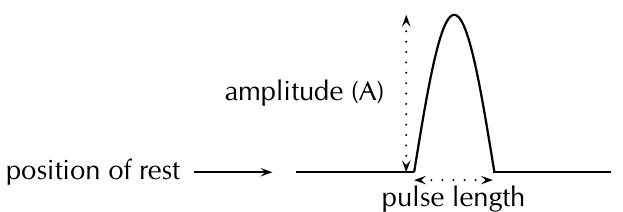
Amplitude
Amplitude is the maximum distance the medium is displaced from its rest position. It tells us how "big" or "strong" the pulse is.
Note
Key points about amplitude:
- Symbol: A
- Unit: metres (m)
- Measured from the rest position to the highest point of the pulse
- Shows how far the medium moves from its normal, undisturbed position
Pulse length
Pulse length measures how long the pulse is - essentially the width of the disturbance as it travels through the medium.
The position of rest (also called the equilibrium position) is where the medium would naturally be if no pulse was present. This serves as our reference point for measuring amplitude.
Pulse behaviour over time
An important discovery about pulses is that their amplitude and length remain constant as they travel through a medium.
Important
Critical concept: Pulse properties remain constant
As a pulse travels through a medium:
- The pulse keeps the same shape as it moves
- The amplitude stays the same throughout the journey
- The pulse length doesn't change
- Only the position of the pulse changes with time
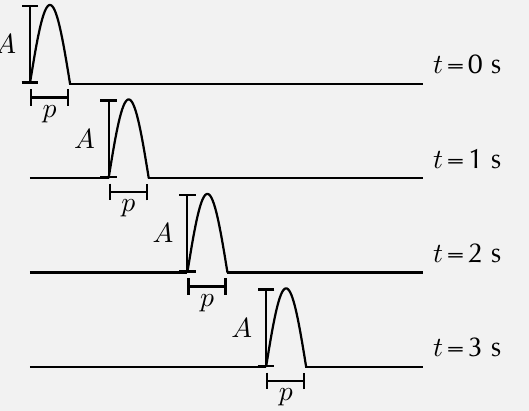
This constancy is crucial for understanding how energy and information can be transmitted through different media without losing their original characteristics.
Pulse speed
Pulse speed measures how fast a pulse travels through a medium. It's the distance covered by the pulse divided by the time taken.
Formula for pulse speed:
Where:
- = pulse speed (m·s⁻¹)
- = distance travelled (m)
- = time taken (s)
Example
Worked Example: Calculating pulse speed
Problem: A pulse covers a distance of 2 m in 4 s on a heavy rope. Calculate the pulse speed.
Solution:
-
Identify given information:
- Distance () = 2 m
- Time () = 4 s
- Find: pulse speed ()
-
Apply the formula:
-
Calculate:
-
Final answer: The pulse speed is 0.5 m·s⁻¹
Important
Important note: Pulse speed depends on the properties of the medium (like tension, density, material type) and NOT on the amplitude or pulse length. A small pulse and a large pulse will travel at the same speed through the same medium.
Summary
Key Points to Remember:
- A pulse is a single disturbance that travels through a medium, unlike continuous waves
- Transverse pulses have particle motion perpendicular to the direction of pulse travel
- Amplitude measures the maximum displacement from the rest position - it shows pulse strength
- Pulse length measures the width of the disturbance as it travels
- Pulse properties remain constant - amplitude and length don't change as the pulse moves
- Pulse speed = distance ÷ time and depends only on medium properties, not pulse characteristics