Other Properties of Transverse Waves (Grade 10 NSC Matric Physical Sciences): Revision Notes
📚Revision Notes
Other Properties of Transverse Waves
Points in phase
Understanding points in phase is essential for grasping other wave properties. When we examine a wave, certain points along the wave pattern behave in exactly the same way at the same time.
Note
Activity: Discovering Wave Patterns
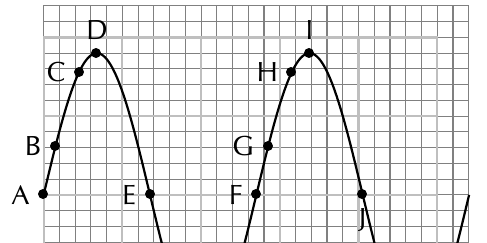
Let's explore this concept through a practical activity. When you measure the distances between specific points on a wave, you'll discover an important pattern.
| Points | Distance (cm) |
|---|---|
| A to F | |
| B to G | |
| C to H | |
| D to I | |
| E to J |
Through this activity, you would find that the distances between these point pairs are equal. This happens because these points are in phase with each other. Two points are in phase when they are separated by a whole number (1, 2, 3, ...) of complete wave cycles or wavelengths.
The key insight is that points in phase don't have to be crests or troughs - they just need to be separated by complete wavelengths and behave identically.
Definition of wavelength using points in phase
Important
Wavelength is the distance between any two adjacent points that are in phase.
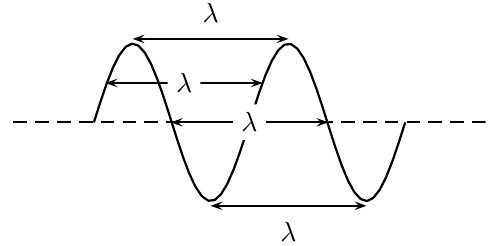
This gives us an alternative way to define wavelength. Rather than just measuring from crest to crest or trough to trough, we can measure between any two neighbouring points that are in phase.
Note
Points that are out of phase are those not separated by complete wavelengths. For example, if you look at points A and C, or D and E from the activity, these would be out of phase because they don't match the complete wavelength pattern.
Period and frequency
These two properties describe how waves behave over time, and they're closely connected to each other.
Understanding period
Imagine sitting by a pond watching waves pass by. You see one wave crest arrive, then a trough, then another crest. The time between one crest arriving and the next crest arriving is called the period.
Important
Period (T) is the time taken for two successive crests (or troughs) to pass a fixed point.
- Unit: seconds (s)
- Symbol: T
Understanding frequency
Now imagine counting how many wave crests pass you in exactly one second. This count gives you the frequency of the wave.
Important
Frequency (f) is the number of successive crests (or troughs) passing a given point in 1 second.
- Unit: hertz (Hz)
- Symbol: f
The relationship between period and frequency
Period and frequency are inversely related. If the period gets longer (more time between crests), then fewer crests pass in one second, so frequency decreases.
Note
Mathematical Relationship
The mathematical relationship is:
For example, if the time between consecutive crests is 0.5 seconds, then the period is 0.5 s. The frequency would be Hz, meaning 2 crests pass every second.
Worked example: calculating period from frequency
Example
Worked Example: Calculating Period from Frequency
Question: What is the period of a wave of frequency 10 Hz?
Solution:
Step 1: Determine what is given and what is required
- Given: frequency Hz
- Required: period
Step 2: Determine the approach We know that:
Step 3: Solve the problem s
Step 4: Write the answer The period of a 10 Hz wave is 0.1 s.
Speed of a transverse wave
Wave speed tells us how fast the wave pattern moves through the medium.
Definition of wave speed
Important
Wave speed (v) is the distance a wave travels per unit time.
- Unit: metres per second (m⋅s⁻¹)
- Symbol: v
Deriving the wave equation
Think about what happens in one complete period of a wave. The distance between two successive crests is one wavelength (λ). In the time of one period (T), the wave travels exactly one wavelength in distance.
Note
Wave Equation Derivation
Therefore:
Since , we can substitute to get:
This gives us the fundamental wave equation:
Important
Wave Equation:
Where:
- = speed in m⋅s⁻¹
- = wavelength in m
- = frequency in Hz
Worked example 1: string vibration
Example
Worked Example: String Vibration
Question: When a particular string is vibrated at a frequency of 10 Hz, a transverse wave of wavelength 0.25 m is produced. Determine the speed of the wave as it travels along the string.
Solution:
Step 1: Determine what is given and what is required
- Given: Hz, m
- Required: wave speed
Step 2: Determine the approach
Use the wave equation:
Step 3: Substitute the values
Step 4: Write the final answer The wave travels at 2.5 m⋅s⁻¹ along the string.
Worked example 2: ripples in water
Example
Worked Example: Ripples in Water
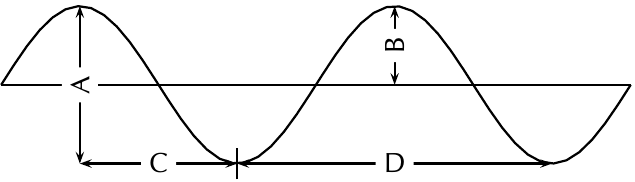
Question: A cork on the surface of a swimming pool bobs up and down once every second on some ripples. The ripples have a wavelength of 20 cm. If the cork is 2 m from the edge of the pool, how long does it take a ripple passing the cork to reach the edge?
Solution:
Step 1: Determine what is given and what is required
- Given: Hz, cm, distance m
- Required: time for ripple to travel from cork to edge
Step 2: Determine the approach Time = Distance/Speed, so We need to find using
Step 3: Convert wavelength to SI units 20 cm = 0.2 m
Step 4: Solve the problem First find speed:
Then find time: s
Step 5: Write the final answer A ripple passing the cork will take 10 s to reach the edge of the pool.
Summary
Key Points to Remember:
- Points in phase are separated by complete wavelengths and behave identically
- Wavelength is the distance between any two adjacent points that are in phase
- Period and frequency are inversely related:
- The wave equation connects speed, frequency, and wavelength
- Always check units are consistent when using the wave equation in calculations