Characteristics of Developing Countries (Grade 11 NSC Matric Economics): Revision Notes
📚Revision Notes
Characteristics of Developing Countries
Common characteristics of developing countries
Developing countries are nations that have lower levels of industrialisation and lower living standards compared to developed countries. Understanding their characteristics helps us identify the challenges these nations face and the areas where development is needed.
Low standard of living
One of the most obvious features of developing countries is their poor quality of life. This can be seen through several key indicators:
Low per capita income means that when you divide the country's total income by its population, each person's share is very small. This makes it difficult for individuals and families to afford basic necessities like food, clothing, and shelter.
High levels of poverty affect large portions of the population. Many people live below the poverty line, struggling to meet their daily needs. This creates a cycle where families cannot afford education or healthcare, making it harder for future generations to improve their circumstances.
Low economic growth means the country's economy is expanding slowly or not at all. When economic growth is limited, there are fewer job opportunities and less money available for government services like schools and hospitals.
Note
Uneven distribution of income is a serious problem in developing countries. While a small group of wealthy people may live comfortably, the majority of the population has very little. This inequality creates social tensions and prevents many people from accessing opportunities. The gap between rich and poor tends to be much wider in developing countries than in developed nations, making it one of the most challenging aspects of development to address.
Low life expectancy indicates that people in developing countries typically do not live as long as those in developed nations. This is due to factors like poor healthcare, inadequate nutrition, disease, and limited access to clean water and sanitation.
Population and dependency challenges
Developing countries often experience high population growth rates. This means their populations are increasing rapidly, which puts pressure on limited resources like food, water, housing, and healthcare. When population grows faster than the economy, living standards can actually decline.
These countries also have many dependants – people who rely on working family members for support. This includes large numbers of children and sometimes elderly relatives. When families have many dependants but few income earners, it becomes difficult to save money or invest in education and business opportunities.
Note
The Demographic Challenge
The combination of rapid population growth and high dependency ratios creates what economists call a "demographic burden." When a large portion of the population is too young or too old to work, the working-age population must support more people. This limits the resources available for investment in education, infrastructure, and economic development.
Economic structure and productivity
Most developing countries show a heavy dependence on primary products, particularly agricultural produce. This means their economies rely mainly on farming, fishing, mining, or forestry rather than manufacturing or services. This dependence is problematic because:
- Primary products often have unstable prices in world markets
- Agricultural income can be affected by weather and climate
- There is limited value addition to raw materials
- These sectors typically provide lower wages than manufacturing or services
Low productivity is another major challenge in developing countries. Productivity refers to how much output (goods or services) can be produced with given inputs (labour, capital, materials). Several factors contribute to low productivity:
Primitive technology means that workers often use outdated tools and equipment. A farmer using a hand plough will produce much less than one using a modern tractor. Without access to modern technology, workers cannot produce efficiently.
Poor organisation of businesses and workplaces means that resources are not used effectively. There may be unclear management structures, inadequate planning, or inefficient work processes that waste time and materials.
Limited capital and human inputs create a significant barrier to development. Capital refers to things like machinery, buildings, and equipment needed for production. Human capital includes the knowledge, skills, and health of workers. When both physical and human capital are scarce, productivity remains low.
Low skill levels in workers result from inadequate education and training systems. Without proper skills, workers cannot operate complex machinery, manage businesses effectively, or innovate to improve production methods.
Important
The Productivity Trap
Low productivity creates a vicious cycle: without productive workers, businesses cannot generate enough profit to invest in better technology and training. Without investment, productivity stays low. Breaking this cycle requires coordinated efforts in education, technology transfer, and capital investment – all of which require resources that developing countries often lack.
Employment and infrastructure challenges
High unemployment affects many developing countries. This means that large numbers of people who want to work cannot find jobs. High unemployment leads to poverty, social problems, and wasted human potential. It also reduces tax revenue that governments need to provide services.
Inadequate infrastructure is a fundamental problem that affects all aspects of life in developing countries. Infrastructure includes:
- Roads and transportation systems
- Electricity and water supply
- Telecommunications networks
- Schools and hospitals
- Ports and railways
Poor infrastructure makes it difficult for businesses to operate efficiently, prevents access to markets, and limits people's access to education and healthcare. For example, children cannot attend school if there are no roads to reach it, and businesses cannot export products if there are no reliable ports.
Measuring development using the Human Development Index
Understanding the HDI
The Human Development Index (HDI) is a comprehensive measurement tool that compares and classifies nations according to their level of human development. Rather than looking at economic measures alone, the HDI takes a broader view of what makes a country developed.
The HDI helps distinguish between countries with very high human development, high human development, medium human development, and "low human development". This classification is more useful than simply calling countries "developed" or "developing" because it recognises different levels of progress.
Note
Why HDI Matters More Than GDP Alone
Traditional measures like GDP only tell us about economic output, not whether people are actually living better lives. A country might have high GDP from oil exports, but if most people lack education and healthcare, they haven't truly developed. The HDI provides a more complete picture by measuring whether economic growth translates into better health, education, and living standards for ordinary people.
The HDI serves several important purposes. It provides a standard way of measuring well-being across countries, making fair comparisons possible. It pays special attention to child welfare, recognising that children's health and education are crucial for a country's future. The index also helps measure whether economic policies are actually improving people's quality of life, not just increasing national wealth.
What the HDI measures
The HDI assesses a country's population's ability to:
Live a long and healthy life – This reflects access to healthcare, nutrition, clean water, and safe living conditions. Life expectancy is the key indicator used here.
Communicate with others – This captures people's ability to read, write, and share information. Literacy and education enable people to participate fully in society and the economy.
Participate in the economy – This means having opportunities to work, start businesses, and contribute to economic life. Education and skills are essential for economic participation.
Earn sufficient income to live a decent life – This ensures people can afford basic necessities and enjoy a reasonable standard of living. Income per person is the measure used here.
Components of the HDI
The HDI is calculated using three main statistics:
Life expectancy at birth (longevity) measures how long a newborn baby can expect to live if current mortality rates continue. Countries with good healthcare, nutrition, and sanitation have higher life expectancy. This component reflects the health dimension of human development.
The education index combines two measures. Adult literacy shows what percentage of adults can read and write, reflecting past educational efforts. Average years of schooling indicates how long people typically spend in education, showing current educational attainment. Together, these measures capture the knowledge dimension of development.
GDP per capita is the country's total Gross Domestic Product divided by its population. This shows the average economic output per person and serves as a proxy for standard of living. It represents the income dimension of human development.
Example
Understanding HDI in Practice: Comparing Two Countries
To see how these three components work together, consider a practical comparison:
Country A might have:
- High life expectancy (80 years) = Strong health system
- High education index (95% literacy) = Good education access
- Moderate GDP per capita ($25,000) = Decent living standards
Country B might have:
- Low life expectancy (55 years) = Poor health outcomes
- Low education index (60% literacy) = Limited education access
- Low GDP per capita ($3,000) = Poverty challenges
Country A would score much higher on the HDI because it performs well across all three dimensions, not just one.
How the HDI scale works
The HDI ranks all countries in the world on a scale from 0 to 1. A score of 0 represents the lowest possible human development, while 1 represents the highest. No country scores exactly 0 or 1, but this scale allows for meaningful comparisons.
Countries are then grouped into categories based on their scores:
- Very high human development: HDI of 0.800 or above
- High human development: HDI between 0.700 and 0.799
- Medium human development: HDI between 0.550 and 0.699
- Low human development: HDI below 0.550
Example
Real-World HDI Comparison: Norway vs South Africa (2010)
To understand what these numbers mean in practice, consider this comparison from 2010:
Norway: HDI of 0.929
- Ranked among the world's most developed nations
- Excellent healthcare, education, and income levels
- Near the top of the global rankings
South Africa: HDI of 0.597
- Indicates medium human development
- Shows progress but significant challenges remain
- Needs improvement in life expectancy, education, and income equality
The difference of 0.332 points represents substantial gaps in health outcomes, educational attainment, and economic opportunities between the two countries.
Global HDI patterns
Looking at HDI rankings across the world reveals clear geographical patterns. The map below shows how human development is distributed globally.
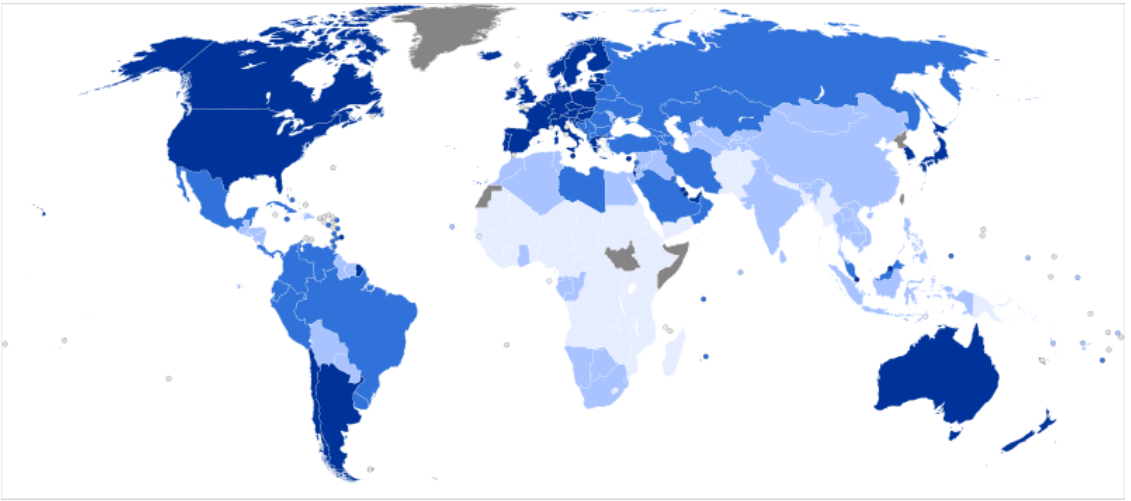
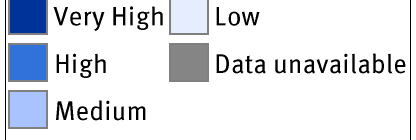
North America, Western Europe, and Australia consistently show very high human development (dark blue on the map). These regions have excellent healthcare systems, high-quality education, and strong economies that provide good incomes for their citizens.
Parts of South America, Eastern Europe, and East Asia show high to medium human development (medium to light blue). These countries have made significant progress but still face challenges in specific areas like income equality or education access.
Much of Africa, parts of South Asia, and some other regions show medium to low human development (light blue to white). These areas often struggle with poverty, disease, limited education, and inadequate infrastructure.
Important
The Development Gap
Some regions, particularly in Sub-Saharan Africa, show the lowest human development levels. These countries face multiple challenges including conflict, disease outbreaks, extreme poverty, and limited access to education and healthcare. The stark contrast between regions on the HDI map illustrates the massive inequalities in human development across our world.
Understanding these patterns helps us see where development efforts are most needed and allows countries to learn from those that have successfully improved their HDI scores.
Development strategies
Countries seeking to improve their development levels need comprehensive strategies. Economic theory suggests there are five phases in a country's economic development journey:
- The traditional society – characterised by subsistence farming and limited technology
- The transitional stage – where infrastructure begins to develop and some sectors start to grow
- The take-off stage – rapid growth in specific industries and wider economic expansion
- The drive to maturity – economy diversifies and technological advances spread throughout sectors
- High mass consumption – citizens enjoy high living standards and wide access to goods and services
Understanding these phases helps policymakers design appropriate strategies for their country's current development stage. However, development is not automatic – it requires deliberate policy choices, investment in education and infrastructure, and good governance.
Summary
Key Points to Remember:
-
Developing countries share common challenges including low per capita income, high poverty, uneven wealth distribution, rapid population growth, dependence on agriculture, low productivity, high unemployment, and inadequate infrastructure.
-
The Human Development Index (HDI) provides a comprehensive measure of development by combining life expectancy, education levels, and income per person into a single score from 0 to 1.
-
HDI has three key components: life expectancy at birth (health), education index (knowledge), and GDP per capita (living standards). Remember them as "LEG" – Life expectancy, Education, GDP.
-
Global HDI patterns show significant inequality with North America, Europe, and Australia having very high human development, while much of Africa and parts of Asia show low to medium human development.
-
South African context: With an HDI of 0.597 (2010 data), South Africa falls into the medium human development category, indicating progress but also highlighting areas needing improvement in health, education, and income equality.