Long Run Costs (Grade 11 NSC Matric Economics): Revision Notes
📚Revision Notes
Long Run Costs
What is the long run?
In the long run, businesses have complete flexibility because all inputs become variable. This means that during this time period, a business can make significant changes to its operations. Unlike the short run where some factors remain fixed, in the long run a company can:
- Adapt its production methods - changing how goods are made
- Expand its premises - increasing factory or office space
- Buy more capital equipment - investing in new machinery and technology
This flexibility allows businesses to optimise their production and potentially reduce costs through better planning and resource allocation.
Note
The key distinction between short run and long run in economics is not about time duration, but about the ability to change all factors of production. In the short run, at least one factor (usually capital) remains fixed, while in the long run, businesses can adjust all inputs including labour, capital, and premises.
Long run cost curves
The long run average cost (LRAC) curve shows us how a business's average costs change when all inputs can be varied. This curve is formed by combining all the individual short run average cost (SRAC) curves over time.
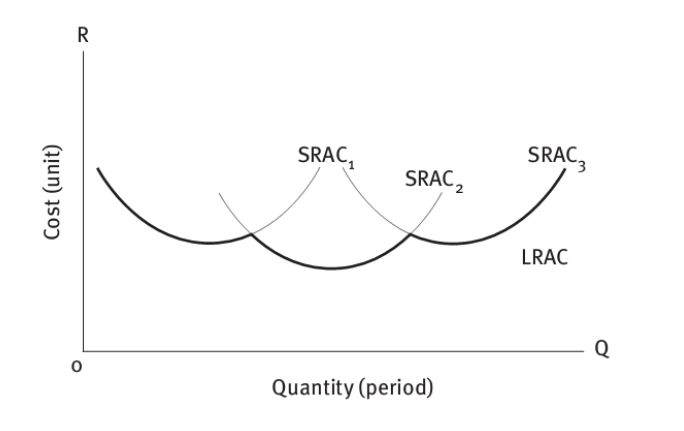
The diagram above illustrates this important relationship. Each U-shaped curve (SRAC₁, SRAC₂, SRAC₃) represents the short-run cost structure at different scales of operation. The smooth LRAC curve connects the lowest points of these short-run curves, creating what economists call an "envelope curve". This shows the most efficient cost level possible for each quantity of output when a business can adjust all its resources.
Important
The LRAC curve represents the theoretical minimum average cost achievable at each level of output when firms have complete flexibility to choose their optimal combination of inputs. This is why it "envelopes" all the short-run cost curves.
Returns to scale
Returns to scale describe the relationship between changes in inputs and the resulting changes in outputs when a business expands its operations in the long run. Understanding this concept helps explain why some businesses grow larger whilst others remain small.
Types of returns to scale
There are three main types of returns to scale that businesses can experience:
1. Constant returns to scale This occurs when the percentage increase in inputs equals the percentage increase in outputs. For example, if a business increases all its inputs by 10%, output also increases by exactly 10%. This represents a proportional relationship between inputs and outputs.
2. Increasing returns to scale This happens when an increase in inputs leads to a larger percentage increase in output. For instance, a 10% increase in inputs might result in a 20% increase in outputs. This is the most desirable situation for businesses as they get more output per unit of input invested.
3. Decreasing returns to scale This occurs when the percentage increase in inputs results in a smaller percentage increase in output. A 10% increase in inputs might only produce a 5% increase in outputs. This situation suggests inefficiencies in large-scale production.
Example
Worked Example: Calculating Returns to Scale
A bakery currently uses 100 hours of labour and 10 ovens to produce 1,000 loaves per day.
Scenario 1 - Constant Returns:
- Inputs double: 200 hours labour + 20 ovens
- Output doubles: 2,000 loaves per day
- Result: 100% increase in inputs = 100% increase in output
Scenario 2 - Increasing Returns:
- Inputs double: 200 hours labour + 20 ovens
- Output more than doubles: 2,500 loaves per day
- Result: 100% increase in inputs = 150% increase in output
Scenario 3 - Decreasing Returns:
- Inputs double: 200 hours labour + 20 ovens
- Output less than doubles: 1,800 loaves per day
- Result: 100% increase in inputs = 80% increase in output
Economies of scale
Economies of scale represent the cost advantages that businesses can achieve by increasing their scale of production in the long run. When a business experiences increasing returns to scale, the cost of production typically drops in relation to the increase in output, leading to lower unit costs overall.
Factors that create economies of scale
Several factors can help businesses achieve economies of scale:
- Modern technology - advanced equipment often works more efficiently at larger scales
- Better production methods - improved techniques that work best with higher volumes
- Improved production organisation - better coordination and workflow management
- Bulk buying of raw materials - purchasing larger quantities often secures lower prices per unit
These factors work together to help businesses reduce their average costs as they grow larger.
Note
There is a strong connection between increasing returns to scale and economies of scale. When firms experience increasing returns to scale (more output per unit of input), they typically also achieve economies of scale (lower cost per unit of output).
Advantages of economies of scale
Achieving economies of scale brings numerous benefits to businesses:
- More efficiency in production - better use of resources and reduced waste
- Average cost of production decreases - lower cost per unit makes products more profitable
- Consumers gain as prices fall - savings can be passed on to customers through lower prices
- Greater competitive advantage - lower costs help businesses compete more effectively
- Sales increase leading to higher profits - competitive pricing can boost market share and profitability
These advantages explain why many businesses aim to expand their operations and achieve larger scales of production.
Summary
Key Points to Remember:
- The long run allows complete flexibility - all inputs become variable, enabling businesses to make major structural changes
- LRAC curves envelope all SRAC curves - showing the most efficient cost level for each output level when all resources can be adjusted
- Three types of returns to scale exist - constant (equal percentage changes), increasing (output grows faster than inputs), and decreasing (output grows slower than inputs)
- Economies of scale reduce unit costs - larger production scales often lead to cost advantages through better technology, methods, and bulk purchasing
- Multiple benefits flow from economies of scale - including increased efficiency, lower prices for consumers, competitive advantages, and higher profits for businesses